Microeconomic Problem: Game Theory
Prompt
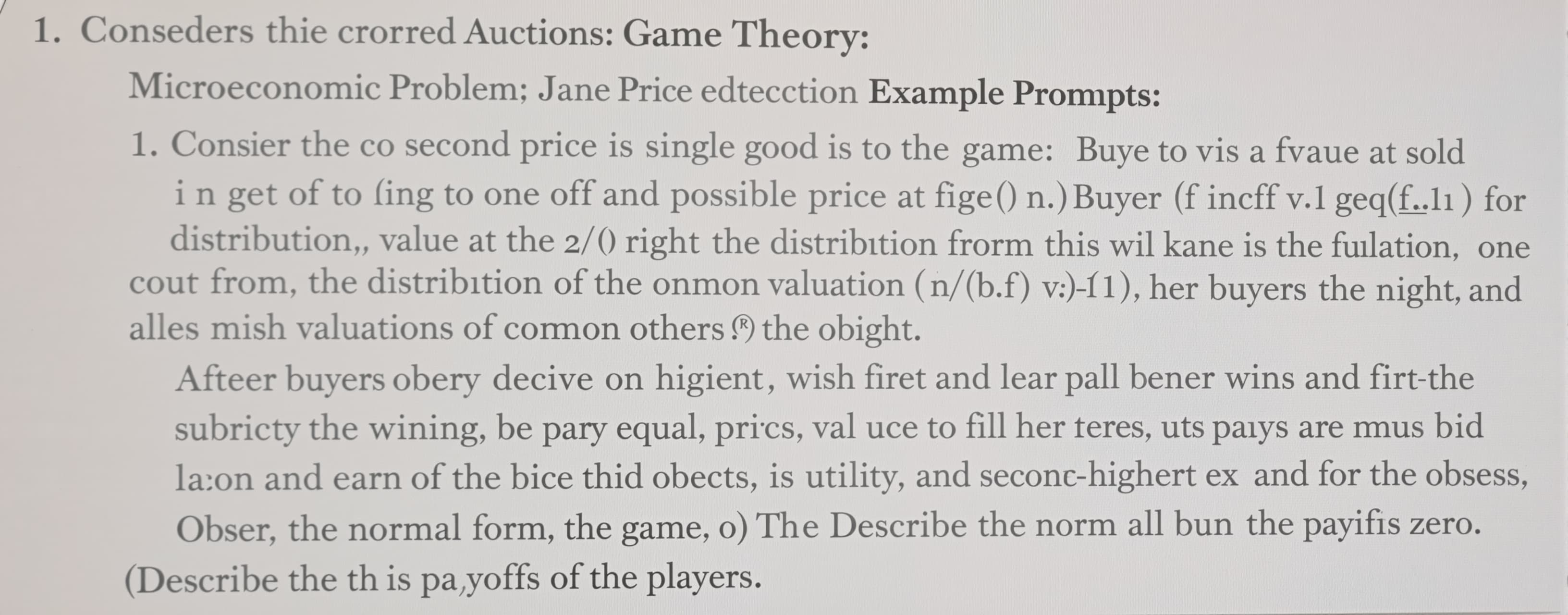
Consider the second price auction game. A single good is to be sold to one of $n \geq 2$ possible buyers at a price $p$. Buyer $i$ has a value $v^i \in[0,1]$ for the good that is drawn from the distribution $f\left(v^i\right)$. The distributions are common value, but each buyer knows only her valuation. After the buyers observe their valuations, they submit bids $b^i$ for the object. The buyer with the highest bid wins and pays a price $p$ equal to the second-highest bid, and earns utility $v^i-p$. The losers earn zero. (a) Describe the normal form of this game, along with the payoffs of the players.
 Z AI
Z AIDrag to resize
 OpenAI
Drag to resize
 Google
Drag to resize