ABAP Test
Create an ABAP Code Plan
Prompt
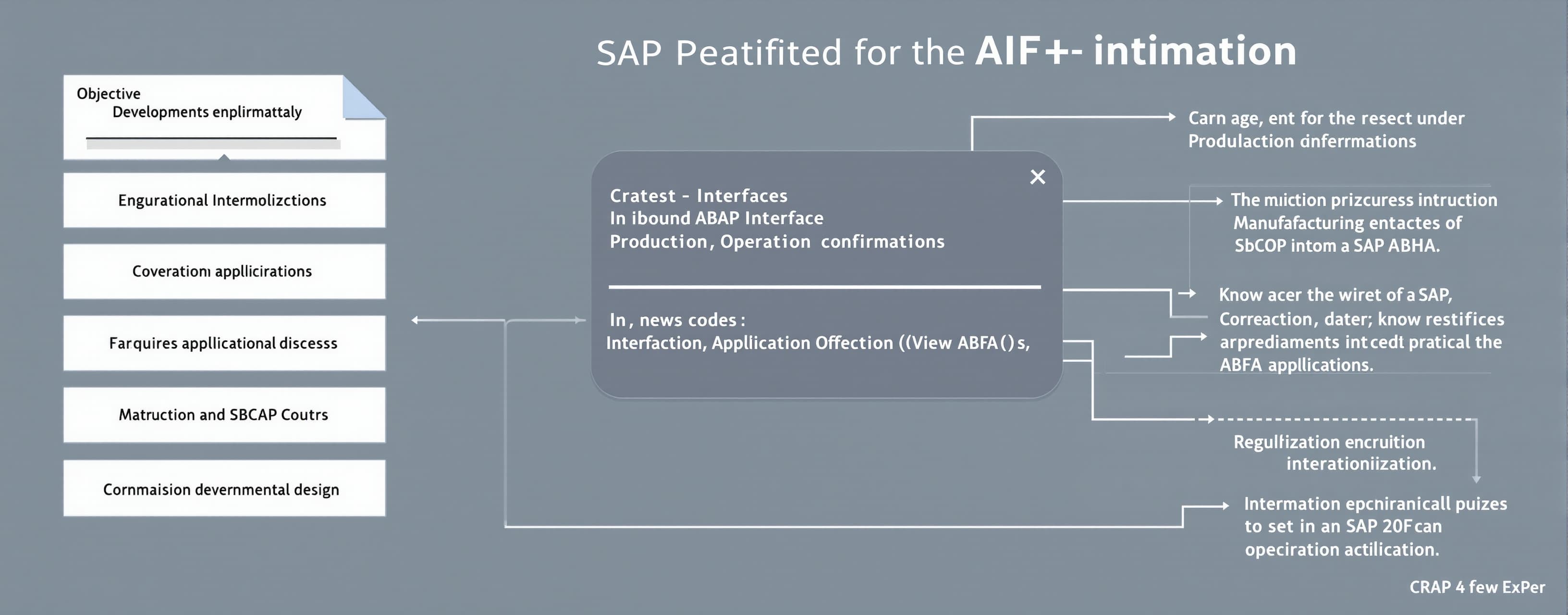
You are an ABAP / SAP Expert # ABAP/AIF Code-Planning Benchmark ## Inbound MES Production Confirmation Interface ### Objective Design a detailed implementation plan for an ABAP interface using **SAP Application Interface Framework (AIF)**. The interface receives production-operation confirmations from a shop-floor **Manufacturing Execution System (MES)** and posts them into SAP S/4HANA. Your task is **not primarily to write the final ABAP code**. Instead, produce a development/code plan detailed enough that an experienced ABAP developer could implement the interface from it. The quality of the response will be evaluated on: * understanding of the business process; * appropriate use of AIF; * SAP/ABAP architecture; * identification of required development objects; * error handling and operational support; * transaction and retry behavior; * idempotency; * testability; * security and maintainability; * completeness and sequencing of the implementation plan. --- # Business Scenario A manufacturing plant uses an external MES to manage production activity on the shop floor. When an operator completes or partially completes an operation, the MES sends a **production confirmation message** to SAP S/4HANA. SAP is the system of record for production orders and inventory. The MES may send hundreds of confirmations per hour across multiple production lines. The interface must be supportable by the production operations team through **SAP AIF monitoring and error handling**. --- # Example Inbound Message Assume the inbound payload has already been received by SAP and deserialized into an ABAP structure. A logical payload resembles: ```json { "messageId": "MES-PLANT01-20260909-00018473", "plant": "1000", "productionOrder": "000123456789", "operation": "0020", "workCenter": "ASSY_LINE_04", "confirmationType": "FINAL", "yieldQuantity": 48, "scrapQuantity": 2, "unitOfMeasure": "EA", "postingDate": "2026-09-09", "personnelNumber": "00004217", "machineId": "LINE04-STATION12", "eventTimestamp": "2026-09-09T18:42:17Z" } ``` Assume an ABAP Dictionary structure named: ```text ZMES_S_PROD_CONFIRM ``` represents the incoming message. A table type may be created if needed. --- # Functional Requirements The interface must validate the message before posting the production confirmation. At minimum, validate: 1. `messageId` is supplied. 2. The same MES message has not already been successfully processed. 3. Plant exists and is valid. 4. Production order exists. 5. Production order belongs to the supplied plant. 6. Production order is in a status permitting confirmation. 7. Operation exists on the production order. 8. Work center is consistent with the production-order operation. 9. Yield quantity cannot be negative. 10. Scrap quantity cannot be negative. 11. At least one of yield or scrap quantity must be greater than zero. 12. Unit of measure is valid and compatible with the production operation/order. 13. Posting date is within an acceptable posting period. 14. Confirmation type must be one of: ```text PARTIAL FINAL ``` 15. A FINAL confirmation must not be posted if the operation has already been finally confirmed. Some validation errors are expected to require manual correction or investigation. These errors must therefore be visible and understandable in **AIF Error Handling**. --- # Posting Behavior After successful validation, the interface must post the production confirmation using an appropriate **released SAP API, BAPI, or other supported SAP application interface**. Do not directly update SAP standard database tables. The implementation should determine the appropriate SAP posting mechanism rather than assuming that direct table manipulation is acceptable. The posting should record, where supported: * production order; * operation; * yield; * scrap; * UoM; * posting date; * personnel information; * final/partial confirmation status. If some source fields cannot be stored directly in the standard production-confirmation object, explain how they should be handled. --- # AIF Requirements The interface must use **SAP Application Interface Framework** for application-level interface monitoring and error handling. Design an appropriate AIF interface, including the relevant concepts such as: * namespace; * interface name; * interface version; * raw and/or SAP data structures where appropriate; * structure mapping if required; * checks/validations; * value mappings if appropriate; * actions; * application processing; * error messages; * key fields; * monitoring/search fields; * restart/reprocessing behavior. The interface should make it easy for support personnel to find a failed transaction using: * MES Message ID; * Production Order; * Plant; * operation; * approximate processing date/time. Explain which logic belongs in **AIF configuration** versus custom ABAP classes/functions. Do not assume that every business rule should be hard-coded into one monolithic ABAP program. --- # Idempotency MES systems can resend messages if they do not receive an acknowledgement. Therefore: ```text MES-PLANT01-20260909-00018473 ``` may arrive more than once. The design must prevent an already successfully processed MES message from creating a second SAP production confirmation. At the same time, a message that previously failed due to a correctable error must be capable of being reprocessed through AIF. Describe: * where processing state should be stored; * when a message should be considered successfully processed; * how duplicate detection should work; * what happens if SAP commits the production confirmation but the interface fails immediately afterward; * how AIF restart/reprocessing interacts with the idempotency implementation. --- # Error Handling Distinguish between at least three categories of failure: ### 1. Business validation error Example: ```text Operation 0020 does not exist for production order 123456789. ``` Expected behavior: * no confirmation posted; * meaningful error visible in AIF; * message remains available for investigation/reprocessing. ### 2. Temporary technical/application failure Example: ```text Production order is temporarily locked by another process. ``` The design should explain whether the message can safely be retried. ### 3. Permanent or duplicate condition Example: ```text MES Message ID MES-PLANT01-20260909-00018473 was already successfully processed. ``` Explain whether this should be: * an AIF error; * an informational successful duplicate; * or another status. Justify the choice. --- # Transaction Management The production confirmation and interface processing state must not become inconsistent. Explain the proposed transaction boundary. Consider scenarios such as: ```text 1. Confirmation posts successfully. 2. SAP database commit occurs. 3. An error occurs before the interface records that messageId was processed. 4. MES retries the same message. ``` The design should explicitly address this failure mode. Avoid unnecessary `COMMIT WORK` statements inside low-level reusable methods. --- # Logging and Monitoring Production support should not need to inspect source code or debug the interface for ordinary failures. Design AIF messages that provide sufficient context. For example: ```text Production order &1 does not contain operation &2. ``` is preferable to: ```text Processing failed. ``` Identify useful AIF monitoring fields and application log information. Do not log the complete payload unnecessarily if it contains information that does not need to be retained. --- # Performance Expected average volume: ```text 200–500 confirmations/hour ``` Peak: ```text 2,000 confirmations/hour ``` The design does not need extreme high-volume optimization, but should avoid obvious performance problems such as: * repeated unnecessary SELECTs; * SELECTs inside avoidable loops; * repeated retrieval of the same production-order data; * unnecessarily serialized processing. Mention any locking or concurrency issues that should be considered. --- # Development Constraints Assume: ```text Platform: SAP S/4HANA Language: ABAP Integration monitoring: SAP AIF Custom namespace: Z* ``` Follow modern ABAP development practices. Prefer: * classes over large procedural programs; * clear separation of responsibilities; * released SAP APIs where available; * dependency injection or seams where useful for testing; * ABAP Unit-testable business logic. Avoid: * direct updates to SAP standard tables; * monolithic function modules containing the entire interface; * hard-coded plant-specific logic when configuration is more appropriate; * swallowing SAP return messages; * generic catch-all error handling without useful context. --- # Expected Deliverable Produce a **code/development plan**, not merely a conceptual architecture. ## 1. Proposed Architecture Show the processing flow from: ```text MES message ↓ Inbound SAP endpoint / existing transport layer ↓ AIF ↓ Validation / mapping ↓ Production Confirmation Application Service ↓ SAP production confirmation API ↓ SAP database ``` Modify this flow if you believe a different design is better. Explain each major component. --- ## 2. Development Objects Provide a proposed object inventory. For each object specify: ```text Object name Object type Purpose Major responsibilities Important dependencies ``` You may propose names such as: ```text ZMES_S_PROD_CONFIRM ZMES_CL_CONFIRM_PROCESSOR ZMES_CL_CONFIRM_VALIDATOR ZMES_CL_CONFIRM_POSTER ZMES_CL_CONFIRM_IDEMPOTENCY ZMES_I_CONFIRM_POSTER ``` but determine the appropriate design yourself. Include relevant: * DDIC objects; * classes/interfaces; * database tables if necessary; * message classes; * AIF configuration objects; * customizing/configuration objects; * test classes. --- ## 3. Detailed Processing Sequence Describe the processing sequence step by step. For example: ```text 1. Receive message. 2. Establish AIF transaction. 3. Validate technical fields. 4. Check duplicate-processing state. 5. Retrieve production-order context. 6. Execute business validation. 7. Map MES confirmation into SAP API structure. 8. Call SAP confirmation API. 9. Interpret SAP return messages. 10. Persist successful idempotency state. 11. Complete transaction. 12. Return processing result to AIF. ``` Do not simply repeat this example. Refine it where necessary. --- ## 4. Class and Method Design For the important custom classes, propose major public methods and their responsibilities. Example format: ```abap ZMES_CL_CONFIRM_PROCESSOR PROCESS( IS_CONFIRMATION TYPE ZMES_S_PROD_CONFIRM ) ZMES_CL_CONFIRM_VALIDATOR VALIDATE( IS_CONFIRMATION TYPE ZMES_S_PROD_CONFIRM IS_ORDER_CONTEXT TYPE ... ) ZMES_CL_CONFIRM_POSTER POST_CONFIRMATION( IS_CONFIRMATION TYPE ... ) ``` Exact ABAP syntax is not required, but method boundaries and responsibilities should be clear. Explain important interfaces or abstractions. --- ## 5. AIF Design Specify how AIF should be configured. Include: * namespace; * interface; * version; * data structure; * interface keys; * checks; * mappings; * actions; * error handling; * index/search fields; * restart behavior. Explain what custom ABAP code AIF invokes and at what stage. --- ## 6. SAP Production Confirmation API Identify the SAP-supported mechanism you would investigate/use to post the confirmation. Explain: * why it is appropriate; * major input/output structures; * how SAP return messages should be handled; * transaction considerations. If the exact API depends on the S/4HANA release or deployment model, state that clearly and describe how you would verify the correct released API rather than inventing one. --- ## 7. Idempotency Design Provide a concrete design. Include any proposed custom persistence structure/table and important fields. For example, consider fields such as: ```text MESSAGE_ID SOURCE_SYSTEM PROCESSING_STATUS PRODUCTION_ORDER OPERATION AIF_MESSAGE_GUID SAP_CONFIRMATION_NUMBER CREATED_AT PROCESSED_AT ``` Determine the appropriate design rather than blindly using this example. Address concurrency and database locking. --- ## 8. Error Strategy Provide representative examples of: * AIF validation errors; * SAP API errors; * temporary errors; * duplicate messages; * unexpected technical exceptions. Explain which conditions should permit AIF restart. --- ## 9. ABAP Unit Testing Strategy Identify the important units that can be tested without creating real production confirmations. Include tests for at least: ```text Valid confirmation Missing production order Invalid operation Wrong work center Negative yield Zero yield + zero scrap Invalid UoM Already finally confirmed operation Duplicate MES message Failed SAP API call Successful retry after correction Concurrent duplicate submission ``` Explain where test doubles would be useful. --- ## 10. Integration Testing Describe a small end-to-end test suite. Include: * happy-path partial confirmation; * happy-path final confirmation; * AIF validation failure; * SAP application failure; * AIF correction and restart; * duplicate transmission; * transaction failure/recovery scenario. --- ## 11. Implementation Order Provide an ordered development sequence suitable for assigning work to an ABAP developer. For example: ```text Phase 1 — DDIC and contracts Phase 2 — domain/application services Phase 3 — SAP posting adapter Phase 4 — idempotency Phase 5 — AIF configuration Phase 6 — tests Phase 7 — operational readiness ``` For each phase, identify dependencies and completion criteria. --- # Important Instructions Do not jump directly to generating a large final ABAP implementation. The main deliverable is a **precise implementation plan**. Where there are multiple reasonable SAP/AIF implementation approaches: 1. identify them; 2. choose a recommended approach; 3. explain the tradeoff. Do not invent SAP APIs, AIF transactions, classes, function modules, or configuration capabilities if uncertain. Explicitly identify anything that should be confirmed against the specific S/4HANA and AIF release. The final plan should be detailed enough that another ABAP developer could begin implementation without first redesigning the solution.
 OpenAI
 OpenAIOpenAI