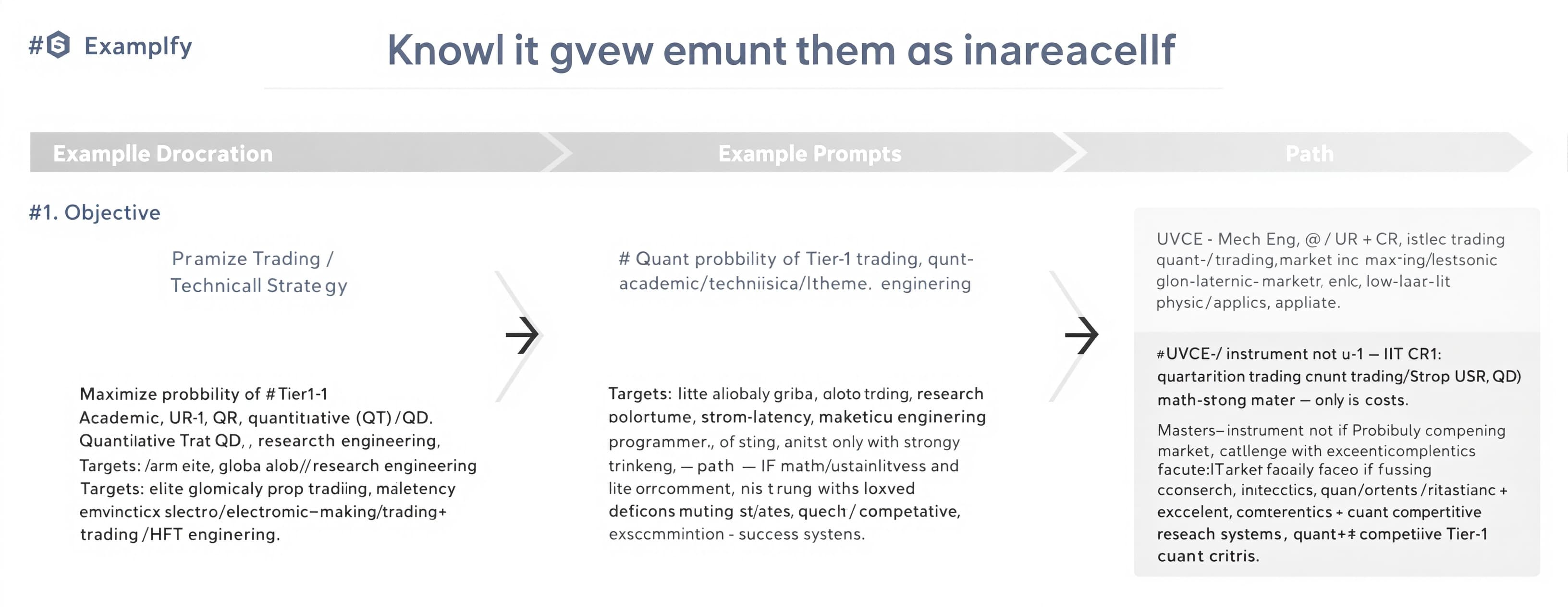
# Quant Trading / Academic / Technical Strategy — Handoff #...
Prompt
# Quant Trading / Academic / Technical Strategy — Handoff ## Objective Maximize probability of Tier-1 quant trading role. Primary: Quantitative Trader (QT). Secondary: QR, QD, research engineering, low-latency/HFT engineering. Targets: elite global prop trading/market-making/electronic-trading/HFT firms — competing with IIT/top US-UK-EU/math-CS-physics applicants. Masters=instrument not goal, use only if value>cost+opportunity cost. **Path:** UVCE Mech Eng → math-strong → algorithmically strong → strong programmer → strong probability/stats → market-making thinker → CS/systems competent → quant projects/research → 1-2 internships → excellent interviews → competitive Tier-1 QT/QR/QD. **Success criteria:** CGPA 9.0–9.3+; strong calculus/linear algebra/probability/stats/discrete math; real analysis(masters); combinatorics/EV/stochastic-process intuition; Codeforces 2100–2300+; AtCoder Blue; strong C++/Python; competent C/systems; strong DSA/CP/CS fundamentals; market-making ability; microstructure knowledge; quant projects/research; 1-2 internships pre-grad; strong interviews; deep explainability of work; keep masters+direct recruiting open simultaneously. **Hardware:** i7-11800H, RTX 3060, 16GB RAM, 1TB NVMe, dual-boot Win11+Linux(Mint→EndeavourOS/Arch, KDE Plasma, rEFInd). **Broader tech curriculum** ("Software & Technology Intelligence"): ~31 sections, ~1,280 topics, Markdown knowledge graph spanning computing foundations, OS, programming, algorithms/theory, math/stats, compilers/runtimes, SWE, git, networking, web, databases, distributed systems, cloud, DevOps/SRE, security, data engineering, AI/ML, GPU/HPC, mobile, graphics/media, embedded/IoT/robotics, enterprise software, fintech, system design, HCI/UX, emerging tech, tech business/economics/history/society, cross-domain connections. Rule: supporting infrastructure only — must not displace quant-critical prep. ## Preferences & Constraints 1. QT primary, not generic finance; QR/QD legit secondary 2. Prioritize prop trading/market-making/electronic/HFT/systematic, not banking 3. Aim Tier-1 eventually; optimize long-term compounding over first-year comp 4. Pursue pre-grad internships, target ~May 2027; prefer quant/programming internships over generic finance 5. Maintain direct-employment+masters routes simultaneously; masters not automatically mandatory/superior 6. UVCE Mech=real signalling constraint — compensate via demonstrated ability(GPA, CP rating, projects, internships, research, interviews) 7. Family income: **USD 7,000–8,000/year** — compare total cost not tuition alone; don't assume family funds expensive foreign program 8. **Singapore=strongest location preference**(Bangalore proximity, safety, low corruption, quality of life, Indian community, tax/stability); Amsterdam/London acceptable alternatives 9. Comp matters but not sole target — lifestyle/stability/taxation/geography matter; international mobility desirable 10. Deep understanding>memorization; solve before reading solutions; classify errors(knowledge gap/reasoning/arithmetic/rushing/misunderstanding); timed practice only after accuracy reliable; measure demonstrated ability not chapters read 11. Masters compared on recruiting access, curriculum, rigor, peer group, signalling, comp, internship access, geography, cost, funding, admission probability, Tier-1 probability, ROI — not by entrance-exam existence alone 12. Financial feasibility=hard constraint — no debt assuming future comp repays it; factor scholarship probability 13. Consider elite Indian programs seriously alongside foreign 14. Secondary languages(Java, C#, JS, TS, Go, Rust, Kotlin, Swift, Bash, MATLAB) must not displace core Python/C++/C/DSA 15. ML secondary to probability/stats/math for QT — more relevant if QR/systematic/alt-data becomes major target ## Decisions Made 1. QT=primary target(math+probability+decision-under-uncertainty+markets+tech+upside) 2. UVCE Mech=disadvantage not disqualifier — build evidence so institution becomes one variable 3. Pursue internships early, target ~May 2027, goal 1-2 pre-grad 4. Direct employment remains serious route — compare at decision point vs masters 5. Masters portfolio diversified beyond Oxford — maximize Tier-1 probability 6. CP strategically important — CF1700+/Cyan initial→CF1900+/2100+/2100-2300+/AtCoder Blue later; evidence not end goal 7. Python/C++/C role division(must stay intact): Python=research/data/prototyping/automation/numerical; C++=CP/QD/systems/performance/low-latency/HFT; C=memory/OS/low-level/systems 8. Broad CS=supporting infrastructure — must not displace math→probability/stats→algorithms/programming→market reasoning→technical depth 9. Tech curriculum=knowledge graph — connect via prerequisites/dependencies/implementations/alternatives/architecture/business consequences, not isolated topics 10. Four learning depths: Recognition, Working knowledge, Technical understanding, Deep expertise — default L2 broad, L3 foundations, L4 selective 11. Mechanism-first teaching: what/why/how/components/implementation/alternatives/trade-offs/limitations/dependencies/downstream-effects/connections to prior material 12. Entrance exams=signal amplifiers, not inherent quality markers 13. Elite Indian programs≠consolation prizes — can beat expensive mediocre foreign programs once funding/debt/recruiting/curriculum/ROI considered 14. Financial feasibility=hard constraint ## Academic Current StatePending: Sem3-8, GPA recovery, course-level DB, elective selection, masters prereqs **Sem3(23cr): **Sem4(21cr): **Sem5(21cr): **Sem6(21cr): **Sem7(21cr):* **Sem8(16cr):* **High-value electives:** Data Structures, DBMS, Operations Research, Theory of Optimization, Computer Networks, possibly Soft Computing(very high relevance); FEM, CFD, Control Engineering, Reliability Eng, Robotics, Mechatronics/IoT, Quantum Tech(additional relevance). Syllabi inspection still needed. ## Technical Roadmap **Quant projects:** market-making sim, order-book sim, inventory/risk sim, betting-game sim, execution sim, statistical strategy research, factor/signal research, time-series analysis, Monte Carlo/probability sims, optimization projects, order-book implementation, market-data parser, exchange simulator, low-latency C++ benchmark, lock-free/concurrent data structures, networking/perf experiments. **Existing:** Clash Royale bot(Python, OpenCV, ADB, Waydroid) — demonstrates automation/CV/external-system interaction; needs supplementing with explicit quant projects. **CP progression:** CF 1200→1400→1600→1700+→1900+→2100+→2100-2300+; AtCoder Cyan→Blue. Purpose: objective evidence of algorithmic thinking/implementation speed/debugging/abstraction/perf awareness. ## Interview Prep 2026 QT research shows concentrated core: probability, EV, mental math, conditional probability/Bayes, market making, betting/trading games, reasoning under pressure; coding/deeper stats more role-dependent(NeetQuant guide). Components: OAs, mental math, probability, EV, combinatorics, brainteasers, market-making games, trading games, estimation, stats, coding, behavioral. Mental math sequence: accuracy→speed→time pressure(arithmetic, fractions, percentages, ratios, multiplication, division, squares, probability arithmetic, EV, estimation). Probability method: define variables→state assumptions→decompose→solve→sanity-check→explain aloud→adapt to changed conditions. Brainteasers: recognize structures(conditional probability, symmetry, recursion, EV, linearity of expectation, counting, invariants, optimization, info gathering), don't memorize. Market-making: estimate fair value→quote bid/ask→account uncertainty→manage inventory→infer info from trades→update fair value→avoid adverse selection; being wrong acceptable, failing to update isn't. Behavioral: why QT/this firm/trading-vs-SWE/this market, mistake story, difficult decision, changed your mind, reaction to being wrong, handling competition/uncertainty. Mock interviews: no reliable record of completed mocks — benchmark objectively before assuming readiness. **Resources:** Xinfeng Zhou—*A Practical Guide to Quantitative Finance Interviews*(Green Book); *Heard on the Street*; *Fifty Challenging Problems in Probability*. Loop: learn concept→attempt without solution→check result→classify mistake(knowledge gap/reasoning/arithmetic/rushing/misunderstanding)→reattempt→timed practice→periodic review. ## Masters Portfolio & Ranking **Foreign:** 1.**CMU MSCF**—target 9.0-9.3+, exceptional math/probability/stats/linear algebra/numerical methods/C++/Python/research/LORs, GRE Quant~169-170; est.~5-12%. 2.**Baruch MFE**—NYC, prop/quant ecosystem, engineering-friendly, QBA test; est.~10-20%. 3.**Oxford MCF**—elite reputation, rigor, global recruiting; prep probability/stats/ODE-PDE/linear algebra/analysis/real analysis/programming/research; est.~5-10%. 4.**Princeton MFin**—reach; target 9.2-9.5+, exceptional math, real analysis; est.~2-6%. 5.**Berkeley MFE**—target 9.2+, linear algebra, multivariable calc, diff eq, numerical analysis, C++/Python/ML/research; est.~3-8%. 6.**Imperial RMFE**—engineering-friendly; target 9+; est.~10-20%. 7.**NYU MIF(Courant)**—probability, stochastic processes, PDE, stats, numerical methods; est.~5-12%. **India:** 8.**ISI M.Stat**—target 9+, exceptional entrance; est.~15-30%. 9.**CMI MSc Mathematics**—entrance+interview, scholarship potential, low cost; est.~20-35%. 10.**ISI M.Math**—better if QR dominant, needs analysis/multivariable calc/linear algebra/ODE/real analysis/abstract algebra; est.~10-25%. 11.**IISc quant programme**—exact program TBD, factors coursework/GATE/research/programming/math-stats-ML-optimization. 12.**ISI M.Tech QROR**—OR/optimization/stats/programming, entry via ISI/GATE(TBD). 13.**CMI CS/Data Science**—for QR/ML/QD/research engineering. 14.**Selected IIT quant masters**—evaluate by curriculum/recruiting/entrance/placements/cost. **Ranking:** CMU MSCF>Baruch MFE>Oxford MCF>Princeton MFin>Berkeley MFE>Imperial RMFE>NYU MIF>ISI M.Stat>CMI Math>ISI M.Math>IISc>ISI QROR>CMI CS/DS>IIT programs. ## Target Companies **Tier-1/global:** Jane Street, Citadel Securities, Hudson River Trading(HRT), Optiver, IMC, Jump Trading, SIG/Susquehanna, DRW, Five Rings. **Tier-2/2.5 early-career:** WorldQuant, Quantbox, Trexquant, Futures First, NK Securities, Qube, Da Vinci, Graviton, Tower, Quadeye. **Other discussed:** Flow Traders, Akuna Capital, Chicago Trading Company/CTC, Maven Securities. ## Application/Networking State No verified record of applications, referrals, recruiter/alumni contacts, networking events, interview offers — **unknown, not completed**. Tracking fields: Company, Role, Location, Eligibility, Opening date, Deadline, OA, Interview stages, Referral, Status, Result, Compensation, Sponsorship, Notes. ## Open Issues no confirmed internship/networking DB; exact IISc program & IIT masters shortlist TBD; scholarship/funding universe needs verification; direct-employment vs masters decision contingent on actual outcomes; QT vs QR/systematic weighting open; first-job country open(Singapore currently strongest pref); exact Tier-1 firm ranking unresolved; broad-CS vs quant-specific depth balance unresolved; Sem3-8 elective preferences not finalized; internship eligibility by company/year unverified; admission probabilities are strategic estimates not published stats; foreign-program funding assumptions need re-verification at actual cycle; no "mastery" claim valid merely from reading material. ## Rejected Approaches "Get masters because UVCE is weak"→not inherently necessary, compare routes at actual decision point. "Rank programs by entrance-exam existence"→exam=demonstration channel not quality. "Foreign automatically beats Indian"→elite low-cost Indian program can beat expensive mediocre foreign one. "Learn finance vocabulary first"→correct priority: probability+EV+mental math+reasoning+market making. "Memorize famous brainteasers"→learn reusable structures instead. "ML first because quant=AI"→correct: math→probability/stats→algorithms→research→ML where useful. "Generic CS curriculum replaces quant prep"→CS breadth supports but cannot replace it. "LeetCode alone proves quant ability"→correct: DSA+CP+probability+mathematical reasoning+actual quant work. ## Environment and Key Data & Priority Stack UVCE, B.Tech Mech Eng, 42 credits, CGPA 7.76/10, 165 total credits, grad~2029(~age 21), 42×7.76=325.92 grade points — recalc CGPA from actual course-level credits/grades going forward. **Progress DB fields:** CGPA, Credits, Semester, Math/Probability/Stats(topics+level), C++/Python/C/DSA capability, CF/AtCoder rating, CP weaknesses, Mental math(accuracy/speed), Quant interview readiness, Market making readiness, Microstructure knowledge, Projects, Research, Internships, Applications, Networking, Masters status, Scholarships, Tech curriculum topics, Systems capability, ML capability, Next priority/bottleneck. Newest state supersedes older conflicting state. ## Next Steps (priority order) P0: Build complete course-level academic DB(Sem1-2 course/credits/grade). P1: GPA recovery model — required weighted averages for 8.0/8.5/8.75/9.0/9.1/9.2/9.3/9.5. P2: Resolve Bridge Math I/II CGPA/credit/masters-prereq treatment. P3: Analyze every elective(credits/GPA difficulty/math depth/relevance to QT-QR-QD/time cost). P4: Benchmark quant baseline objectively(algebra, calculus, linear algebra, discrete math, combinatorics, probability, EV, conditional probability, Bayes, stats, mental math, DSA, C++). P5: Establish CP baseline→build progression. P6: Build math foundation: algebra→discrete math→combinatorics→probability→stats→linear algebra→calculus→optimization→stochastic processes→analysis/real analysis. P7: Build Python+C+++DSA+CP simultaneously; then C→OS→architecture→networking→concurrency→performance→low-latency systems. P8: Start quant interview prep early — don't wait for final year. P9: Build explicit quant projects(measurable, explainable). P10: Build internship pipeline — track Tier-2 pool while monitoring Tier-1 firms. P11: Maintain masters pipeline — track requirements, prereqs, GPA expectations, tests, dates, LORs, research reqs, scholarships, tuition, living cost, funding, debt, recruiting, placement, geography, ROI. P12: Make final masters decision near graduation comparing Direct Route vs Masters Route — choose strongest expected long-term outcome. **Strategic model:** UVCE Mech→recover GPA→rigorous math→probability+stats→Python+C++/DSA→CP→CF2100-2300+/AtCoder Blue→mental math+EV+probability interviews→market making→microstructure→quant projects/research→1-2 internships→CS/systems depth→apply direct Tier-1+Tier-2 roles+elite masters programs→evaluate actual offers+funding→choose highest expected Tier-1 outcome→Tier-1 Quant Trader/Researcher/Developer. Core principle: not escaping UVCE Mechanical through credentials — building evidence strong enough that UVCE Mechanical becomes only one contextual variable in the application.
 OpenAI
 Google
 Anthropic