May 27, 2026
ITBench-AA: Agentic benchmark to test models on real-world SRE tasks
**Artificial Analysis and IBM are launching ITBench-AA, the first in a new series of benchmarks evaluating models on agentic enterprise IT tasks, starting with Site Reliability Engineering tasks where frontier models score below 50% **
ITBench-AA’s SRE tasks benchmark model performance on Kubernetes incident response, where models must diagnose live systems by reading logs, tracing dependencies, and identifying root-cause entities across complex infrastructure. The underlying ITBench dataset has been developed by IBMs 's Software Innovation Lab, leveraging IBM’s deep expertise in enterprise IT operations
Artificial Analysis has worked closely with IBM over the last 6 months to develop a implementation of the dataset for frontier AI evaluation, beginning with Site Reliability Engineering (SRE) and expanding to Financial Operations (FinOps) and Chief Information Security Officer (CISO) tasks over time
ITBench-AA SRE overview:
➤ 59 SRE tasks in total: 40 public tasks and 19 brand new, held-out tasks
➤ Each task provides a Kubernetes incident snapshot containing alerts, events, traces, metrics, logs, and application topology. The model must identify the minimal set of independent root-cause Kubernetes entities responsible for the incident
➤ Faults span typical SRE failure modes including infrastructure, service, application, and chaos-injected incidents, such as resource quota exhaustion, rollout failures, connection pool exhaustion, and network partitions
Methodology details:
➤ Agentic harness: each task is solved by the model running in our open-source Stirrup reference harness, with shell access to a sandboxed file system containing the relevant logs and snapshots. 100-turn cap per task, 3 repeats per task
➤ Models submit a list of root-cause entities (Kubernetes Deployments, Services, Pods, etc.) they believe caused the incident. Each submission is compared against a ground-truth set of root causes provided by IBM
➤ Scoring uses average precision at full recall: if a model misses any of the ground-truth root causes, it scores 0.0 for that repeat. If it identifies all of them, it is awarded a score equal to its precision - the share of its submitted entities that are actual root causes, i.e. true positives / (true positives + false positives). The headline score is the average across 59 tasks × 3 repeats
➤ The harness (Stirrup) is held constant across all evaluated models, allowing an apples-to-apples comparison between models.
Key findings:
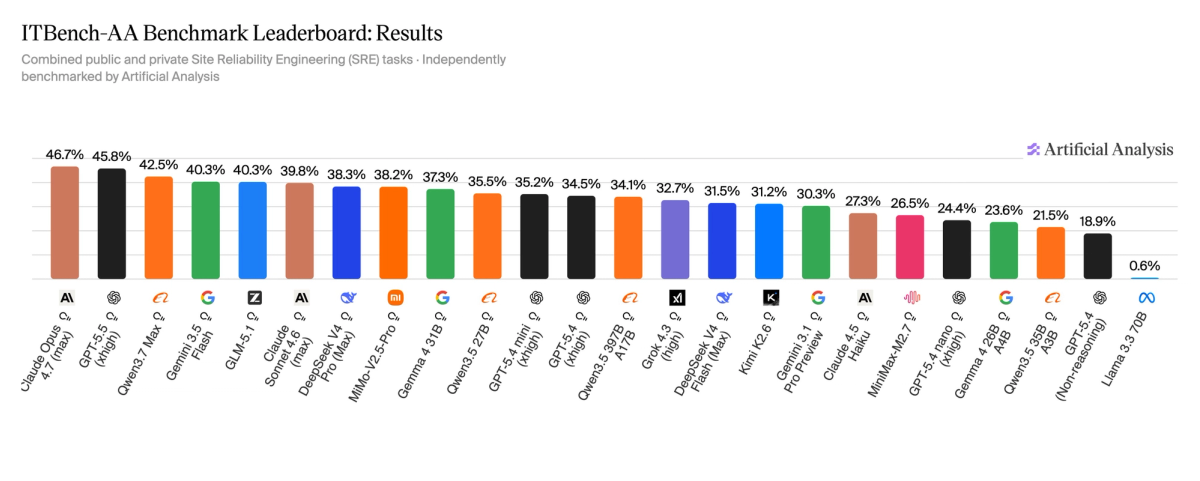
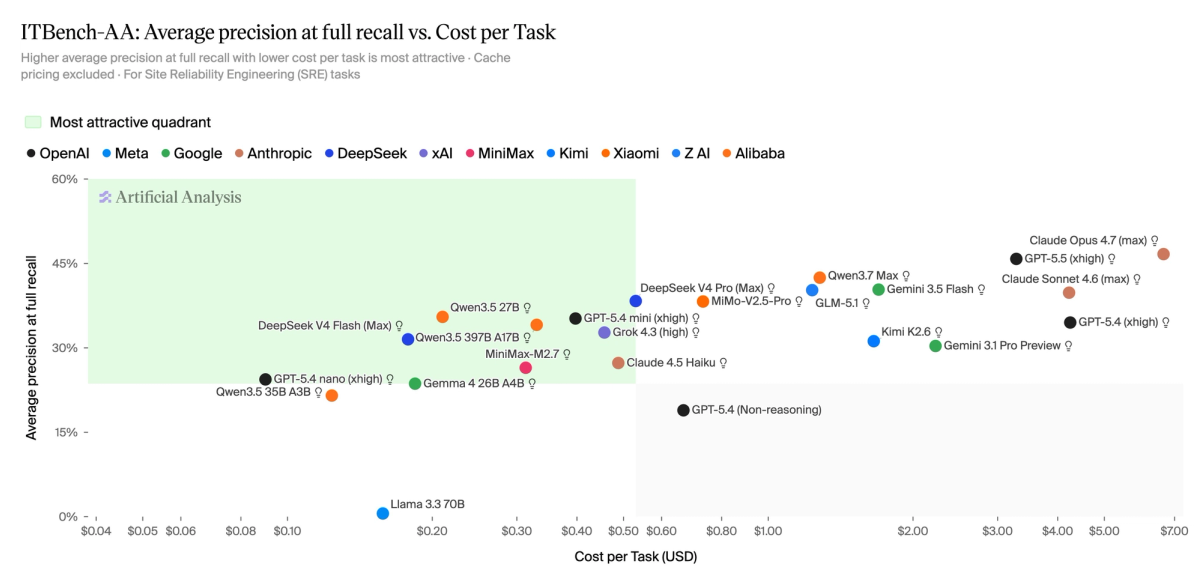
➤ Claude Opus 4.7 (Adaptive Reasoning, Max Effort) leads at 47%, followed by GPT-5.5 (xhigh) at 46% and Qwen3.7 Max at 42%
➤ All frontier models score below 50%, making ITBench-AA SRE one of the least saturated agentic benchmarks in our suite. For context, frontier models score considerably higher on Terminal-Bench
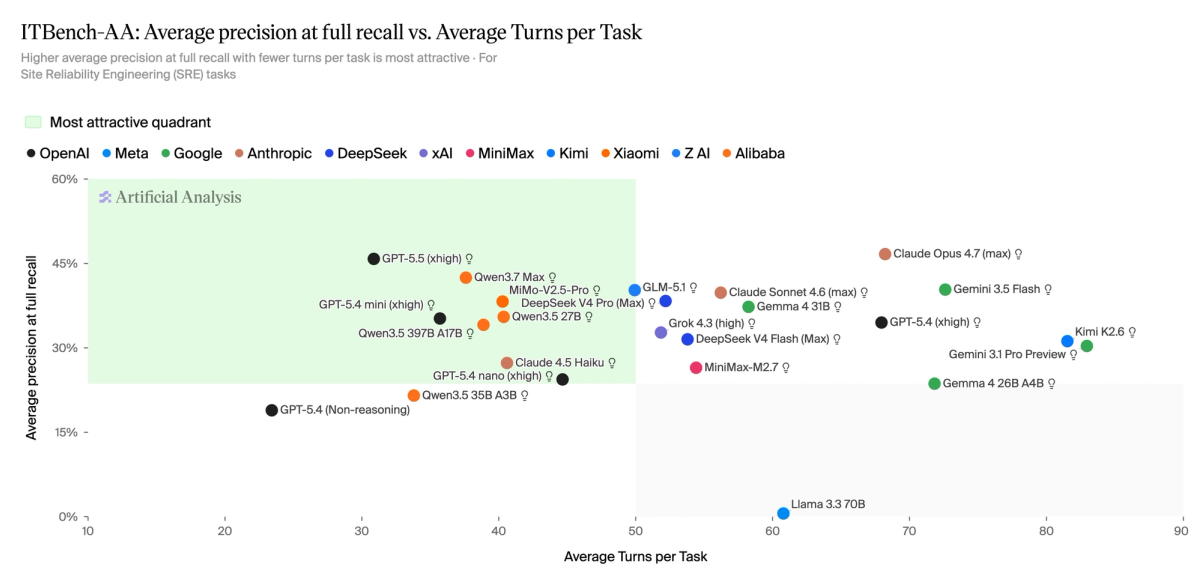
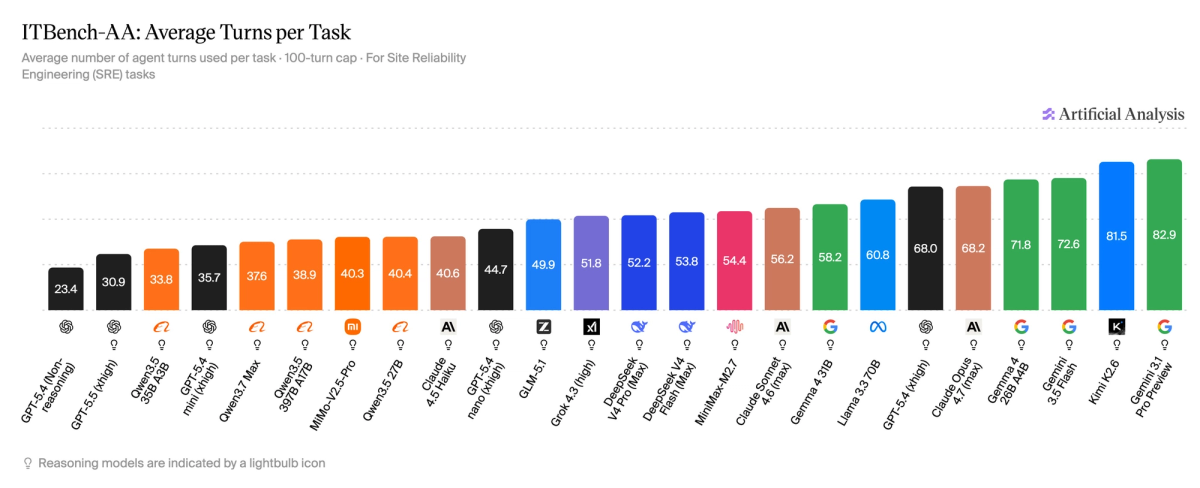
➤ Turn counts vary nearly 3x and longer trajectories do not translate to higher accuracy. GPT-5.5 (xhigh) averages 31 turns per task at 46%, while Gemini 3.1 Pro Preview averages 83 turns at 30%. Models that over-investigate tend to surface upstream fault-injection mechanisms or co-occurring symptoms as false positives
➤ GLM-5.1 (Reasoning) leads open weights models at 40%, effectively tied with Gemini 3.5 Flash (high). DeepSeek V4 Pro (Reasoning, Max Effort) follows at 38%, with Gemma 4 31B (Reasoning) at 37%, ahead of Gemini 3.1 Pro Preview at 30%
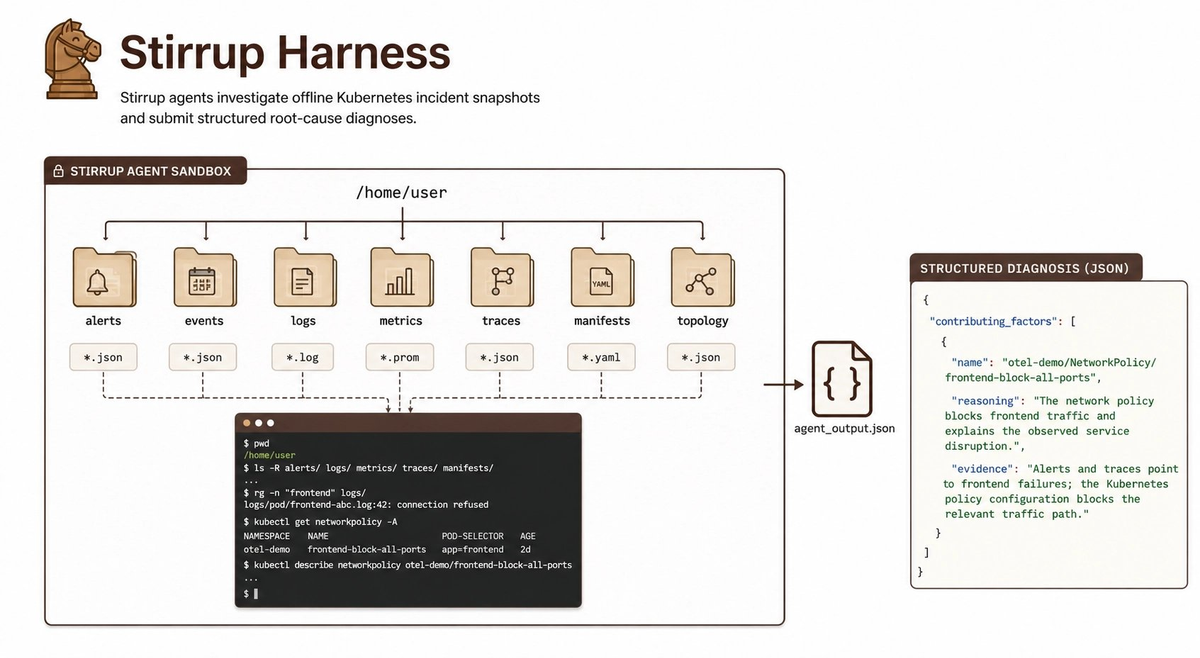
Tasks require agents to investigate Kubernetes incident snapshots through shell commands and submit a structured JSON diagnosis identifying the responsible root-cause entities.
In one public SRE task, the agent sees user-facing failures in the frontend path. It uses shell commands to inspect the offline snapshot: reviewing alerts shows the incident window, then traces/logs narrow the failure to frontend traffic. Topology pins down the affected services, and Kubernetes manifests reveal a network policy blocking the frontend. The successful diagnosis identifies the responsible root-cause entity: otel-demo/NetworkPolicy/frontend-block-all-ports.
More turns do not mean better answers. Models that submit additional contributing entities beyond the true root cause get penalized. This is why some models with long trajectories underperform terser ones: Gemini 3.1 Pro Preview averages 83 turns and scores 30%, while GPT-5.5 (xhigh) averages 31 turns and scores ~46%
Models vary significantly in cost per task. Gemma 4 31B (Reasoning) scores 37% at $0.14 per task, outperforming Gemini 3.1 Pro Preview ($2.23 per task, 30%) on both score and cost. GLM-5.1 (Reasoning) scores 40% at $1.23 per task, matching Gemini 3.5 Flash (high) ($1.70) on score at lower cost. Claude Opus 4.7 (Adaptive Reasoning, Max Effort) leads the leaderboard at 47% but is the most expensive at $5.38 per task
Read the latest
Code2Video-AA: how well do AI models design videos in code?
Artificial Analysis' implementation of HeyGen's Code2Video Bench, evaluating how well models create short product and brand videos from 114 design briefs using HyperFrames HTML.
October 26, 2026
GPT-6.1 Terra pushes the cost efficiency frontier
OpenAI has released GPT-6.1 Terra, pushing the cost efficiency frontier. It is the first Terra-class model since GPT-5.6, and is more intelligent for less than a third of the cost
October 26, 2026
Kimi K3.1 Pro launches at 4th on the Intelligence Index and will lead open weights models
Kimi K3.1 Pro launches at 4th on the Artificial Analysis Intelligence Index and will lead open weights models
October 23, 2026