October 26, 2026
OpenAI has released GPT-6.1 Terra, pushing the cost efficiency frontier. It is the first Terra-class model since GPT-5.6, and is more intelligent for less than a third of the cost
See model page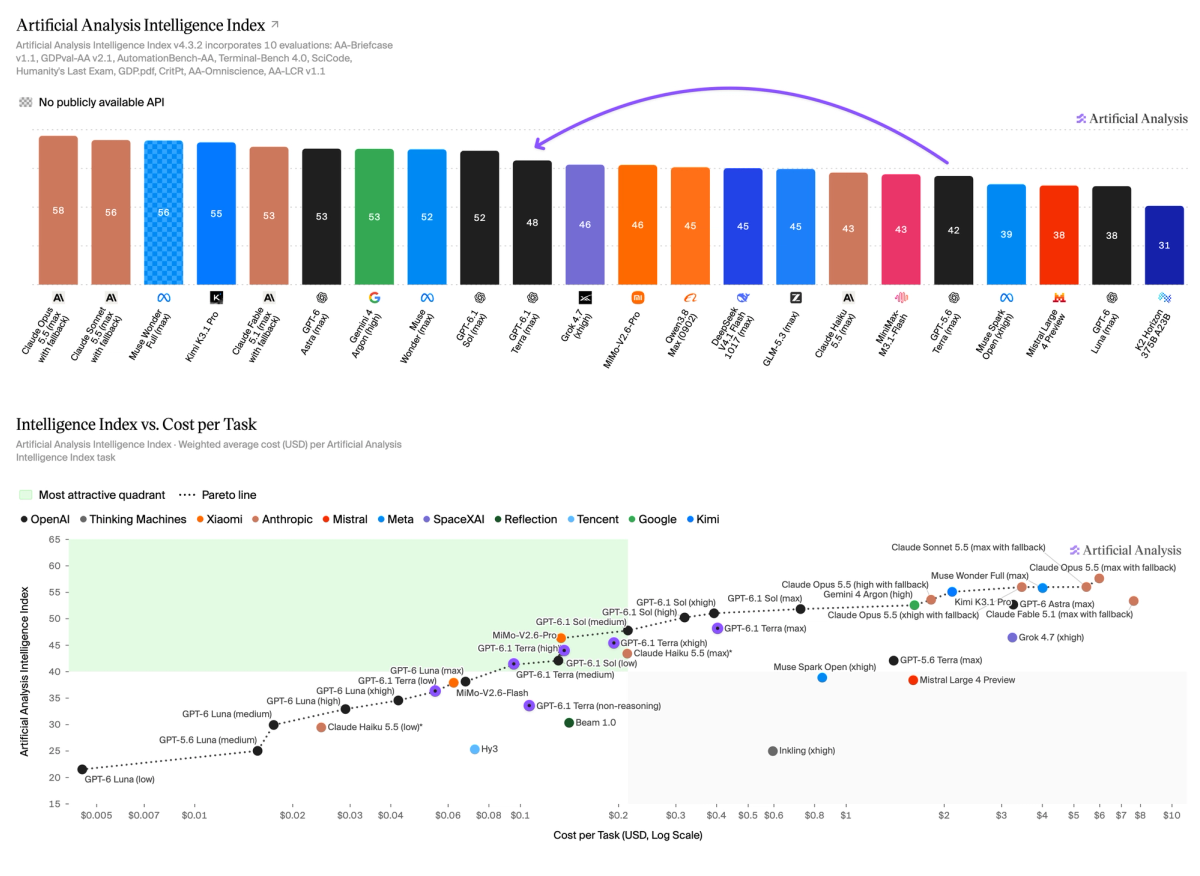
Pricing per token is half or less that of GPT-5.6 Terra - at $1/$5 per million input/output tokens vs $2/$12 for the previous model. Cache write has also halved, now at $1.25 per million tokens. Cached input is one quarter at $0.05 vs $0.20 per million tokens.
Key takeaways:
➤ Pareto-optimal for Intelligence vs Cost at low and medium effort: At max effort, GPT-6.1 Terra gains 6 points in the Artificial Analysis Intelligence Index over GPT-5.6 Terra, at less than a third of the cost per task ($0.40 vs $1.40). At lower effort levels the gain is larger, between 7 and 13 points. The low and medium effort levels are Pareto-optimal for cost efficiency, while the other effort levels sit behind the frontier. At max effort, the model scores 4 points below GPT-6.1 Sol and 10 points above GPT-6 Luna in the Intelligence Index.
➤ Pushes the Coding Agent Index cost efficiency frontier: With a score of 48 in the newly released Artificial Analysis Coding Agent Index v2.0, the model is 6 points below GPT-6.1 Sol (54) and 17 points above GPT-6 Luna (31). The xhigh and low effort settings sit on the frontier of cost efficiency in the Coding Agent Index, while other effort levels are behind the frontier.
➤ 50 point drop in hallucination rate: GPT-6.1 Terra guesses 38% of the time when it does not know the answer to a question in AA-Omniscience, our private knowledge and hallucination benchmark. Previously, GPT-5.6 Terra's hallucination rate was 88%. This significant reduction in hallucination is coupled with a 2 point increase in AA-Omniscience accuracy - meaning the model simultaneously answers more questions correctly.
➤ 20 point jump in Terminal-Bench 4.0, small improvements across most evaluations: The model makes significant progress in the terminal-based agentic benchmark, Terminal-Bench 4.0, with a gain of ~20 points, now rivaling GPT-6.1 Sol at max effort. Gains across most other evaluations are smaller, for example, 5 points in GDP.pdf.
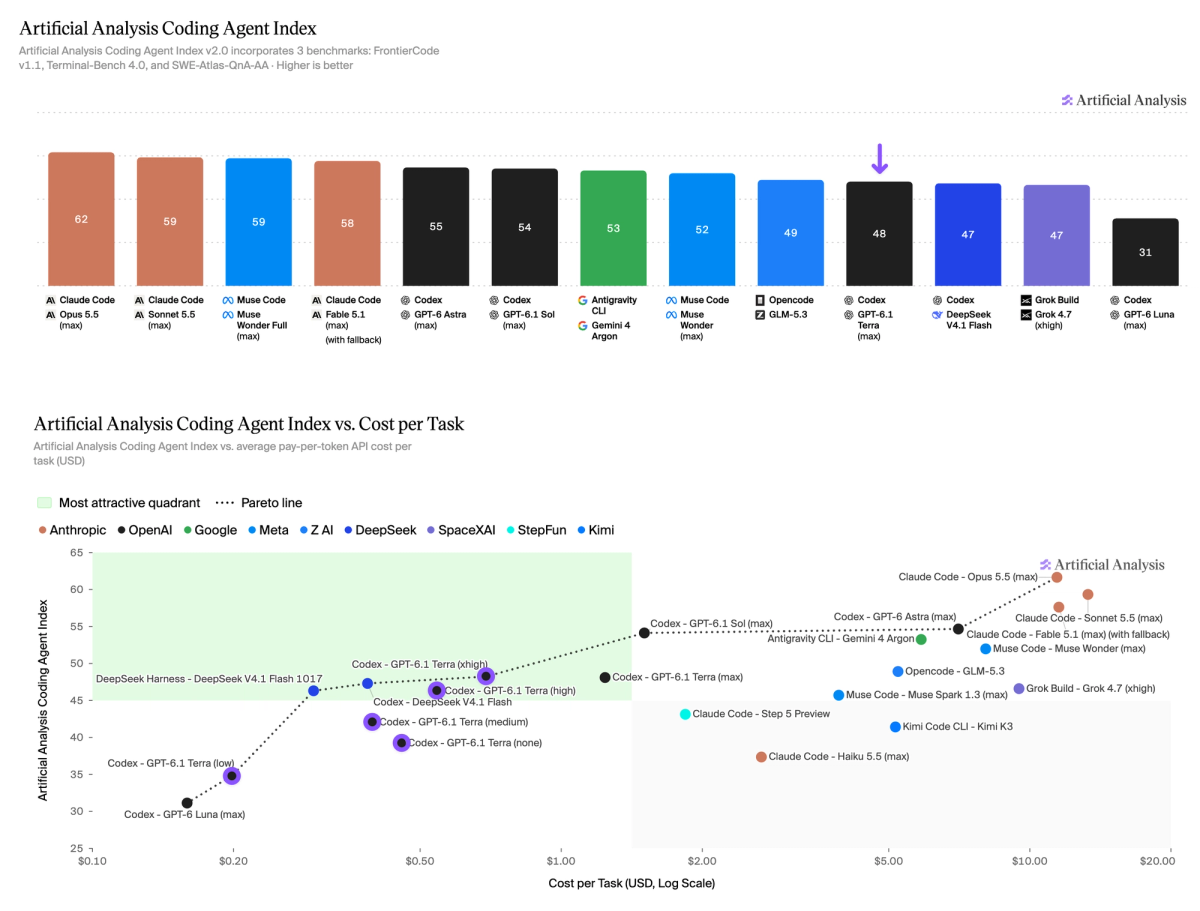
With a score of 48 in the Artificial Analysis Coding Agent Index v2.0, GPT-6.1 Terra is 6 points below GPT-6.1 Sol (54) and 17 points above GPT-6 Luna (31). The xhigh and low effort settings sit on the frontier of cost efficiency.
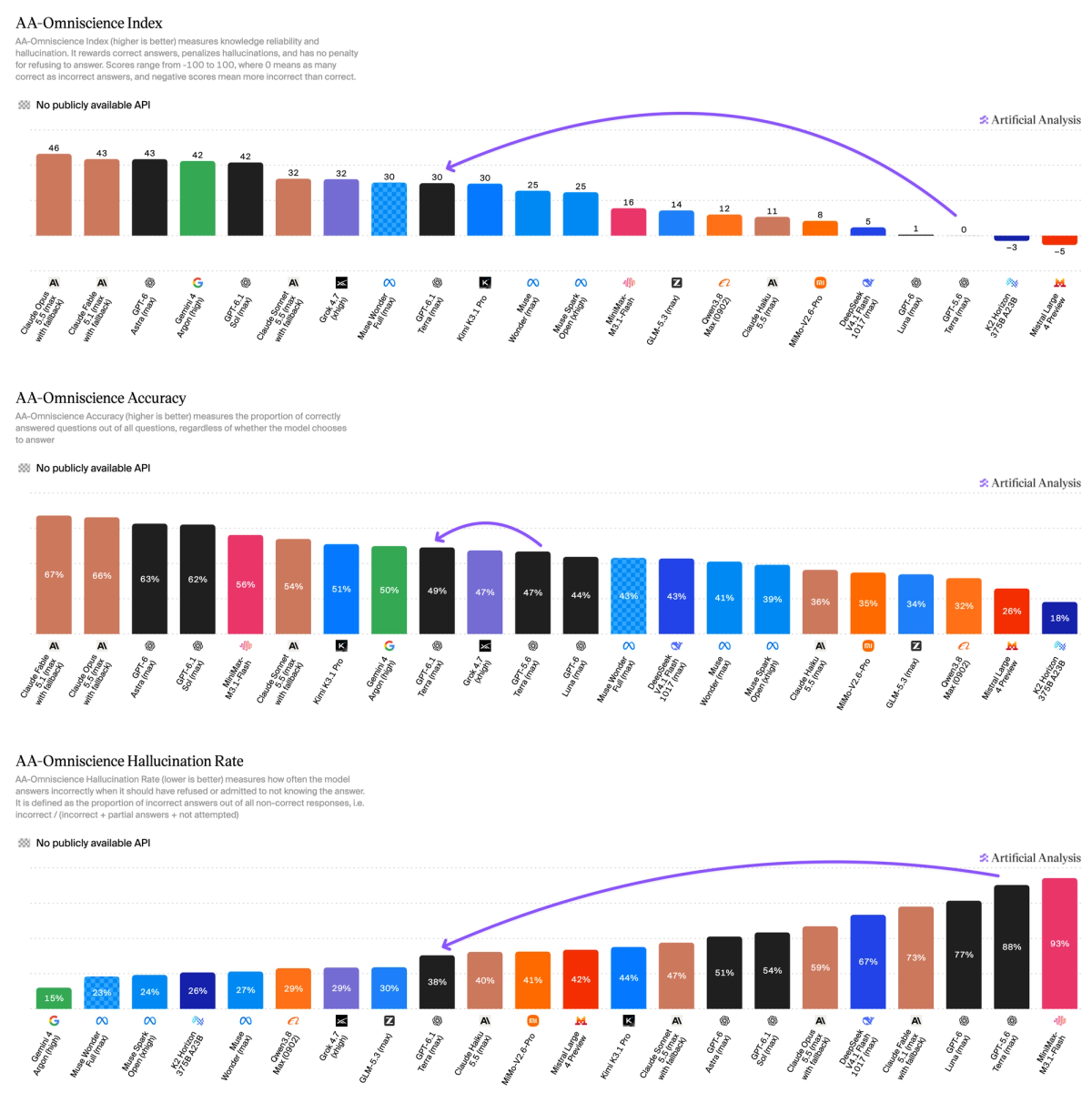
GPT-6.1 Terra shows a 50 point drop in hallucination rate, measured in AA-Omniscience. This is coupled with a 2 point increase in AA-Omniscience accuracy - meaning the model simultaneously answers more questions correctly.
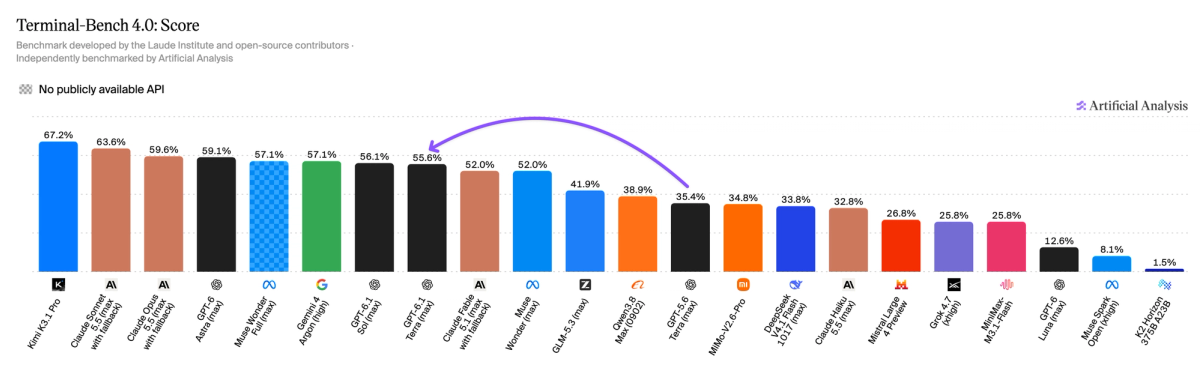
The model makes significant progress in the terminal-based agentic benchmark, Terminal-Bench 4.0, with a gain of ~20 points, now rivaling GPT-6.1 Sol at max effort.
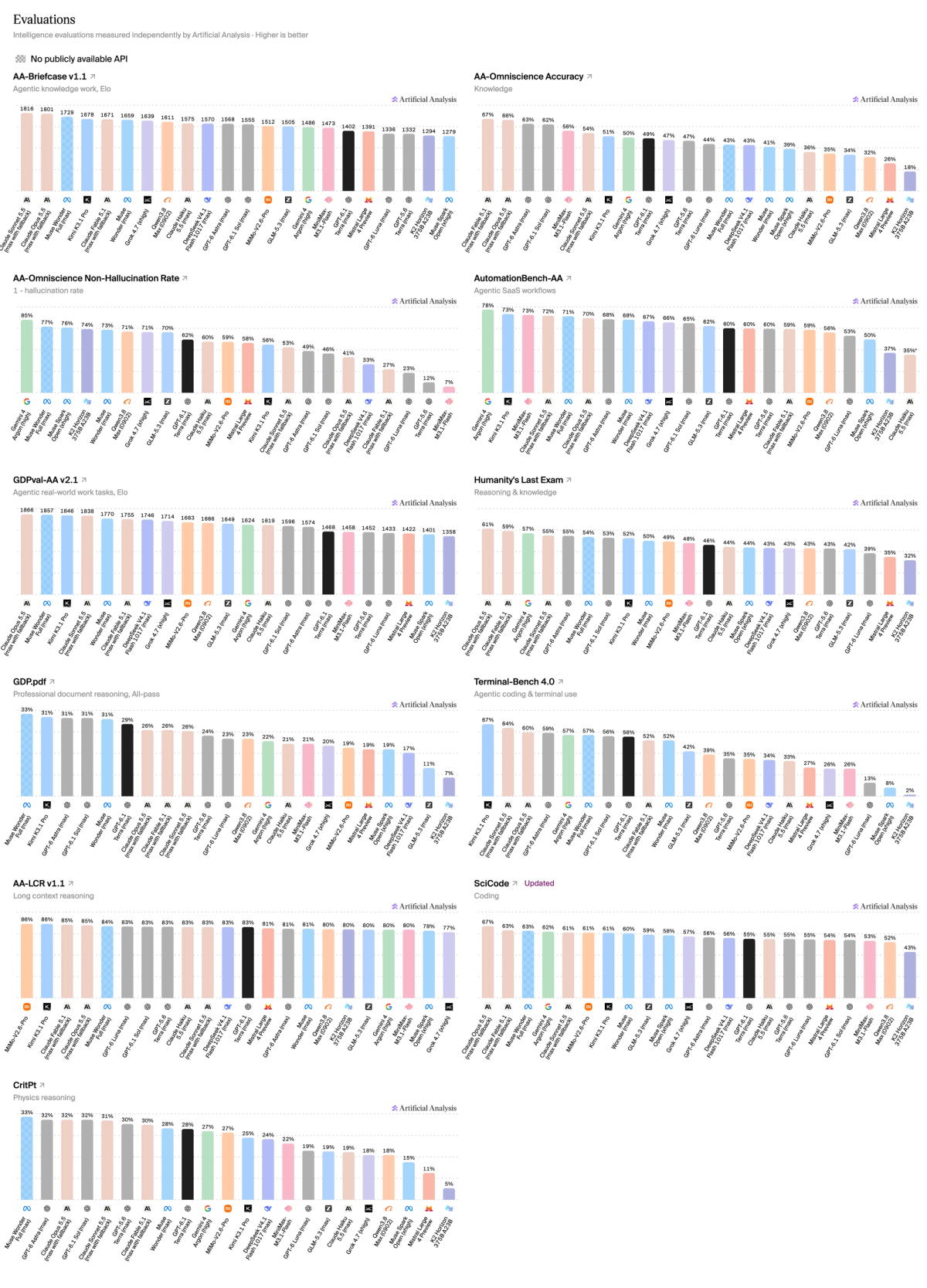
Breakdown of the individual evaluations in the Artificial Analysis Intelligence Index v4.3.2
Compare GPT-6.1 Terra with other leading models at: https://artificialanalysis.ai/models/releases/gpt-6-1-terra
Read the latest
Multimodal Knowledge Agent (MKA) benchmark: testing knowledge work capabilities with complex visual files
We’ve partnered with Google DeepMind to launch their Multimodal Knowledge Agent (MKA) evaluation, a new benchmark for agentic knowledge work over complex visual files
November 10, 2026

Endpoint Accuracy Index v1.1: Tighter long context intervals and expanded model coverage
We are launching the Artificial Analysis Endpoint Accuracy Index v1.1, a minor version upgrade alongside new coverage for GLM-5.3 Flash and Muse Spark Open.
November 9, 2026
Meta's Muse Ember is the cheapest model scoring 36 on the Intelligence Index
Meta's newest model Muse Ember scores 36 on the Artificial Analysis Intelligence Index, matching Claude Haiku 5.5 (max) at a third of the Cost per Task
November 9, 2026