July 9, 2026
GPT-5.6 benchmarks across Intelligence, Speed and Cost
See model pageGPT-5.6 Sol comes close second to Claude Fable 5 in the Artificial Analysis Intelligence Index at one third of the cost, and leads the Artificial Analysis Coding Agent Index in OpenAI’s Codex harness
We supported OpenAI with pre-release evaluation of GPT-5.6 Sol, Terra, and Luna. GPT-5.6 Sol (max) scores 1 point below Claude Fable 5 (max) in the Artificial Analysis Intelligence Index at 59 points, at approximately one third of the cost. GPT-5.6 Terra (max) and Luna (max) score 55 and 51 respectively in the Intelligence Index, at ~50% and ~80% lower Cost per Task than Sol.
GPT-5.6 Sol (max) leads the Artificial Analysis Coding Agent Index at 80 points.
Key takeaways:
➤ One third of the cost of Claude Fable 5: On max reasoning effort, GPT-5.6 Sol costs $1.04 per task in the Artificial Analysis Intelligence Index - offering a similar level of intelligence to Claude Fable 5 at approximately one third of the cost. Reasoning levels across GPT-5.6 Sol and Luna offer a range of options at the Pareto frontier of Intelligence vs Cost per Task. For example, GPT-5.6 Luna (max) matches or exceeds the intelligence of GLM-5.2 (max) and Gemini 3.5 Flash at a lower cost. GPT-5.6 Terra (max) and Luna (max) cost $0.55 and $0.21 per Intelligence Index task, ~50% and ~80% less than Sol. Across reasoning efforts, each new GPT-5.6 model pushes past GPT-5.5 on the Pareto frontier (excluding non-reasoning). Notably, Luna and Sol are always on the Pareto frontier ahead of Terra. This means that for any Terra effort level, there is a Luna or Sol effort level that is more intelligent at no extra cost, or equally intelligent at lower cost.
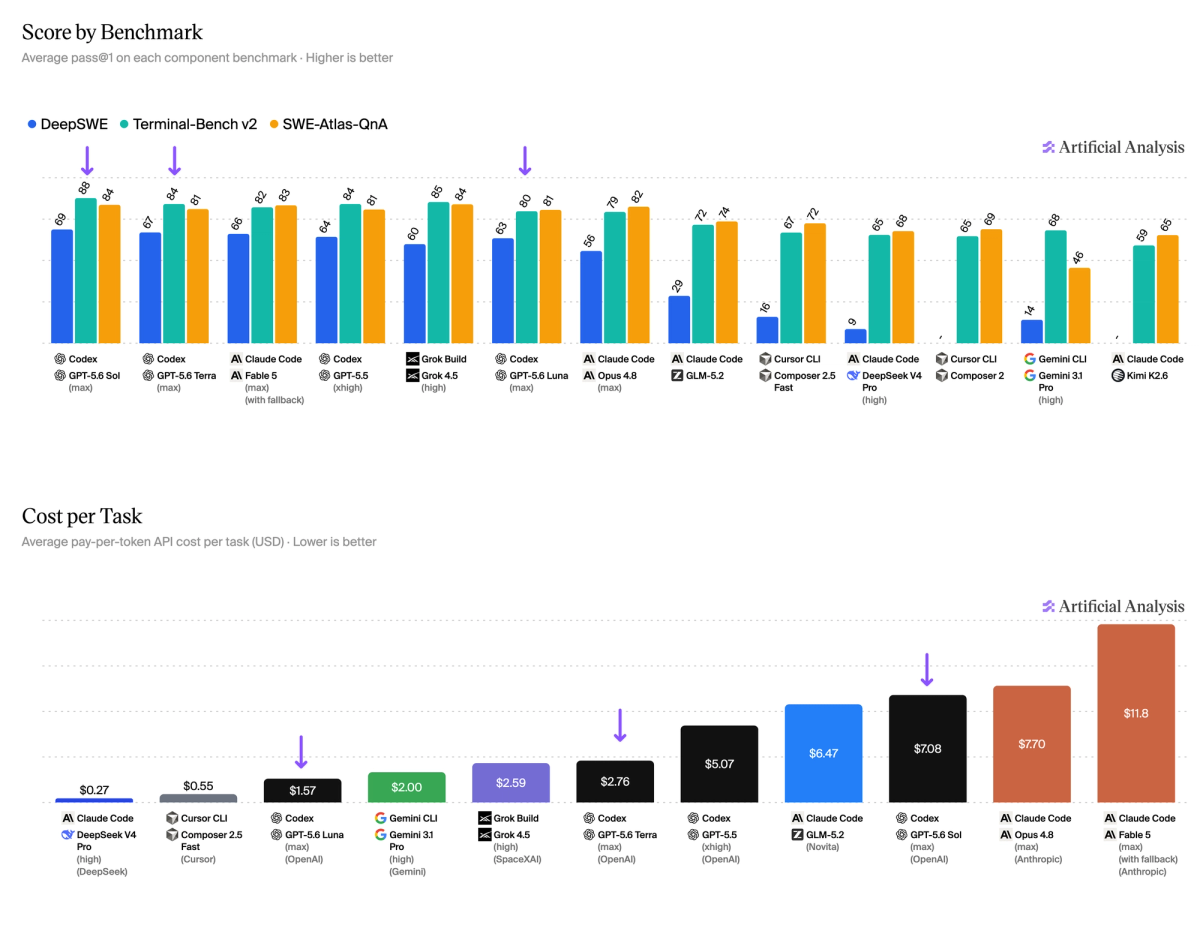
➤ Leading in all Coding Agent evaluations: The new Artificial Analysis Coding Agent Index pairs models with agentic harnesses and features three frontier coding evaluations - DeepSWE, Terminal-Bench v2, and SWE-Atlas-QnA. GPT-5.6 Sol (max) in Codex scores 80 in the Index, leading in all three evaluations (tying Grok 4.5 in Grok Build for SWE-Atlas-QnA). In addition to scoring higher, its per task cost is ~40% and ~10% cheaper than Claude Fable 5 (max) and Opus 4.8 (max) respectively in Claude Code. GPT-5.6 Terra (max) and Luna (max) score 77 and 75 in the Coding Agent Index respectively, with ~60% and ~80% per-task cost reductions compared to Sol.
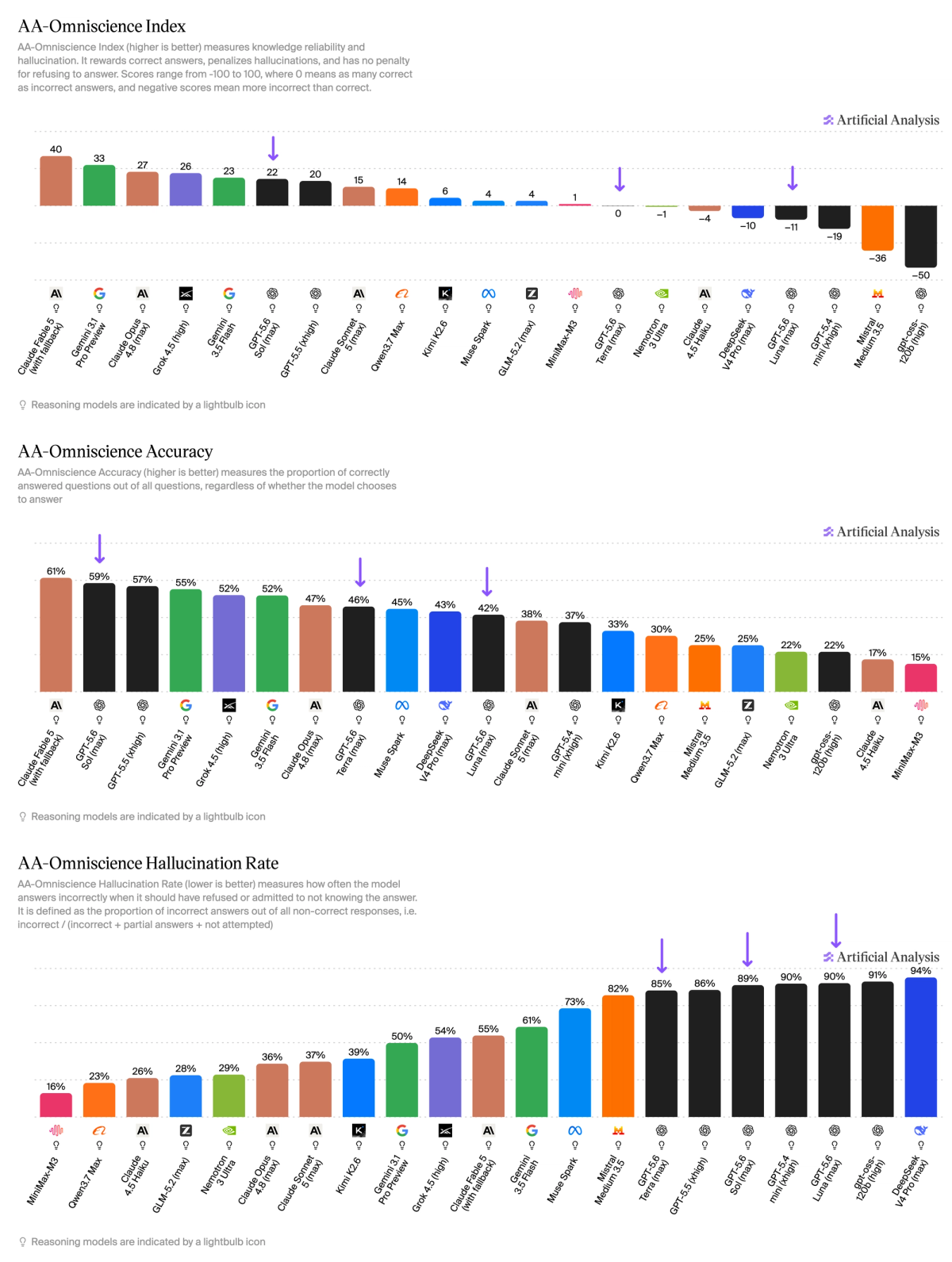
➤ Highest Presentation Elo in AA-Briefcase: GPT-5.6 Sol (max) ranks second only to Claude Fable 5 (max) in AA-Briefcase, and has the highest Presentation Elo of any model. AA-Briefcase is a new benchmark for testing models on realistic knowledge work tasks in complex projects built by industry experts. GPT-5.6 Sol (max) has the highest recorded Presentation Elo - its outputs across various file types, including PowerPoint and Excel, are the most visually attractive of any model. Fable 5 (max) still leads AA-Briefcase, largely due to its Rubric Score of 56% vs 42% for GPT-5.6 Sol (max). Fable 5 (max) also scores 1764 in Analytical Quality Elo vs GPT-5.6 Sol (max) at 1592.
➤ First OpenAI models with cache-write pricing: GPT-5.6 introduces cache-write pricing for the first time at OpenAI. Sol, Terra, and Luna are priced at $5/$30, $2.5/$15, and $1/$6 respectively per million input/output tokens. OpenAI has retained its previous discount of 90% for cache reads, but joins Anthropic in introducing a cost premium for cache writes, at 1.25x the price of input tokens. Cache writes occur when input tokens are committed to memory. Charging for a cache write more accurately reflects the model’s cost to serve, as cached tokens occupy memory whether or not they are reused. Also in line with Anthropic’s models, GPT-5.6 introduces a max reasoning effort level.
➤ Low token use: GPT-5.6 Sol (max) uses fewer output tokens than most models of comparable intelligence, and defines a new Pareto frontier of Intelligence vs Output Tokens per Task. GPT-5.6 Sol (max) offers a slight improvement in token efficiency with 15k tokens per Intelligence Index task, vs GPT-5.5 at 16k. Notably, it uses fewer tokens and is more intelligent than Claude Opus 4.8 (max), GLM-5.2 (max), and Gemini 3.5 Flash (high).
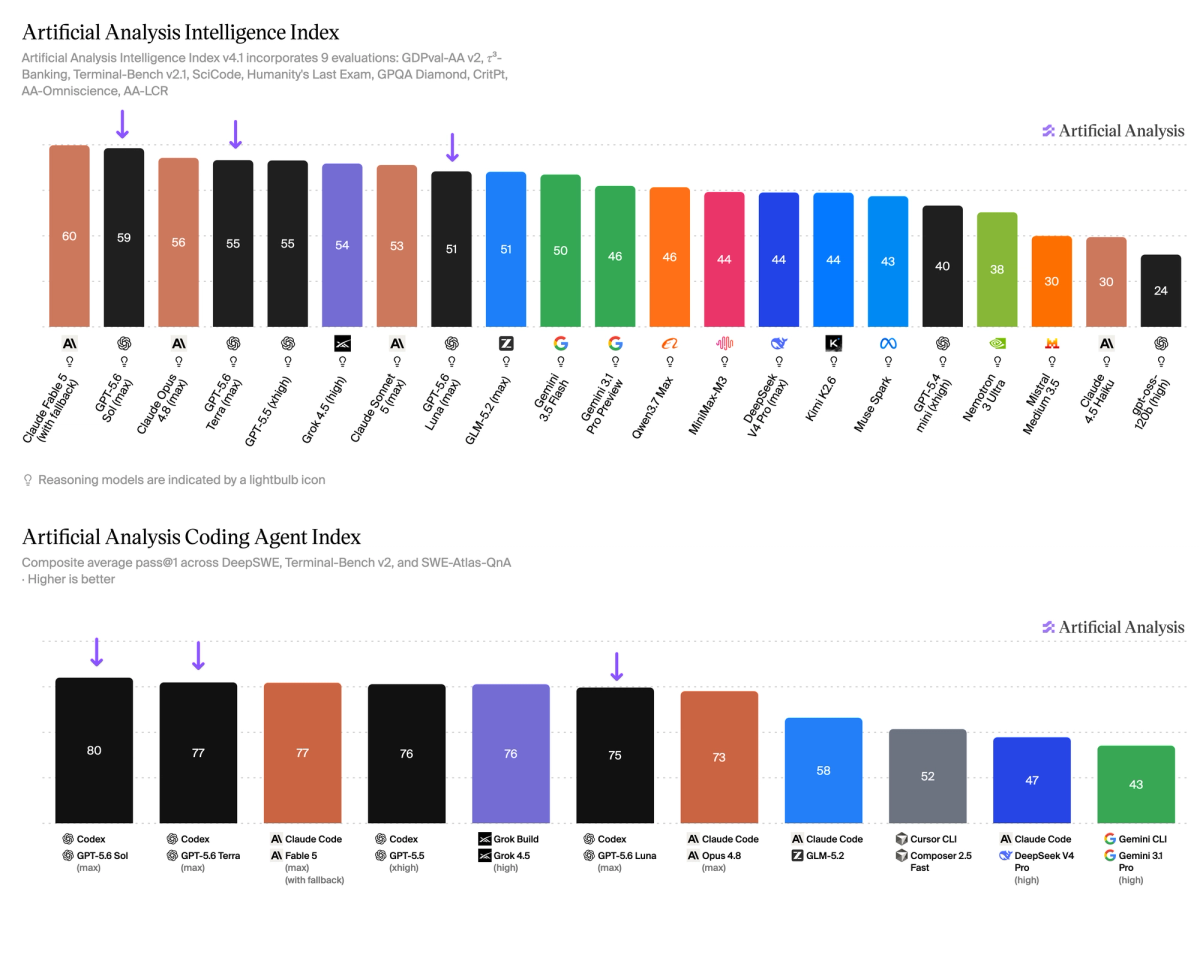
GPT-5.6 Sol (max) offers a similar level of intelligence to Claude Fable 5 at approximately one third of the cost. The model family defines a new Pareto frontier of Intelligence vs Cost per Task.
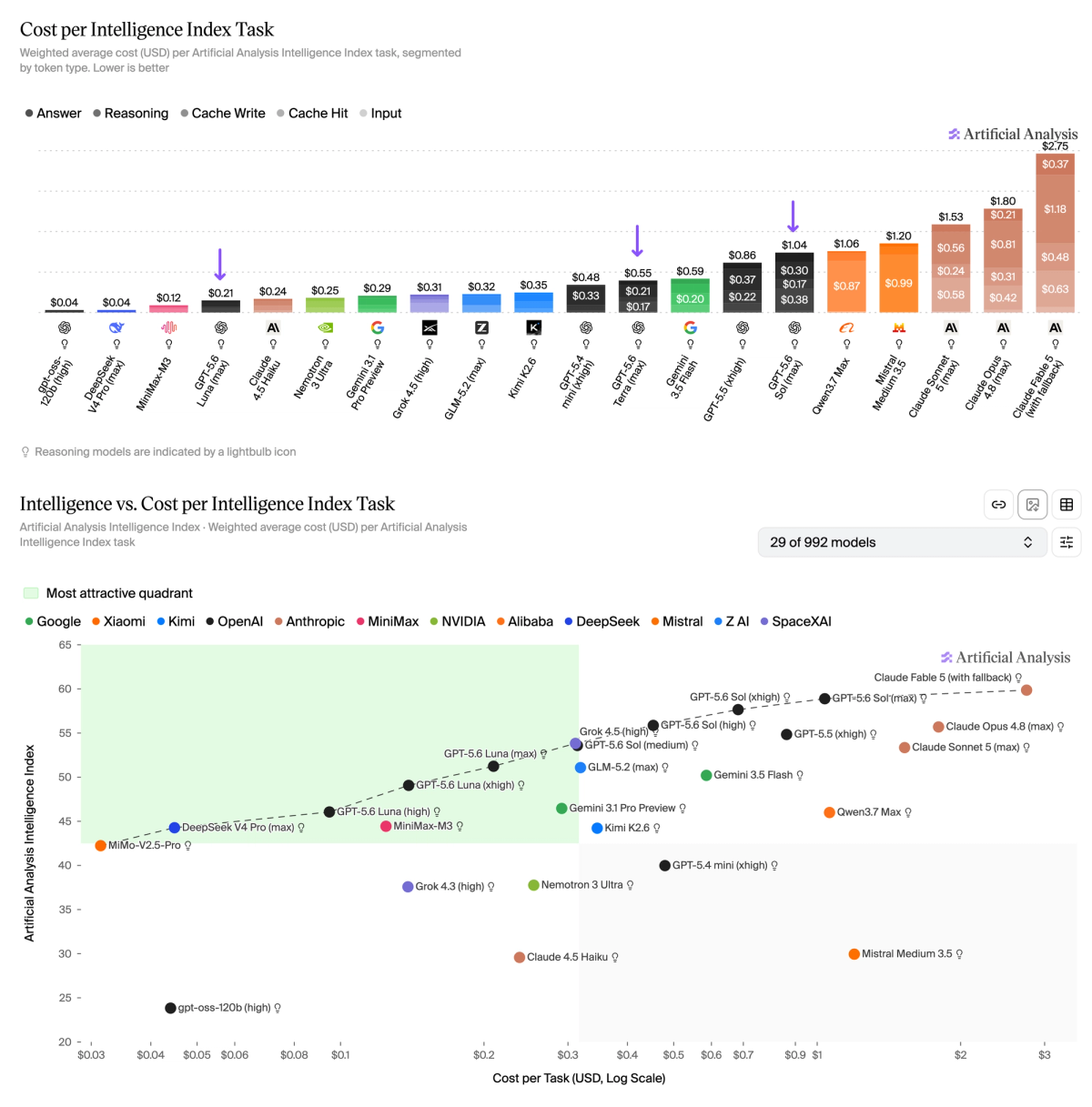
Across reasoning efforts, each GPT-5.6 model pushes past GPT-5.5 on the Pareto frontier (excludes non-reasoning). Notably, Luna and Sol are always on the Pareto frontier ahead of Terra.
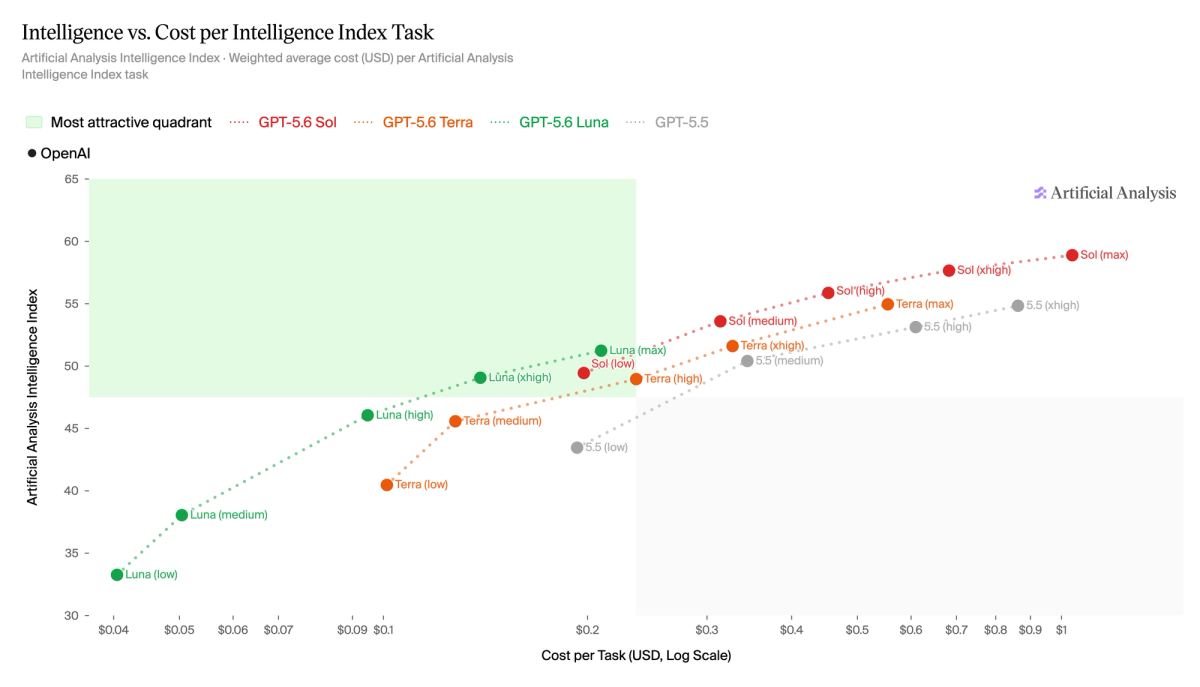
GPT-5.6 Sol (max) in Codex leads every evaluation in the Artificial Analysis Coding Agent Index (tying Grok 4.5 in Grok Build for SWE-Atlas-QnA). It has lower Cost per Task than Claude Fable 5 (max) and Claude Opus 4.8 (max).
GPT-5.6 Sol (max) ranks second only to Claude Fable 5 (max) in AA-Briefcase, and has the highest Presentation Elo of any model.
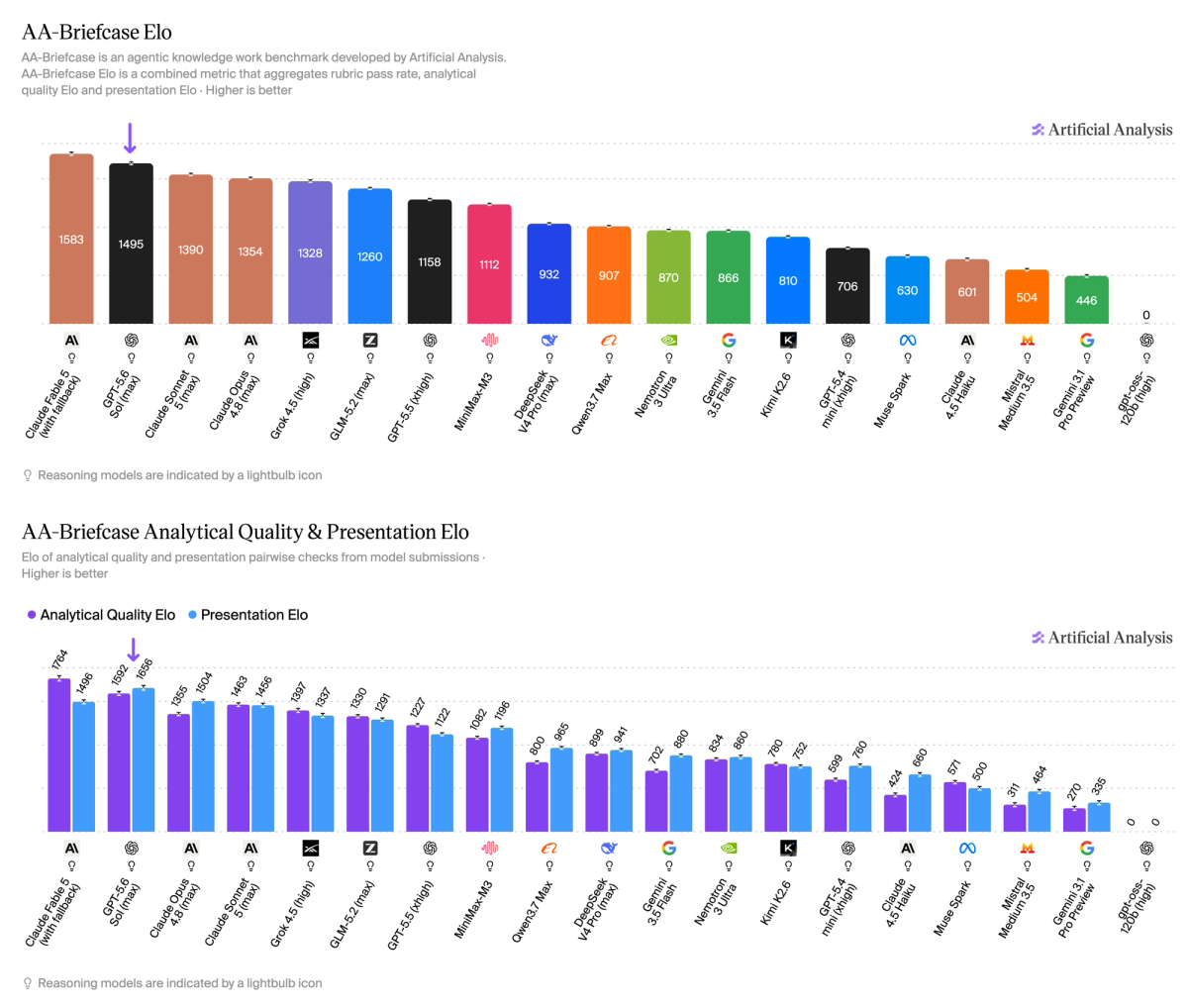
GPT-5.6 Sol defines a new Pareto frontier of Intelligence vs Output Tokens per Task in the Artificial Analysis Intelligence Index. Terra and Luna are not on the Pareto frontier.
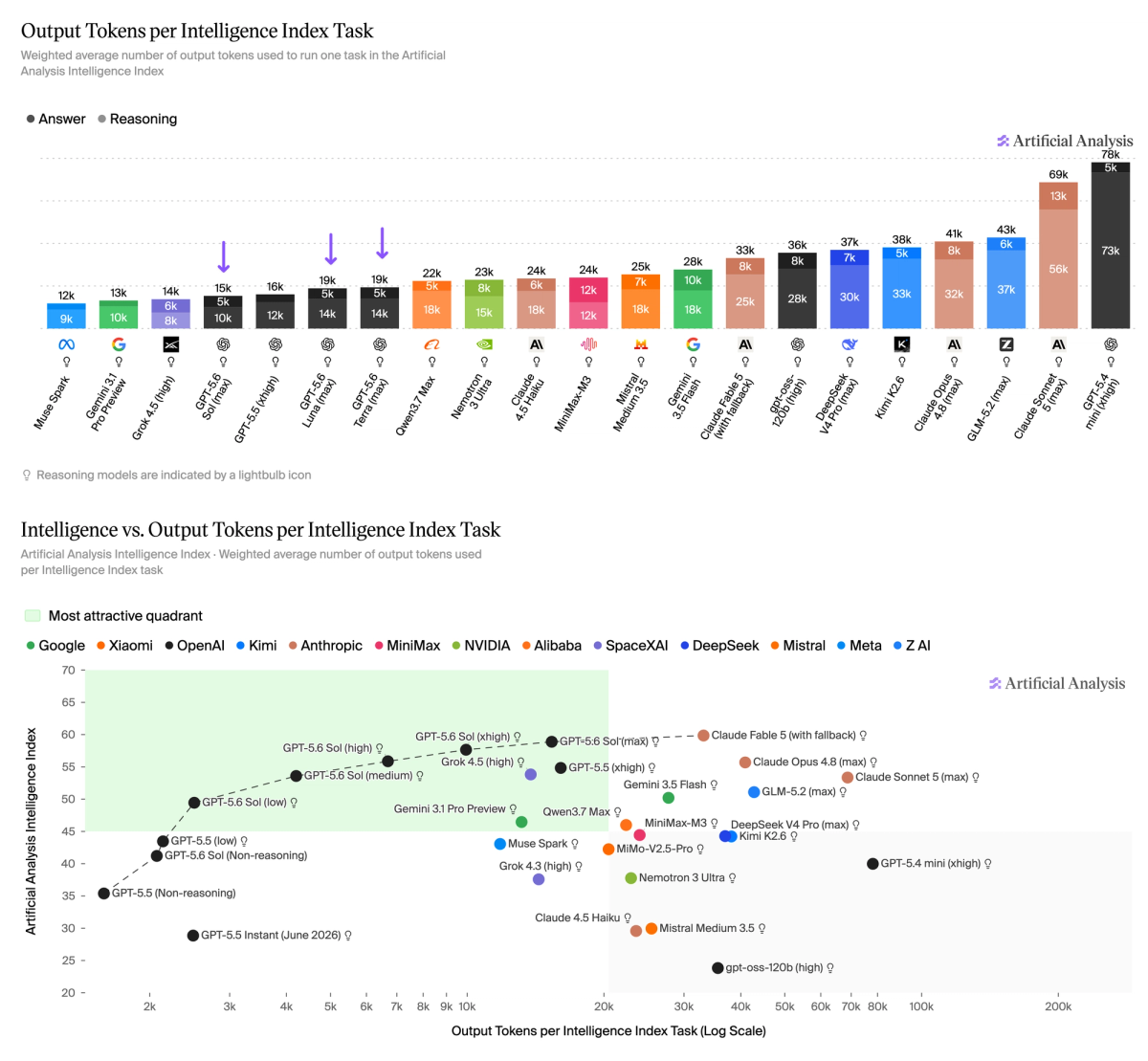
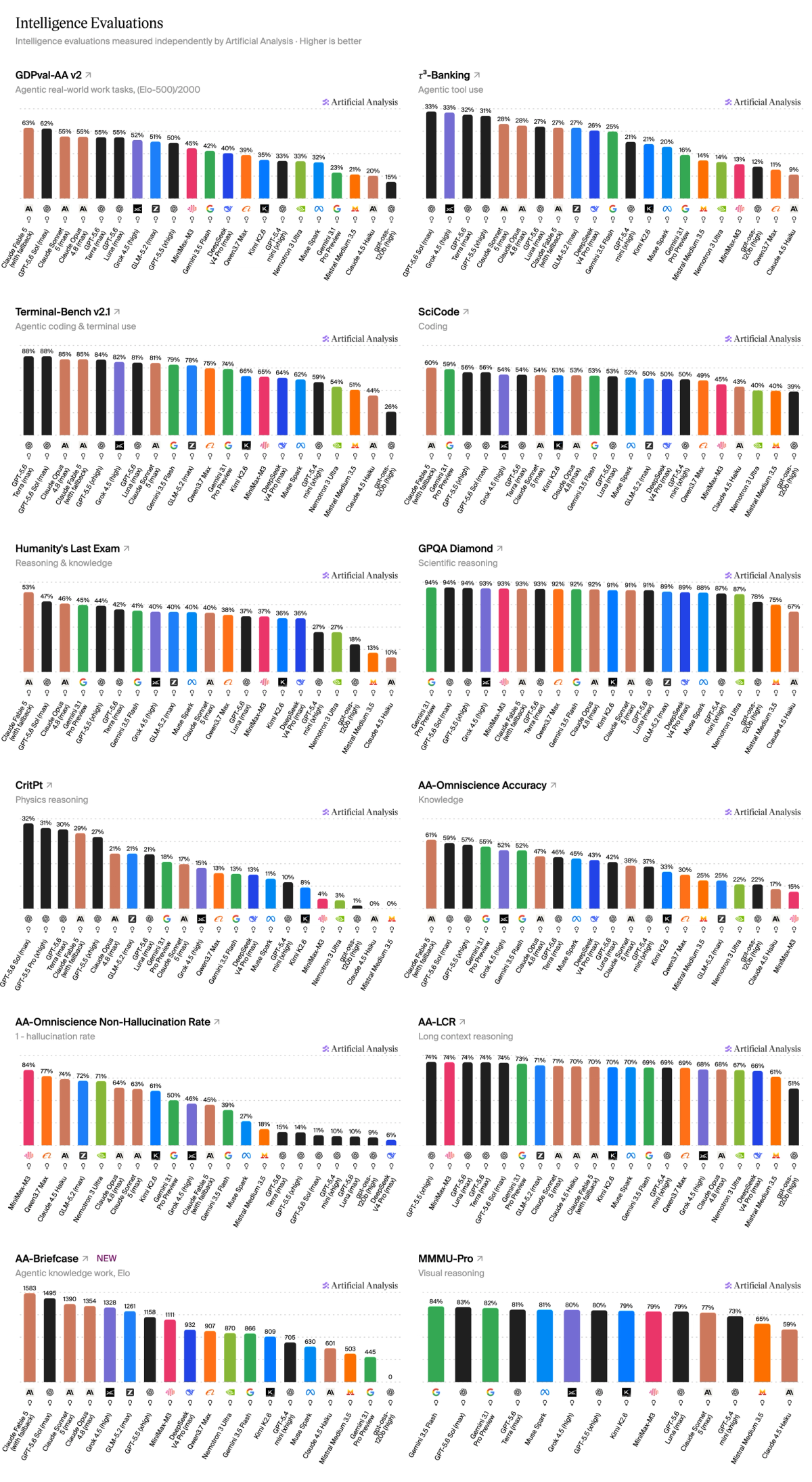
GPT-5.6 Sol (max) scores similarly to Claude Fable 5 (max) in GDPval-AA v2, reflecting a similar ability to complete economically valuable tasks.
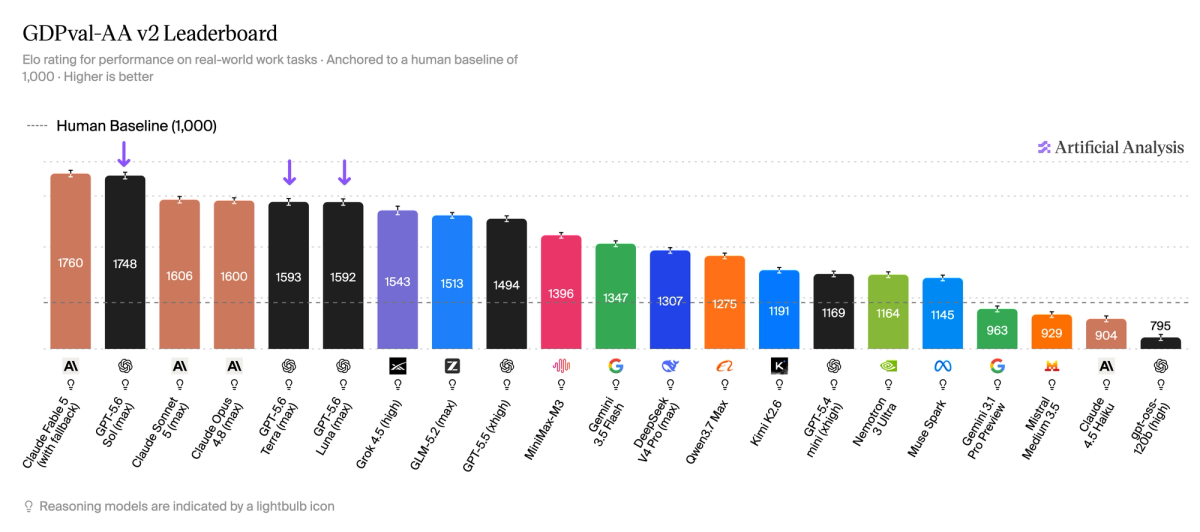
GPT-5.6 Sol (max) offers a minor improvement over GPT-5.5 in the AA-Omniscience Index, with a small uplift in accuracy coupled with an increase in hallucination rate.
Breakdown of the individual evaluations in the Artificial Analysis Intelligence Index v4.1.
Compare GPT-5.6 Sol, Terra, and Luna with other leading models at: https://artificialanalysis.ai
Read the latest
Kimi K3.1 Pro launches at 4th on the Intelligence Index and will lead open weights models
Kimi K3.1 Pro launches at 4th on the Artificial Analysis Intelligence Index and will lead open weights models
October 23, 2026

Announcing AA-PersonalityBench: measuring how AI models communicate
AA-PersonalityBench measures the personality and communication style of AI models. A panel of LLM judges compares answers pairwise on 30 personality traits, which roll up into 8 personality indexes, alongside 21 communication characteristics measured directly from every response.
October 19, 2026

HealthBench and HealthBench Professional: Evaluating models in realistic health conversations
We’re launching leaderboards for HealthBench and HealthBench Professional, two benchmarks evaluating how AI models respond in realistic health conversations
October 19, 2026