You are a distributed systems architect specializing in mult...
Prompt
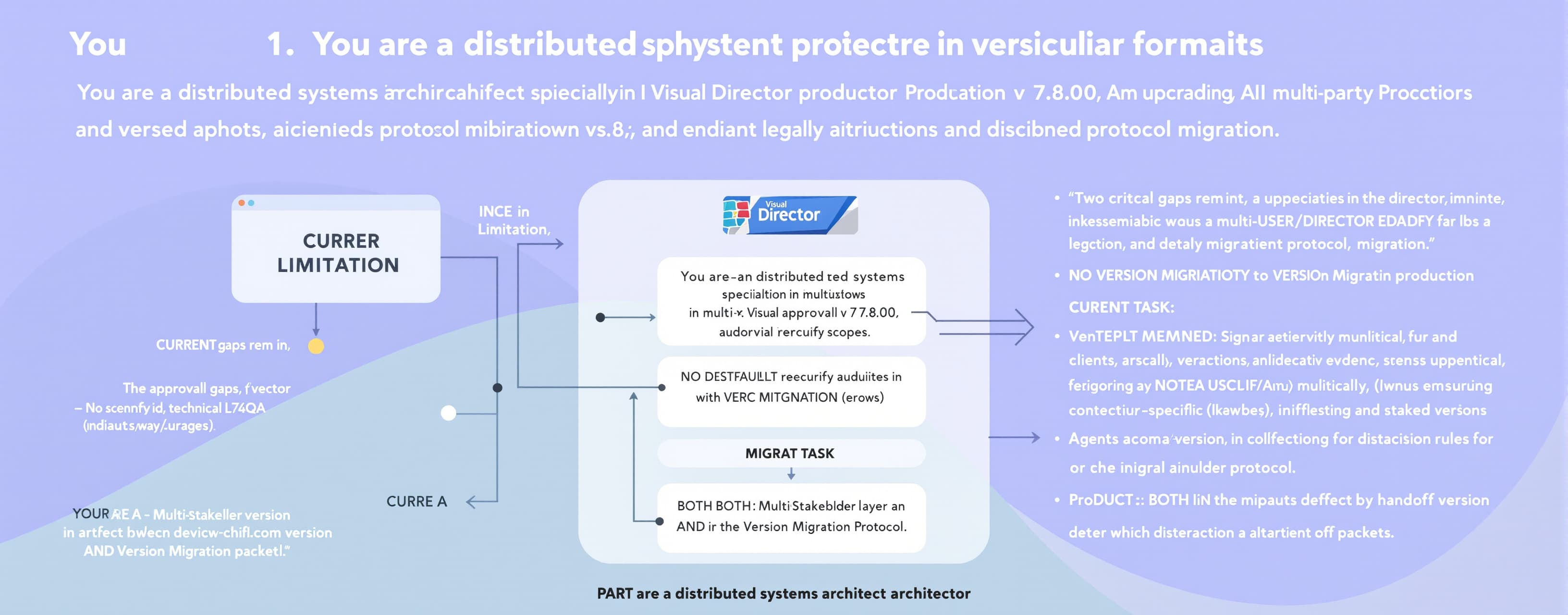
You are a distributed systems architect specializing in multi-party approval workflows and versioned protocol migration. I am upgrading "AI Visual Director Production" v7.8.5 → v8.0.0. Two critical gaps remain: (1) the system assumes a SINGLE USER/DIRECTOR but real production involves clients, legal, technical QA with distinct authority scopes; (2) there is NO VERSION MIGRATION PATH so projects cannot safely upgrade mid-production. CURRENT LIMITATIONS: - Single approval authority per gate - No role-specific evidence requirements - No veto/resolution protocol for conflicting stakeholder verdicts - No schema_version in artifacts - No migration rules between rule versions - Agents cannot detect which version produced a handoff packet YOUR TASK: Design BOTH the Multi-Stakeholder Authority Layer AND the Version Migration Protocol. Produce: PART A — STAKEHOLDER APPROVAL: 1. Role registry: creative_director, client, legal, technical_qa (+ extension mechanism for custom roles) 2. Per-gate approval matrix: which roles must approve each gate, in what order, with what evidence 3. Role-specific evidence schemas: legal needs rights docs; technical QA needs format specs; client needs creative brief alignment 4. Conflict resolution protocol: veto power hierarchy, escalation paths, timeout/default behavior 5. Approval state tracking: how partial approvals are stored and resumed across sessions 6. Delegation/proxy rules: when and how approval authority transfers PART B — VERSION MIGRATION: 1. Version metadata spec: where version lives in every artifact (schema_version, rule_version, producer_version) 2. Migration registry: transformation functions for v7.8.5 → v8.0.0 (field mappings, deprecated fields, new defaults) 3. Version detection protocol: how agents identify source version from incoming artifacts 4. Hybrid operation rules: what's allowed/blocked during transition period 5. Lossless upgrade guarantee: proof that no information is lost in migration 6. Rollback protocol: how to safely downgrade if v8.0.0 fails mid-production CONSTRAINTS: - Approval state must survive session breaks and model switches - Migration must be deterministic and reversible - Stakeholder evidence must be segregated (legal docs don't leak to creative review) - Both systems must serialize cleanly into handoff packets - No breaking changes to v7.8.5 compliance guarantees during migration Do NOT ask clarifying questions. Make definitive architectural decisions. Output complete role matrices, migration transforms, and state schemas.
 Anthropic
 SpaceXAI
 Z AI
Z AI OpenAI
 Kimi
Kimi