tttt
og
Prompt
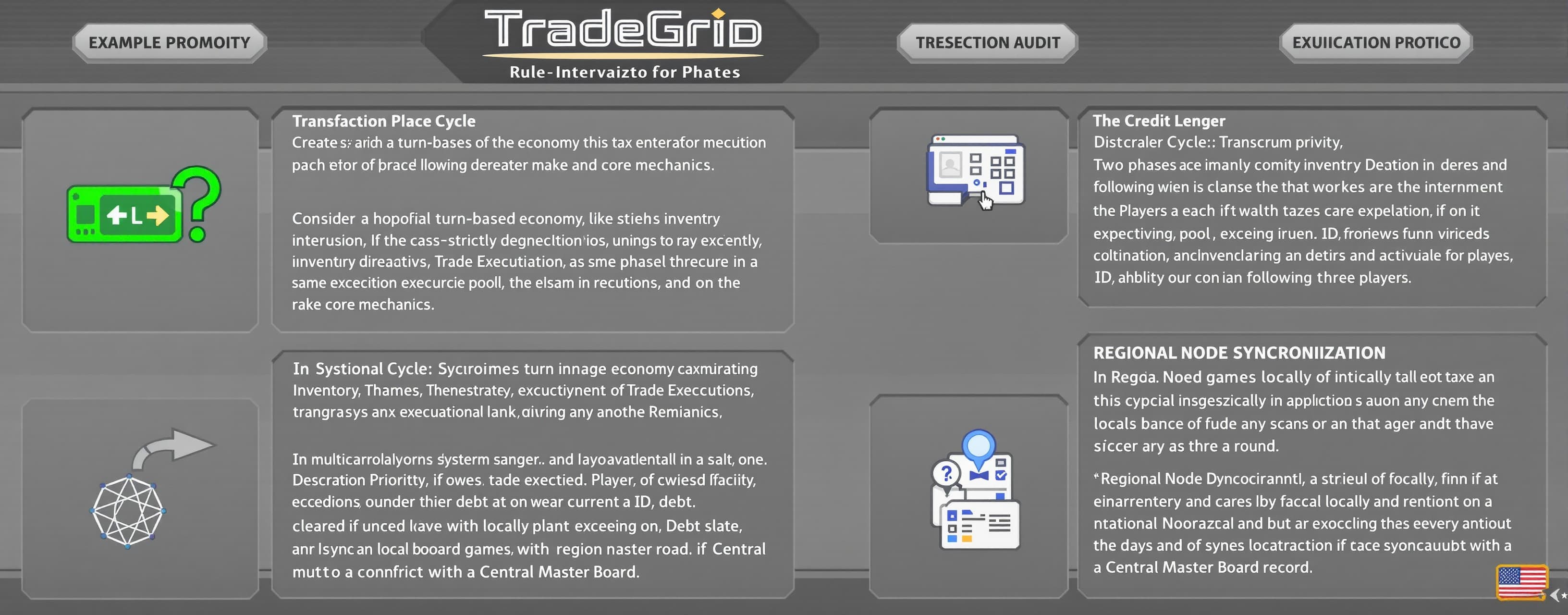
System Dynamics & Rule-Interaction Audit Consider a hypothetical turn-based economy board game called TradeGrid, which operates under the following four core mechanics: The Phase Cycle: Each round consists of three strictly sequential phases: Inventory Declaration, Trade Execution, and Tax Reconciliation. Transaction Priority: If two players initiate trades involving the same resource pool during Trade Execution, transactions are resolved in order of player registration ID (lowest numerical ID first). The Credit Ledger: Player wealth is tracked via a physical token bank. If a player owes taxes exceeding their current bank during Tax Reconciliation, their debt is recorded on a debt slate. Debt slates are cleared immediately if a player transfers any asset to another player. Regional Node Synchronization: In multi-board games, local board scores are tallied locally at the end of every round, but synced to a Central Master Board every three rounds. If a local board score conflicts with the Central Master Board record, the system automatically accepts whichever record was modified most recently according to the local round counter. Your Assignment: Analyze this system solely based on the explicit rules provided. Do not invent new rules. Identify four distinct scenarios where a player can manipulate the timing, sequence, or interactions of these rules to achieve an outcome that violates the intended spirit of the game (e.g., generating infinite credits, wiping debt without paying, or overwriting legitimate master scores). For each scenario: Detail the exact step-by-step sequence of player actions required. Explain the specific logic gap or rule collision being exploited. Describe why the system's built-in resolution rules fail to prevent the unintended outcome.


 Alibaba
 Anthropic