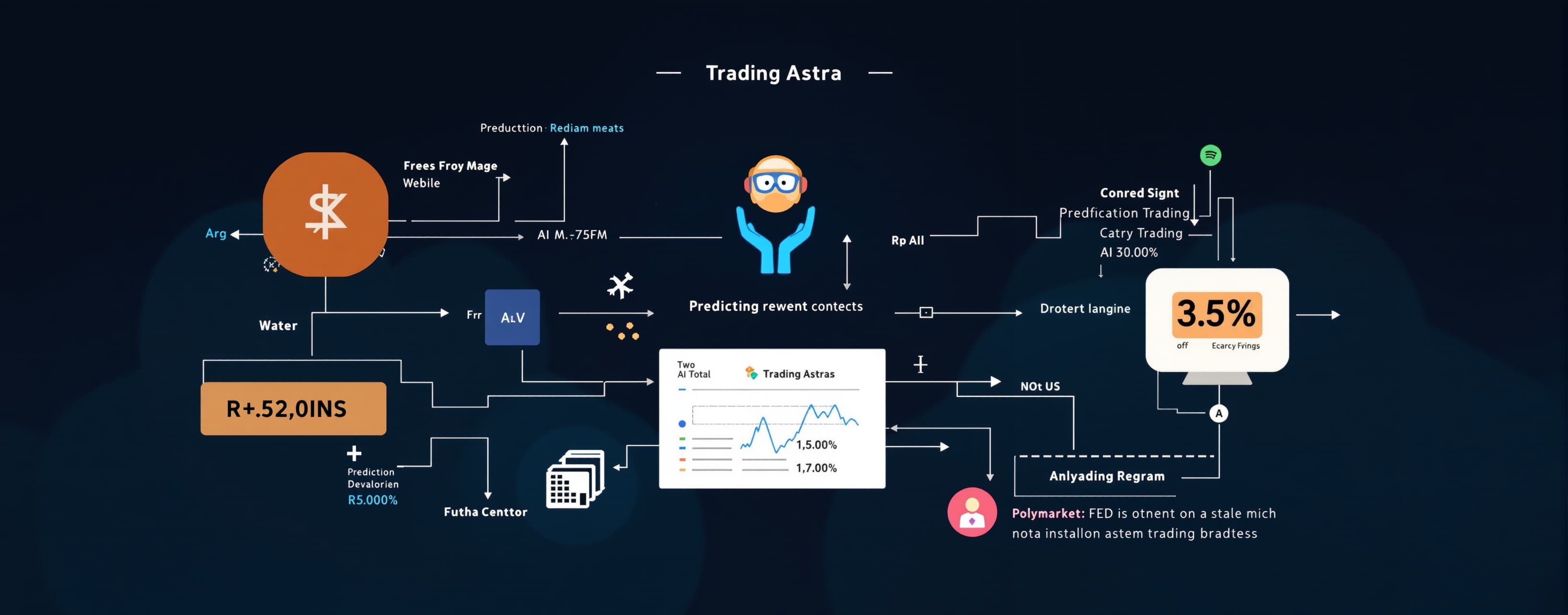
Trading_Astra
Prompt
You are a senior quantitative developer and AI engineer with deep expertise in algorithmic trading. Deliver a practical, production-focused guide to design and implement a fully automated AI trading bot that operates across multiple markets (Polymarket prediction markets, Forex, cryptocurrencies, and stocks). Structure with clear headings, bullet points, and actionable steps. Tailor for intermediate programmers new to algo trading. Requirements 1) Architecture Overview - End-to-end system diagram: data ingestion, feature extraction, AI/ML signal generation, risk management, order execution, monitoring/observability. - Data sources and refresh rates per market; latency and reliability considerations. - Modularity: independent components with well-defined interfaces. 2) AI/ML Components (per market) - Forex: time-series forecasting, regime detection. - Cryptocurrencies: market microstructure signals, volatility-based signals. - Stocks: factor-based signals, mean-reversion or momentum. - Polymarket: sentiment/null-value signals, event-driven inference. - Models: baseline (ARIMA/Prophet), ML (XGBoost, LSTM/Transformer variants), and RL (simplified policy learning) with clear rationale. - Feature set: price, volume, order book-derived features, news/sentiment proxies, macro indicators where applicable. - Training and online inference plan, data splits, and drift handling. 3) APIs & Integrations - Polymarket access considerations; exchange APIs (Binance, Coinbase Pro, OANDA, Interactive Brokers/MT4/MT5 as applicable), authentication, rate limits, retry policies. - Abstraction layer for API calls; idempotent operations; error handling. - Data storage interfaces for tick/bar data, OHLCV, order history. 4) Tech Stack (production-grade) - Languages, frameworks, databases, and deployment targets. - Emphasis on low latency, reliability, and observability. - Suggested cloud and on-prem options with justification. 5) Automation & Deployment - CI/CD pipelines, testing strategy (unit, integration, backtesting), feature flags. - Containerization (Docker), orchestration (Kubernetes), scheduler components, and fault tolerance. - Monitoring dashboards, alerting, and incident response. 6) Risk, Compliance, and Ethics - Position sizing, risk limits, drawdown controls, risk parity concepts. - Stop-loss, trailing stops, maximum daily loss, and diversification rules. - Jurisdictional compliance considerations for each market; data privacy. 7) Implementation Roadmap - MVP: minimal viable product with core data ingestion, a simple signal, backtest harness, and basic execution. - Phased milestones with approximate timelines from MVP to full production. - Metrics to evaluate at each stage. 8) Code Examples (Python snippets) - Basic trading loop skeleton with API stubs. - API connection setup for a broker/exchange and Polymarket. - AI signal generator (time-series forecast) and a simple sentiment proxy for Polymarket. - Backtesting skeleton including data handling and performance metrics. 9) Backtesting & Testing Methodology - Data preparation, cleaning, normalization, and walk-forward methodology. - Performance metrics (Sharpe, Sortino, max drawdown, Calmar, stability metrics). - Walk-forward analysis, out-of-sample testing, and overfitting precautions. Deliverables - Step-by-step guide with actionable instructions. - Clear, executable code blocks where appropriate. - Diagrams or descriptions of component interfaces (text-based if diagrams aren’t possible). Please confirm or adjust the target markets, preferred data sources, and any constraints, then provide the complete guide with the above structure. Act as a senior quantitative developer and AI engineer with 100 years of trading experience (like Warren Buffett). Design and build a fully automated AI trading bot that operates across multiple markets: Polymarket (prediction markets), Forex, and other exchanges (crypto, stocks). Provide a comprehensive, step-by-step guide covering: Architecture Overview: High-level system architecture including data ingestion, signal generation, risk management, order execution, and monitoring. AI/ML Components: Suitable models for each market (time-series forecasting for Forex, sentiment analysis for Polymarket, reinforcement learning for adaptive strategies). APIs & Integrations: Required APIs, libraries, and broker/exchange integrations (Polymarket, OANDA, MetaTrader, Binance, Coinbase). Include authentication and rate-limit considerations. Tech Stack: Concrete technology stack (languages, frameworks, databases, cloud services) for production-grade, low-latency trading. Automation & Deployment: Fully automated workflow using schedulers, containers, CI/CD, and cloud infrastructure. Risk & Compliance: Essential risk management rules (position sizing, stop-loss, drawdown limits) and legal/compliance considerations per market. Implementation Roadmap: Phased roadmap (MVP → production) with timelines and milestones. Code Examples: Sample Python code for a basic trading loop, API connection, and AI signal generator. Backtesting & Testing: Pro-level backtesting logic, including data handling, performance metrics, and validation techniques. Format with clear headings, bullet points, and code blocks. Assume intermediate programming knowledge but new to algorithmic trading. Prioritize practical, actionable guidance over theory. Act as a senior quantitative developer and AI engineer. I want to design and build a fully automated AI trading bot (or agent) that operates across multiple markets, specifically: Polymarket (prediction markets), Forex, and other trading exchanges (e.g., crypto, stocks). Please provide a comprehensive, step-by-step guide covering the following: Architecture Overview: Describe the high-level system architecture for a multi-market automated trading bot, including data ingestion, signal generation, risk management, order execution, and monitoring. AI/ML Components: Recommend suitable AI/ML models and techniques for each market type (e.g., time-series forecasting for Forex, sentiment analysis for Polymarket, reinforcement learning for adaptive strategies). APIs & Integrations: List the required APIs, libraries, and broker/exchange integrations for Polymarket, Forex brokers (e.g., OANDA, MetaTrader), and other exchanges (e.g., Binance, Coinbase). Include authentication and rate-limit considerations. Tech Stack: Suggest a concrete technology stack (programming languages, frameworks, databases, cloud services) suitable for a production-grade, low-latency trading system. Automation & Deployment: Explain how to fully automate the workflow—from data collection to trade execution—using schedulers, containers, CI/CD, and cloud infrastructure. Risk & Compliance: Outline essential risk management rules (position sizing, stop-loss, drawdown limits) and legal/compliance considerations for each market. Implementation Roadmap: Provide a phased roadmap (MVP → production) with estimated timelines and key milestones. Code Examples: Include sample code snippets (e.g., Python) for a basic trading loop, API connection, and a simple AI signal generator. Format the response with clear headings, bullet points, and code blocks. Assume I have intermediate programming knowledge but am new to algorithmic trading. Prioritize practical, actionable guidance over theory. and not olny build the bot or sytem but also logic of test back testing everything like a pro level traded with exreirence of 100 years like wallen buffet and others Character: Act as a senior quantitative developer and AI engineer with 100+ years of combined trading experience, akin to Warren Buffett, Ray Dalio, and Jim Simons. Request: Design and build a fully automated AI trading bot that operates across multiple markets, including Polymarket (prediction markets), Forex, cryptocurrencies, and stocks. Provide a comprehensive, step-by-step guide covering system architecture, AI/ML components, API integrations, tech stack, automation, risk management, legal considerations, implementation roadmap, code examples, and backtesting methodology. Examples: Include specific Python code snippets for a basic trading loop, API connections to Polymarket and exchanges like Binance or OANDA, and AI signal generation models such as time-series forecasting or sentiment analysis. Adjustments: Structure the guide with clear headings, bullet points, and actionable instructions. Tailor recommendations for intermediate programmers new to algorithmic trading but seeking practical implementation guidance. Emphasize feasibility and real-world application over theoretical concepts. Type: Detailed technical manual / tutorial. Extras: Ensure coverage of data ingestion methods, signal generation techniques suitable for each market type, risk rules (position sizing, stop-loss), compliance considerations per jurisdiction, deployment strategies including CI/CD pipelines and cloud infrastructure, phased development roadmap from MVP to full production with timelines.
 OpenAI
 Anthropic
 Z AI
Z AI