spec
Reasoning and Planning
Prompt
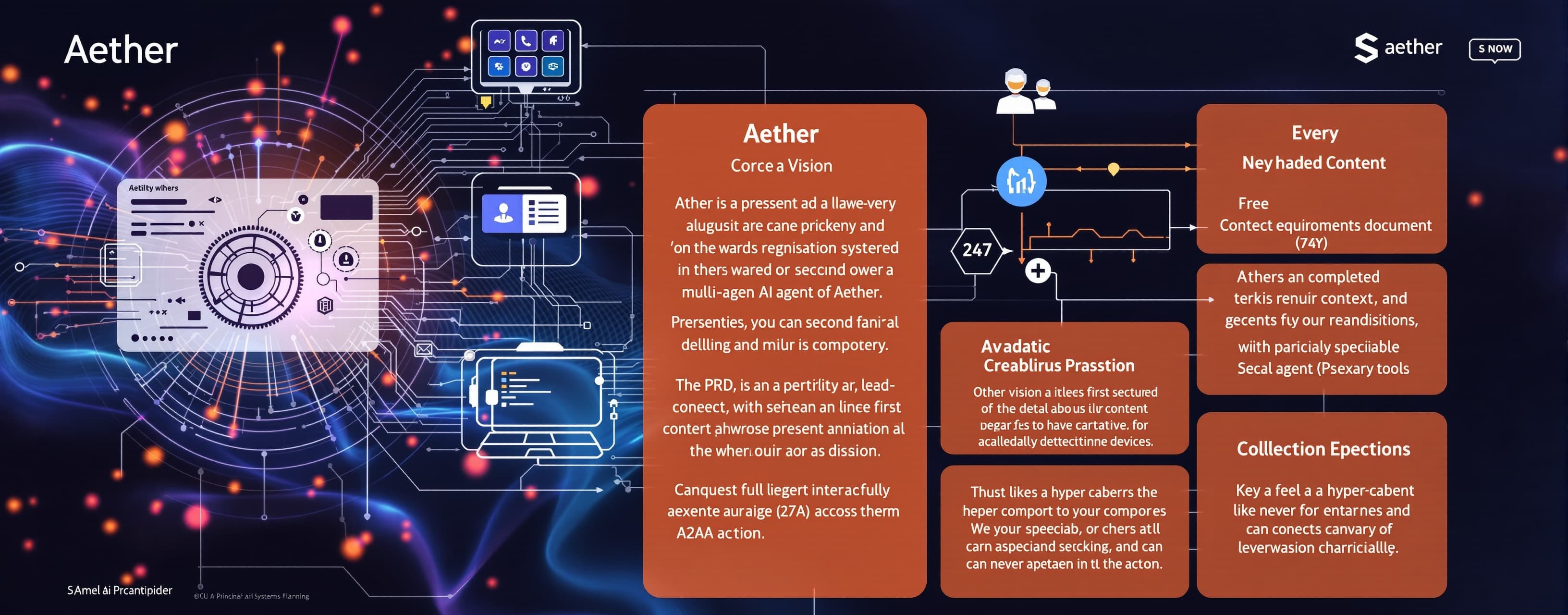
You are a Principal AI Systems Architect at a stealth startup building the world's most advanced personal AI companion. Your task is to produce a complete, highly detailed Product Requirements Document (PRD) + Technical Specification for "Aether" — an always-on, real-time interruptible, multi-agent AI system that runs 24/7 as a proactive digital extension of the user. Core Vision: Aether is a persistent, voice-first (with seamless text fallback) AI "second brain" that lives across devices (phone, desktop, wearables, car, home assistants). It maintains deep context about the user's life, proactively acts on their behalf across all apps/tools, coordinates swarms of specialized sub-agents, and supports full agent-to-agent (A2A) collaboration. It must feel like a hyper-capable, always-present colleague that never forgets, never sleeps, and can be interrupted mid-action naturally. Key Non-Negotiables: - Real-time interruptible voice: Natural, low-latency conversation (sub-200ms) with barge-in support, emotional prosody, filler words, and seamless handoff between voice/text/multimodal. Support for overlapping speech, clarification questions during actions, and "pause/resume" of long-running tasks. - Always-on persistence: Maintains indefinite memory (vector + graph + episodic + procedural) with perfect recall, auto-summarization, and forgetting policies based on user-defined privacy tiers. - Universal tool/app integration: Works across ALL user apps and services (email, calendar, Slack/Discord/Teams, browsers, IDEs, banking, CRM, smart home, etc.) via a combination of APIs, browser automation, desktop control, mobile accessibility services, and reverse-engineered integrations where needed. Full support for "computer use" style actions. - Full A2A + MCP compatibility: Native support for Agent-to-Agent protocols (A2A) and Model Context Protocol (MCP) or equivalent for tool calling, state sharing, and dynamic capability discovery. Agents must be able to spawn, delegate to, monitor, and critique other agents (including third-party ones). - Multi-agent orchestration: A "Conductor" agent dynamically spawns/runs/swarm-coordinates specialized agents (Researcher, Executor, Critic, Planner, Emotional Support, Security Auditor, etc.). Hierarchical + peer-to-peer collaboration with conflict resolution. - Privacy & Security: On-device-first where possible, end-to-end encryption, local models for sensitive tasks, granular permission model, audit logs, and "air-gapped" modes. - Proactivity & Autonomy levels: Configurable from "suggest only" to "act and confirm" to "act autonomously with post-facto reporting." Anticipatory actions based on user patterns, calendar, location, biometrics, etc. Structure your output exactly as follows (use markdown, tables, and diagrams in Mermaid where helpful): 1. **Executive Summary** (1-2 paragraphs) + Success Metrics (KPIs like interruption recovery success rate >98%, task completion without human input >85% for routine tasks, user NPS target, latency budgets). 2. **User Personas & Journeys** (3-4 detailed personas with day-in-the-life scenarios showing voice interruptions, cross-app flows, and multi-agent handoffs). 3. **Functional Requirements** - Voice & Multimodal Interface - Memory & Context System - Agent Architecture & Orchestration - Tool Integration & MCP/A2A Layer - Proactivity Engine - Privacy & Security Controls 4. **Non-Functional Requirements** (performance, scalability, reliability, accessibility, supported platforms/devices). 5. **Technical Architecture** (high-level diagram in Mermaid, data flows, model routing strategy for cost/latency/quality, state management, error handling & recovery). 6. **Phased Roadmap** (MVP → Beta → v1.0) with prioritized features, dependencies, and risk assessment (use MoSCoW method). 7. **Edge Cases & Failure Modes** (at least 8 detailed examples with mitigation strategies, e.g., conflicting agent goals, network loss during critical action, voice interruption mid-sensitive task, hallucinated tool actions, privacy breaches). 8. **Open Questions & Trade-offs** (list 5-7 key decisions that require further input, with pros/cons). Be extremely detailed, concrete, and opinionated. Use specific examples, latency numbers, protocol references, integration patterns, and pseudo-code snippets where they add clarity. Prioritize usability and delight while being technically rigorous. Avoid vagueness — this PRD should be detailed enough for a senior engineering team to start implementation.
 Google
 OpenAIOpenAIOpenAI