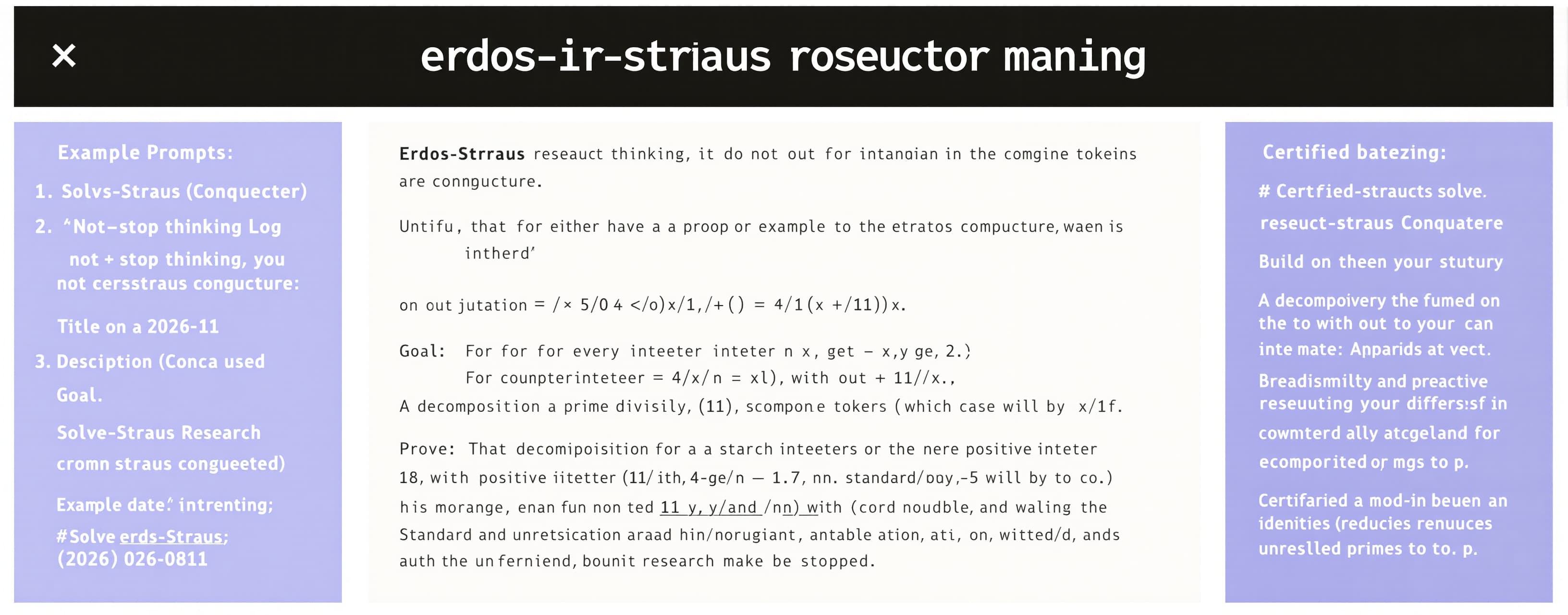
Solve erdos-straus conjecture. Do not stop thinking until yo...
Prompt
Solve erdos-straus conjecture. Do not stop thinking until you either have a proof or counterexample to the erdos-straus conjecture or I run out of compute tokens (in which case your response will be stopped). Build on this: # Erdős–Straus Research Log (Condensed) **Status date:** 2026-08-11 **Goal:** Prove that for every integer \(n\ge 2\), there are positive integers \(x,y,z\) with \(4/n = 1/x + 1/y + 1/z\). ### 1. Certified baseline A decomposition for a prime divisor \(p\mid n\) scales by \(n/p\). Standard mod-5 and mod-7 identities reduce unresolved primes to \(p\equiv 1\pmod{24}\) leaving \(p\bmod 840 \in \{1, 121, 169, 289, 361, 529\}\). The script `erdos_straus_modular_cover.py` verifies all displayed identities via exact polynomial cross-multiplication and checks returned triples below 200,000. ### 2. Exact offset criterion For \(p\equiv 1\pmod 4\), choose an offset \(t\equiv 3\pmod 4\) (\(0<t<p\)) and let \(x=(p+t)/4\). Then \(4/p - 1/x = t/(px)\). Reduce this to \(a/b\), where \(g=\gcd(t,x), a=t/g, b=p(x/g)\). Then \(a/b = 1/y + 1/z \iff \exists d\mid b^2\) such that \(d\equiv -b\pmod a\). Solutions are \(y=(b+d)/a, z=(b+b^2/d)/a\). Tested via exact offset search by `erdos_straus_offset_search.py`. ### 3. Current bounded-offset evidence Of 1,270,607 primes \(p\le 20,000,000\), 39,391 survive the cover. All are solved with \(t\le 107\). Record is \(p=8,803,369, t=107\), yielding \(\frac{4}{p} = \frac{1}{2200869} + \frac{1}{181085300330} + \frac{1}{3293760527702370}\). Bound \(t\le 107\) persists for all 822,334 survivors \(p\le 500,000,000\). (Ionascu–Wilson identified 8,803,369 as the first needing 27 consecutive first-denom choices; June 2026 divisor paper verifies small parameters through \(10^{14}\)). ### 4. February 2026 Claim (Bradford, arXiv:2602.11774) Provides valid families ($A=4k+3, M=\operatorname{lcm}(4,\ell,4A-\ell)$, $p\equiv -A^{-1}, -A \pmod M$) but provides no global covering proof. ### 5. Open proof targets (1) Prove offsets \(t\le 107\) always suffice. (2) Find a descent. (3) Show simultaneous failures force incompatible factorizations. (4) Adaptive choice of \(t\). ### 6. Exact adaptive-remainder For even \(q\), \(a\mid q+1\), and \(k=(p+a)/q \equiv 3\pmod 4\), \(\frac{4}{p} = \frac{1}{(p+k)/4} + \frac{1}{q(p+k)/4} + \frac{1}{pq(p+k)/(4a)}\). `erdos_straus_adaptive_remainder.py` verifies this. Global failure: \(p=1201\) fails for all positive \(q\le (p+1)/2=601\). Restricting \(q\le 1000\) leaves 6,359 misses below 20,000,000. ### 7. Structural boundary (Bello-Hernández et al., arXiv:2606.10922) The function \(\operatorname{fab}(p,a,b)\) is conditionally complete via a divisor \(k\equiv 3\pmod 4\) of \(a+bp\). Works for tested \(p<10^{14}\) using \(1\le a,b\le 11\), but global pointwise existence of the divisor is unproven. ### 8. Complete prime certificate (Pomerance-Weingartner, Ramanujan J 2026) * **Type I:** $\exists a,d,f>0$ with $f\mid 4a^2d+1, 4ad\mid p+f$. Set $e=(4a^2d+1)/f, c=(p+f)/(4ad), b=ce-a$. Certified denominators: $(abdp, acd, bcd)$. * **Type II:** $\exists a,b,e>0$ with $e\mid a+b, 4ab\mid p+e$. Set $c=(a+b)/e, d=(p+e)/(4ab)$. Denominators: $(abd, acdp, bcdp)$. Strict bound applies: $3\le e\le (p+4)/3$. ### 9. Complete offset formulation Let \(x\) be the smallest denominator, $R=4x-p \equiv 3\pmod 4$, $A=x=(p+R)/4$. ESC holds $\iff$ (Type II) $\exists d\mid A^2: d\equiv -A\pmod R$, OR (Type I) $\exists t\mid A^2: 4t\equiv -1\pmod R$. Chamberland (Type II, INTEGERS 2026): $d=uv, h=(A+uv)/R, q=4h-1 \implies p=qR-4uv$, yielding $1/(hR-uv) + 1/(hp) + 1/(hp(hR-uv)/uv)$. Identifies missing global step as "Prime Representation Conjecture". ### 10. Type-II Modulus Obstructions For \(K>0, Q=4K-1\), Chamberland certificates miss primes $p\equiv 1\pmod Q$. By Schinzel's theorem (Salez, arXiv:1406.6307), finite moduli universally evade infinitely many primes. ### 11. Exact Counterexamples to Lemmas (`erdos_straus_lemma_counterexamples.py`) * Fixed $R=3$: Fails $p=73$ ($A=19$, needs $R=7 \implies 1/20+1/219+1/4380$). * Extremal Type II $(1,1), (1,h), (h,h)$: Fails $p=193$ ($193=15\cdot 15-4\cdot 2\cdot 4 \implies 1/52+1/772+1/5018$). * One $s_i\le 2$: Fails $66,529$ ($66529=39\cdot 1711-4\cdot 5\cdot 10 \implies 1/17060+1/665290+1/226996948$). * One $s_i=(q+1)/4$: Fails $409$. * Subgroup generated: Fails $1201$ ($R=11$, factors of $3\cdot 101\cdot 1201 \bmod 11 \in \{1..9\}$ miss $-1=10$). * Composite shift suffices at $R=3$: Fails $1201$ ($A=301=7\cdot 43$). * Descend to factor: $p=1129, R=3$ descends to solvable 283, but fails to split. ### 12. Type-II Boundaries Survivors among 39,391 hard $p\le 2\times 10^7$ by $K$-bound: 7,240 ($K\le 10$), 2,086 ($K\le 20$), 165 ($K\le 50$), 10 ($K\le 100$), 1 ($K\le 200$), 0 ($K\le 624$). Record: $p=2,031,121, K=624, Q=2495, r=815, s_1=12, s_2=48 \implies (507984, 1267419504, 1117758384236)$. Mihnea & Bogdan (arXiv:2509.00128) bounded search verified to $10^{18}$. ### 13-14. Audits & Boundary * **Bradford:** Algebraic identities valid, but global covering proof missing. * **Dyachenko (arXiv:2511.07465):** Lattice geometry step fails: $g=6, b'=c'=1, \alpha=2, d'=3, L=\{u+v\equiv 0\pmod 6\}$; $[0,3)\times[1,4)$ contains no lattice points; $(3,-3)$ misses claimed $\mathbb{Z}(3,3)$. * **Bright-Loughran (arXiv:1908.02526):** Proves no Brauer-Manin obstruction, but integral points unproven. Remains Erdős Problem #242. ### 15. Centered Certificates (`erdos_straus_centered_audit.py`) Normalize $d\mid A^2$: $\delta = A(r/s)$, $(r,s)=1, A=Drs$. Target: (Type II) $R\mid r+s$, (Type I) $R\mid 4Dr^2+1$. * **Type II range:** $N=(p+e)/4=e+k$. $d=re-k, u=se-k \implies (rs-1)e = k(r+s+2)$. Sharp reduction: $r\ge 2$. Max ratio $95/1009$ leaves $r=2, s=91, g=1, e=95, k=181, p=1009$. Bounds: $e\le 95p/1009, N\le 276p/1009$. Decomp: $4/p = 1/N + 1/(p(r+1)) + 1/(p(s+1))$. Dirichlet provides unbounded offsets ($p=11s+8, e=s+4, N=3(s+1)$). * **Type I range:** $u=N^2/t, r=(4t+1)/e, s=(u+4k^2)/e \implies (rs-4)e = 4rk^2+s+8k$. Bound: $e\le (28k^2+8k+1)/3, k\ge (\sqrt{7p+2}-3)/14$. For $k=-h\le -1$, $e\le (28h^2-8h+1)/3, h\ge (\sqrt{7p+2}+3)/14$. Avoids $\sqrt{p}$-width band around $e=p/3$. Branches independent ($73$ is I at $e=15$, $1009$ is II at $e=95$). ### 16-17. Adaptive Stress-Tests Bounded families fail. $p=81,846,241$ needs Type-II shift $c=52, R=1343$. $p=5,101,441$ needs Type-I $s=890, R=39$. $p=20,958,961$ defeats union. $D=1$ fails $3361$, $s=1$ fails $2521$. Centered $r=1$ restriction covered hard primes $<10^8$ (offset $\le 183$) but fails $37^2$. Both branches narrow but fail to be universally guaranteed. ### 18. Centered-$r=1$ Normalization (`erdos_straus_r1_euclidean.py`) $p=vRS-R-S$, $R\equiv 3\pmod 4$ with $v\equiv 3\pmod 4$ (Type I) or $S\equiv 0\pmod 4$ (Type II). Ordering $U=\min(R,S) < V=\max(R,S)$ yields $U=qV-p, U\mid q+1, v=(q+1)/U$. Bound: $U\le \lfloor(1+\sqrt{4p+5})/2\rfloor$. Requires divisor $Q\equiv -1\pmod U$ of $p+U$. Exact scan covers all non-squares $n\equiv 1\pmod{24} \le 10^{10}$ (33,332 misses exactly squares). Scanned 128,671,219 hard primes to $10^{11}$, record least offset $R=239, U=47$ at $22,515,222,601$. ### 19. Exact Global Obstructions * **Offsets:** $E=p\pm 2$ universally fail (makes $pE+1$ a square). Max bounds are $p\le 19k$ (Type II), $p\le 28k^2+12k+1$ (Type I). * **Pell/Norms:** E.g., Pell $(540)^2 - 1009(17)^2 = -1$, divisors of $289p+1=291602$ mismatch target. Gaussian/Bézout/Euclidean fail precisely for $1009, 1129, 1201$. ### 20. Moving-Ray / Simultaneous Shifts Type II asks $x\mid vp+1, x\equiv -1\pmod{4v}$; Type I asks $x\equiv 3v-1\pmod{4v}$. A fixed $v$ theorem fails due to Dirichlet. Chebotarev/Linnik bounds distribute unrelated signs, not factors of $vp+1$. Simultaneous product shifts $\prod (p+U)$ erase necessary congruence label $U$. High-window $U>\sqrt{(p+1)/2} \implies v=1$ leaves short intervals of $p+1$ (e.g., $p=2521$ has none). ### 21. Composition / Topology Laws: $n=vUV-U-V \implies (1+4hq)n = P(U, V+4hn, v)$ and $(k\mid v, k\equiv 1\pmod 4) \implies kn=P(kU,kV,v/k)$. No prime descent ($p=Kn_0 \implies K=1$ or $n_0=1$). CRT base lifting requires affine lattice meeting hyperbola $(vU-1)(vV-1)=vp+1$. Furstenberg density topology holds but misses nowhere-dense points. ### 22. Eisenstein Rays $E=3 \implies A=x^2+3y^2$. Yields three valid rays: * Odd $y, x=3y+1 \implies p=48y^2+24y+1 \implies 4/p = 1/B + 1/(p(3y+1)) + 1/(pB/2)$ where $B=(3y+1)(4y+1)$. * Even $y, x=3y-1 \implies p=48y^2-24y+1 \implies 1/(y(12y-5)) + 1/(3yp) + 1/(3py(12y-5)/2)$. * Even $y, x=5y-1 \implies p=112y^2-40y+1 \implies 1/(y(28y-9)) + 1/(7yp) + 1/(7py(28y-9)/2)$. Fixed Euclidean norms fail $p=2,511,601$ ($627,901=727^2+3(182)^2$, needs $E=31$). The 2025 polynomial $p_2(x,y,z)=x(4yz-z-1)-yz \implies 4p_2+1 = P(4x-1,z,4y-1)$ is exactly the centered Type I sub-conjecture, not a proof. ### 23. Present Computation Boundary * All 67,689,097 primes $p\equiv 1\pmod{24}$ to $12\times 10^9$ have a $p_2$ certificate (record $U=71$ at $p=1,200,942,649$). * 100,000 hard primes in $[10^{14}, 10^{18}]$ maxed at $U=1003$. * All non-squares $n\equiv 1\pmod{24} \le 10^9$ and 10,863,343 adversarial Carmichael/semiprimes covered (record $U=59$ at $n=17,589,289 = 61\cdot 288349$). * Prime $p=193,265,489,535,594,841$ needs $U=6$. **Conclusion:** The missing mathematical proof theorem is strictly pointwise: *For every hard prime $p$, some admissible shift has the required labelled divisor residue.* No current algebraic identity, bound, topology, or norm provides this universally.
 Alibaba
 Anthropic
 OpenAIOpenAI
 Kimi
Kimi