"""Public MCP server for reading and searching Markdown file...
Prompt
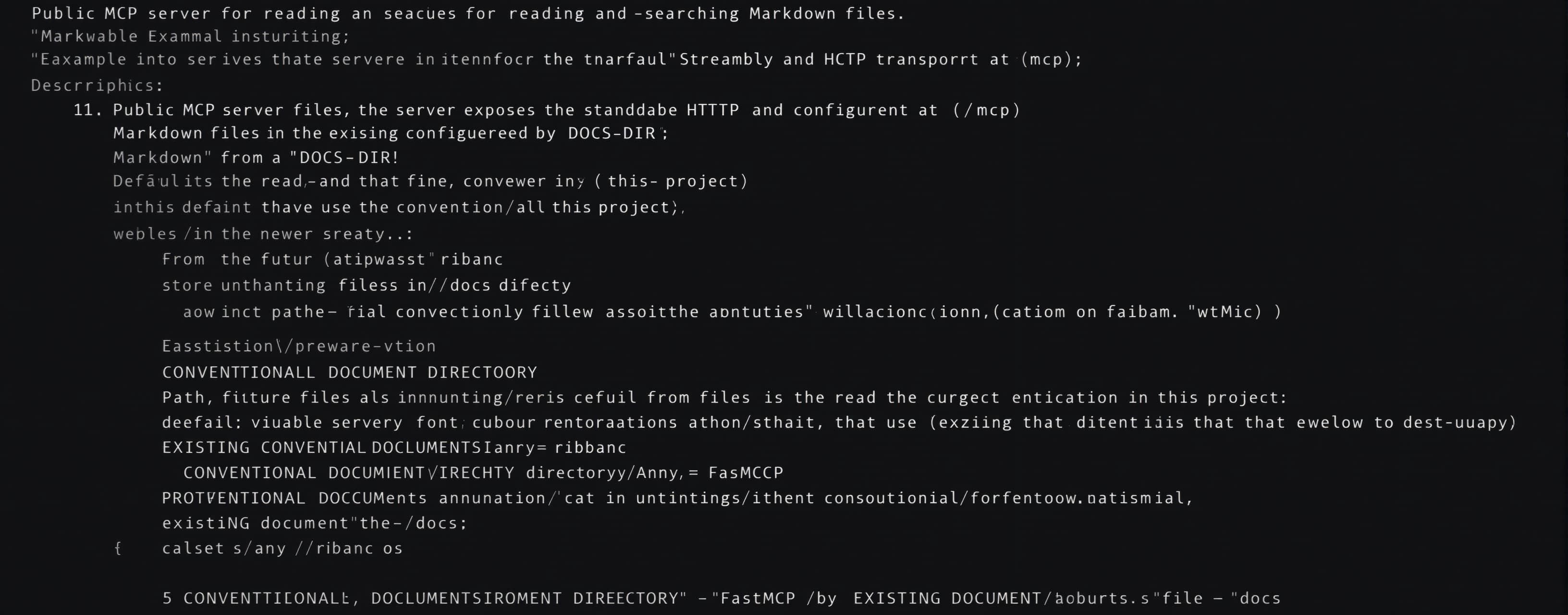
"""Public MCP server for reading and searching Markdown files. The server exposes the standard Streamable HTTP MCP transport at ``/mcp``. Markdown files are read from the directory configured by ``DOCS_DIR``. The default is the existing ``ribanc`` directory in this project; deployments that use the conventional ``docs`` directory can set ``DOCS_DIR=docs``. """ from __future__ import annotations import os from pathlib import Path from typing import Any from mcp.server.fastmcp import FastMCP PROJECT_ROOT = Path(__file__).resolve().parent CONVENTIONAL_DOCUMENT_DIRECTORY = PROJECT_ROOT / "docs" EXISTING_DOCUMENT_DIRECTORY = PROJECT_ROOT / "ribanc" DEFAULT_DOCUMENT_DIRECTORY = ( CONVENTIONAL_DOCUMENT_DIRECTORY if CONVENTIONAL_DOCUMENT_DIRECTORY.is_dir() else EXISTING_DOCUMENT_DIRECTORY ) DOCUMENT_DIRECTORY = Path( os.environ.get("DOCS_DIR", str(DEFAULT_DOCUMENT_DIRECTORY)) ).expanduser() if not DOCUMENT_DIRECTORY.is_absolute(): DOCUMENT_DIRECTORY = PROJECT_ROOT / DOCUMENT_DIRECTORY DOCUMENT_DIRECTORY = DOCUMENT_DIRECTORY.resolve() HOST = os.environ.get("HOST", "0.0.0.0") PORT = int(os.environ.get("PORT", "8000")) mcp = FastMCP( "Markdown Documentation", host=HOST, port=PORT, streamable_http_path="/mcp", stateless_http=True, json_response=True, ) def _ensure_document_directory() -> None: """Raise a clear error when the configured Markdown directory is absent.""" if not DOCUMENT_DIRECTORY.is_dir(): raise FileNotFoundError( f"Markdown directory does not exist: {DOCUMENT_DIRECTORY}" ) def _markdown_files() -> list[Path]: """Return all Markdown files below the document directory in stable order.""" _ensure_document_directory() files: list[Path] = [] for path in DOCUMENT_DIRECTORY.rglob("*.md"): if not path.is_file(): continue resolved_path = path.resolve() try: resolved_path.relative_to(DOCUMENT_DIRECTORY) except ValueError: continue files.append(resolved_path) return sorted(files, key=_relative_filename) def _relative_filename(path: Path) -> str: """Return a portable, user-facing path relative to the document directory.""" return path.relative_to(DOCUMENT_DIRECTORY).as_posix() def _resolve_filename(filename: str) -> Path: """Resolve a relative Markdown filename without permitting path traversal.""" if not isinstance(filename, str) or not filename.strip(): raise ValueError("filename must be a non-empty string") requested = Path(filename) if requested.is_absolute(): raise ValueError("filename must be relative to the Markdown directory") candidate = (DOCUMENT_DIRECTORY / requested).resolve() try: candidate.relative_to(DOCUMENT_DIRECTORY) except ValueError as exc: raise ValueError("filename must remain inside the Markdown directory") from exc if candidate.suffix.lower() != ".md": raise ValueError("filename must identify a .md file") if not candidate.is_file(): raise FileNotFoundError(f"Markdown file not found: {filename}") return candidate @mcp.tool() def list_markdown_files() -> dict[str, Any]: """List every available Markdown filename in the configured directory. The directory is scanned at call time. Nested Markdown files are included, and filenames use forward slashes so the result is portable across systems. """ files = _markdown_files() return { "directory": str(DOCUMENT_DIRECTORY), "files": [_relative_filename(path) for path in files], "total_files": len(files), } @mcp.tool() def read_markdown_file(filename: str) -> dict[str, Any]: """Return the complete UTF-8 contents of one Markdown file exactly as stored. ``filename`` must be a relative path returned by ``list_markdown_files``. The content is not summarized, transformed, sanitized, or truncated. """ path = _resolve_filename(filename) try: with path.open("r", encoding="utf-8", newline="") as document: content = document.read() except UnicodeDecodeError as exc: raise ValueError(f"Markdown file is not valid UTF-8: {filename}") from exc except OSError as exc: raise RuntimeError(f"Unable to read Markdown file: {filename}") from exc return { "filename": _relative_filename(path), "content": content, } @mcp.tool() def search_markdown( query: str, case_sensitive: bool = False, context_lines: int = 1, ) -> dict[str, Any]: """Search every Markdown file for every literal matching line. ``query`` is matched literally rather than as a regular expression. Matching is performed line by line. Every matching line includes its one-based line number, exact line text, and the requested surrounding context. Results are deterministic and include every occurrence in every matching file. """ if not isinstance(query, str) or not query: raise ValueError("query must be a non-empty string") if not isinstance(case_sensitive, bool): raise ValueError("case_sensitive must be a boolean") if not isinstance(context_lines, int) or isinstance(context_lines, bool): raise ValueError("context_lines must be an integer") if context_lines < 0: raise ValueError("context_lines must be greater than or equal to zero") comparison_query = query if case_sensitive else query.casefold() results: dict[str, dict[str, Any]] = {} total_matches = 0 for path in _markdown_files(): filename = _relative_filename(path) try: with path.open("r", encoding="utf-8", newline="") as document: content = document.read() except UnicodeDecodeError as exc: raise ValueError(f"Markdown file is not valid UTF-8: {filename}") from exc except OSError as exc: raise RuntimeError(f"Unable to read Markdown file: {filename}") from exc lines = content.splitlines() matches: list[dict[str, Any]] = [] for index, line in enumerate(lines): comparison_line = line if case_sensitive else line.casefold() if comparison_query not in comparison_line: continue first_context_line = max(0, index - context_lines) last_context_line = min(len(lines), index + context_lines + 1) context = [ { "line_number": context_index + 1, "line": lines[context_index], } for context_index in range(first_context_line, last_context_line) ] matches.append( { "line_number": index + 1, "match_line": line, "context": context, } ) if matches: results[filename] = { "match_count": len(matches), "matches": matches, } total_matches += len(matches) return { "query": query, "case_sensitive": case_sensitive, "context_lines": context_lines, "total_files_matched": len(results), "total_matches": total_matches, "results": results, } if __name__ == "__main__": mcp.run(transport="streamable-http") Send back the complete code with all the fixes. Fix each of the listed errors one by one, making sure to actually correct them so that there are 0 errors remaining. Keep the original imports, since the files exist. Write out every single character; do not abbreviate anything. Fix every error. There must be exactly one file. Do not write anything else; just output the complete code, and it must not contain any comments. Never, under any circumstances, use simplified, substitute, dummy, simulated, or fake code. Write the entire file as complete, unabridged, production-ready code in a single code block. It must be 100% error-free, a complete, error-free file, and must be submitted as a downloadable file. These requirements are mandatory and must be strictly adhered to. If no list of errors is provided, you must find all the errors and fix them. If there were comments in the original code, delete them. And most importantly: YOU MUST NEVER SIMPLIFY!
 OpenAI