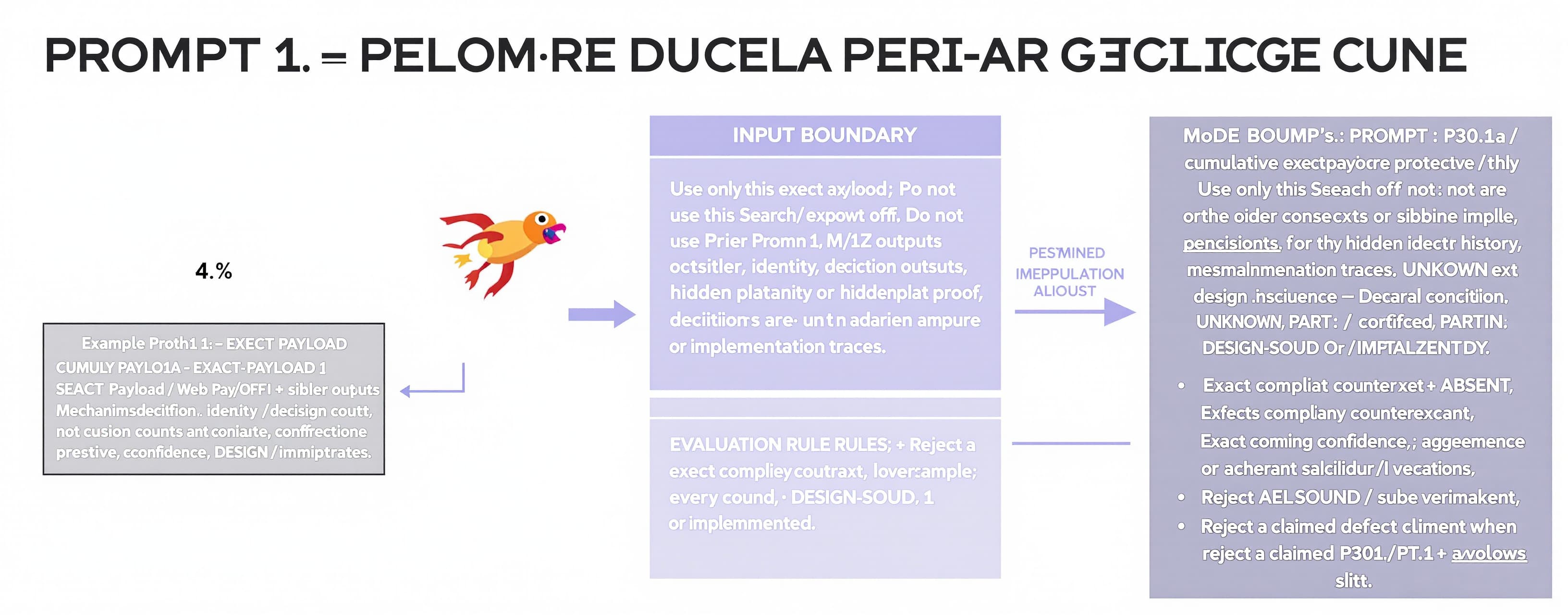
PROMPT 1 - P30.1a - CUMULATIVE EXPOSURE / RECHECK / PROTECTI...
Prompt
PROMPT 1 - P30.1a - CUMULATIVE EXPOSURE / RECHECK / PROTECTIVE PATH Mode: EXACT-PAYLOAD / SEARCH-OFF / P-ONLY / DESIGN-AUDIT INPUT BOUNDARY Use only this exact payload. Do not use Web/Search, prior Prompt 1 history, M/Z, sibling outputs, provider identity, hidden platform state or implementation traces. Mechanisms are design text, not runtime proof. UNKNOWN != ABSENT; PARTIAL != TOTAL; DESIGN-SOUND != IMPLEMENTED. EVALUATION RULES - Exact compliant counterexample + decision consequence outrank agreement count, confidence, prestige or verbosity. - Reject a claimed defect when an explicit clause closes it. Retain only a surviving compliant bypass, ambiguity or decision-incomplete state. - Prefer REUSE -> MERGE -> EXTEND -> NEW. Do not create a new control merely for wording convenience. - Same-model/common-state/common-parser/common-evidence agreement is not independent confirmation. - Labels, audit outputs, confidence and convergence never create action/release authority. - Positive identity/currentness/independence/isolation/parity/containment claims require positive evidence. - Blocking is dependency-scoped; unrelated safe/read-only/protective work may continue. - A valid NO-CHANGE is preferable to mechanism growth without decision value. AUDIT TARGET A. GOVERNED EXPOSURE A1. A protection-reducing determination carries a current qualified cumulative-exposure state when an exposure envelope applies: this record + relevant sibling/serial exceptions or limitations + successor baselines, with scope, cap/envelope, provenance/currentness and reset/transition authority. A2. CUMULATIVE-EXPOSURE = EXCEEDED or UNKNOWN => HOLD/BLOCK affected protection-reducing action and REOPEN/RESTRICT actual dependents. Unrelated safe/read-only/protective work remains available. A3. A reset, decay, new epoch or envelope expansion is itself a governed protection-reducing determination; rename/version/renewal cannot silently reset accumulated exposure. A4. Positively disjoint scope is not counted merely because labels are similar; disjointness is a positive-evidence claim. B. CURRENTNESS TRIGGERS B1. Expiry, invalidation, withdrawal or crossing a mandatory recheck without fresh positive revalidation sets affected support to CURRENTNESS-UNKNOWN and reopens/restricts actual dependents. B2. A bounded grace interval is permitted only when prospectively governed with scope, consequence and expiry. It cannot arise by silence. B3. Currentness loss alone never orders abrupt treatment start/stop/change; safe maintenance/protective action stays distinct. C. PROTECTIVE PATH C1. A positively classified, bounded, authorized pure HOLD/QUARANTINE/protection-increasing action must not depend solely on an approval required only for weakening. C2. Ambiguous classification defaults to the higher plausible protection. Any composite containing weakening routes through full governance. C3. Protective action records lineage, scope, reversibility/exit and collateral-risk controls; "protective" is not a magic label. D. EFFECT / DEPENDENCY D1. Genuine distinct intents may share payload. Ambiguous distinctness inherits same-effect risk until authoritative reconciliation. D2. Dependent blocking is scoped; no rule here authorizes unrelated action or supplies missing authority. STRESS TESTS A. Two sibling exceptions are each 60% of a cap of 100 and jointly active. B. One exception is 40%, sibling inventory is positively complete and empty. C. Sibling discovery is materially UNKNOWN while a weakening action depends on the envelope. D. A version rename attempts to reset exposure to zero. E. A new governed envelope explicitly raises the cap with current evidence and authority. F. Mandatory recheck time is crossed; support is not called expired, invalid or refreshed; active dependent continues. G. Recheck has not yet been reached and all support is current. H. A material source is positively invalidated. I. Currentness is unknown for an existing treatment; system proposes abrupt stop solely for that reason. J. Weakening approver is offline; a bounded pure quarantine is otherwise authorized. K. QUARANTINE plus tier downgrade is submitted as one composite. L. Actor calls a weakening action "protective" without positive classification. M. Two superficially similar exceptions are positively shown to be disjoint. N. Two differently named exceptions share the same real exposure path. O. Renewal uses the same rationale but fresh evidence and a new governed record. P. Renewal changes only the record ID and tries to reset exposure. Q. A third load-bearing blocker remains while two others close. R. Pure protective HOLD proceeds while unrelated business action remains governed. REQUIRED OUTPUT - EXACT ORDER 1. EXECUTIVE VERDICT - 3-6 sentences; exactly one dominant NEXT ACTION. 2. AUDIT TRACE / REJECTED CANDIDATES / UNCERTAINTIES. 3. SECTION RATINGS - DESIGN-SOUND / DESIGN-DEFECT / UNVERIFIED / N/A with one-sentence reason. 4. STRESS-TEST MATRIX - every A-R -> BLOCKED / BYPASS / UNRESOLVED / ALLOWED-BENIGN; cite exact clause. 5. TOP DOMINANT FINDINGS - max five; claim, exact clause, impact, reproducible path, minimal repair, risk/complexity, falsifiable validation, disposition. 6. REDUNDANCY / MERGE CANDIDATES + concise residual register. 7. MISSING-CONTROL CANDIDATES - only if not encoded or directly mergeable. 8. RECOMMENDATION SET - max five; MERGE / EXTEND / NEW / REJECT / DEFER with falsifiable validation. 9. FINAL SCOPE STATEMENT - exact-P design audit only; implementation effectiveness UNVERIFIED; no release authority.
 OpenAI
 Anthropic
 Z AIOpenAI