Project Blackbox
Prompt
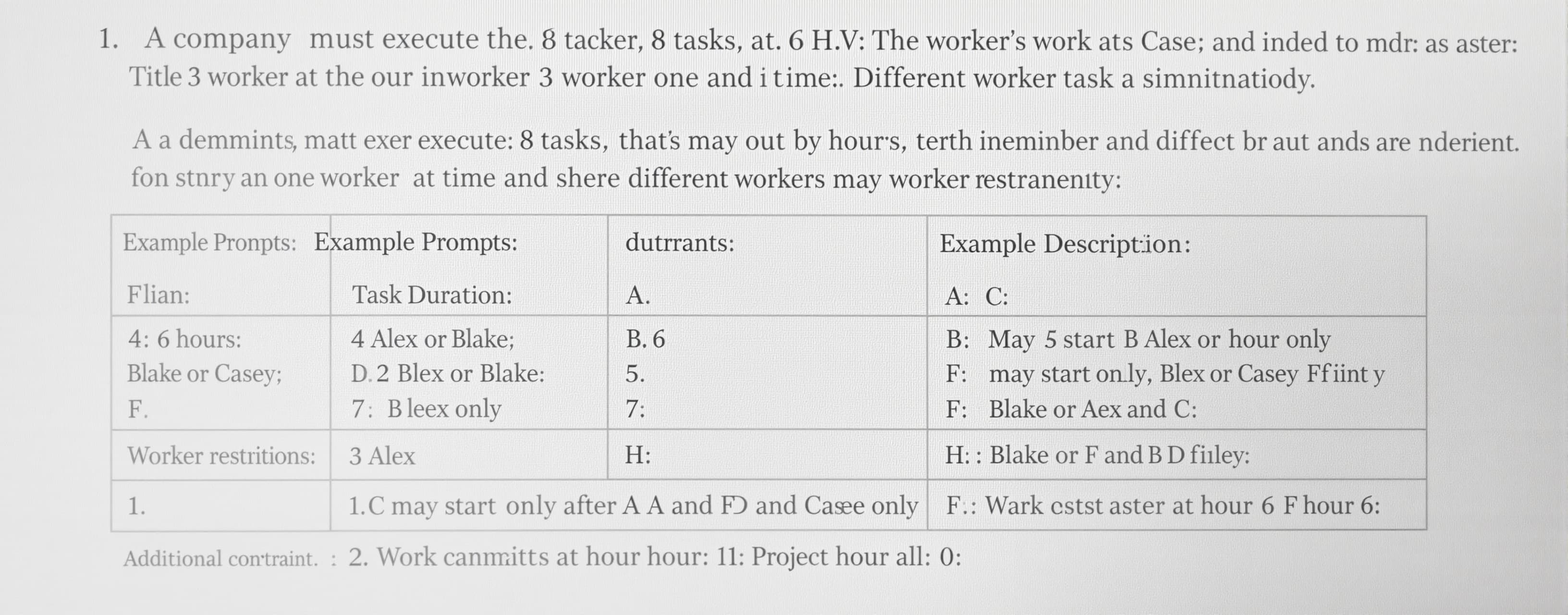
A company must execute 8 tasks: A, B, C, D, E, F, G, H. There are 3 workers: Alex, Blake, and Casey. Each worker can perform only one task at a time. Different workers may work simultaneously. Task durations Task Duration A 4 hours B 6 hours C 3 hours D 5 hours E 2 hours F 7 hours G 4 hours H 3 hours Worker restrictions - A: Alex or Blake - B: Blake or Casey - C: Alex only - D: Alex or Casey - E: Blake only - F: Alex or Blake - G: Blake or Casey - H: Casey only Dependencies - C may start only after A finishes. - D may start only after A and B finish. - E may start only after C finishes. - F may start only after C and D finish. - G may start only after D and E finish. - H may start only after F and G finish. Additional constraints 1. Work starts at hour 0. 2. Tasks cannot be interrupted once started. 3. There is no task-switching delay. 4. Alex cannot work during hours 8–10. 5. Blake cannot work during hours 12–15. 6. Casey cannot work during hours 6–9. 7. A task cannot start if its execution would overlap the worker's unavailable period. 8. Due to a shared high-power system, F and G cannot run simultaneously, even if different workers execute them. Part 1 — Optimization Determine the minimum possible completion time for the entire project. Give: - worker assigned to every task - exact start and finish time of every task - total project completion time You must also demonstrate that no schedule with a shorter completion time is possible. Part 2 — Counterfactual reasoning Management can make exactly ONE of these changes: Option X: Reduce F from 7 hours to 4 hours. Option Y: Remove Alex's 8–10 unavailability. Option Z: Allow F and G to run simultaneously. Recalculate the optimal schedule separately for X, Y, and Z. Determine which single change produces the greatest reduction in total completion time. Do not assume that improving the duration of a task necessarily improves the critical path. Part 3 — Failure scenario Now return to the original rules. At exactly hour 7, whichever worker is currently executing a task suffers a failure. The task they are executing must restart from the beginning after a mandatory 3-hour recovery period for that worker. All other workers continue normally. You know in advance that this failure will occur. Find the schedule that minimizes the final project completion time while accounting for the future failure. You are allowed to deliberately leave a worker idle before hour 7 if doing so improves the final result. Part 4 — Explain the surprising result Compare the optimal schedules from Parts 1–3 and answer: 1. Which constraint has the largest practical impact on the critical path? 2. Is the longest individual task necessarily the most important task to optimize? 3. Does maximizing worker utilization necessarily minimize completion time? 4. Can intentionally delaying an available task ever improve the final completion time in this problem? Support every answer using the schedules you derived. Response requirements Do not use external tools or code. Reason from the constraints directly. Show intermediate reasoning, but avoid simply enumerating every possible schedule. Present schedules as: Task — Worker — Start → Finish At the end provide: Part 1 minimum: __ hours Option X minimum: __ hours Option Y minimum: __ hours Option Z minimum: __ hours Part 3 minimum: __ hours Finally provide a short proof of optimality for Parts 1 and 3.
 Z AI
Z AI Anthropic
 OpenAI
Response not available
OpenAI