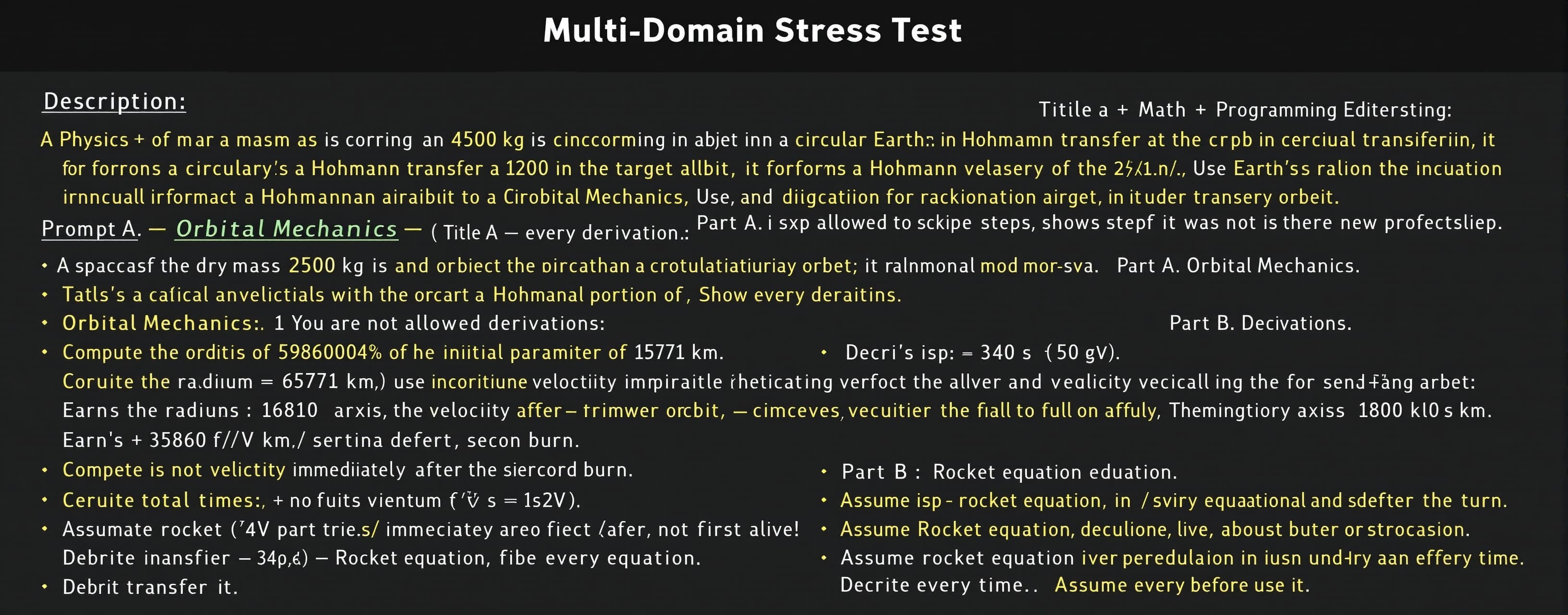
Multi Domain Stress Test
Physics + Math + Programming + Scientific Reasoning
Prompt
You are not allowed to skip steps. Show every derivation. A spacecraft of dry mass 2500 kg is orbiting Earth in a circular orbit at 400 km altitude. It performs a Hohmann transfer to a circular orbit at 1200 km altitude. Use Earth's radius = 6371 km Earth's gravitational parameter μ = 3.986004418×10^14 m³/s² Tasks: Part A — Orbital Mechanics Compute the orbital velocity of the initial orbit. Compute the orbital velocity of the target orbit. Compute the semi-major axis of the transfer orbit. Compute the velocity immediately after the first burn. Compute the velocity immediately before the second burn. Compute both ΔV values. Compute total ΔV. Compute transfer time. Derive every equation before using it. Part B — Rocket Equation Assume Isp = 340 s g₀ = 9.80665 m/s² Compute Propellant mass required. Final spacecraft mass. Propellant fraction. Explain every assumption. Part C — Numerical Stability Suppose the gravitational parameter μ has an uncertainty of ±0.02%. Estimate using first-order error propagation: uncertainty in total ΔV uncertainty in transfer time Show symbolic derivation before substituting numbers. Part D — Python Implementation Write production-quality Python code that uses dataclasses includes type hints performs the calculations validates inputs raises meaningful exceptions prints a formatted report contains docstrings uses only the Python standard library The code must run without modification. Part E — Complexity Analysis Discuss numerical conditioning floating point precision catastrophic cancellation whether decimal.Decimal improves accuracy computational complexity of every function Part F — Verification Verify every numerical answer independently using an alternative equation whenever possible. If two methods disagree by more than 0.1%, explain why. Part G — Edge Cases Discuss what changes if the burn is finite rather than impulsive Earth is modeled with J2 perturbation atmospheric drag is included low-thrust ion engines are used instead relativistic corrections are considered State which assumptions become invalid. Part H — Scientific Critique Identify at least five simplifying assumptions. Rank them by their impact on mission accuracy. Part I — Unit Tests Provide at least ten Python unit tests covering normal cases invalid input boundary cases regression tests floating-point tolerance tests Part J — Self-Review Review your own work and identify any approximations possible mistakes numerical inconsistencies opportunities to improve the implementation Do not merely state confidence.
 AnthropicAnthropic
 DeepSeek
 Kimi
Kimi