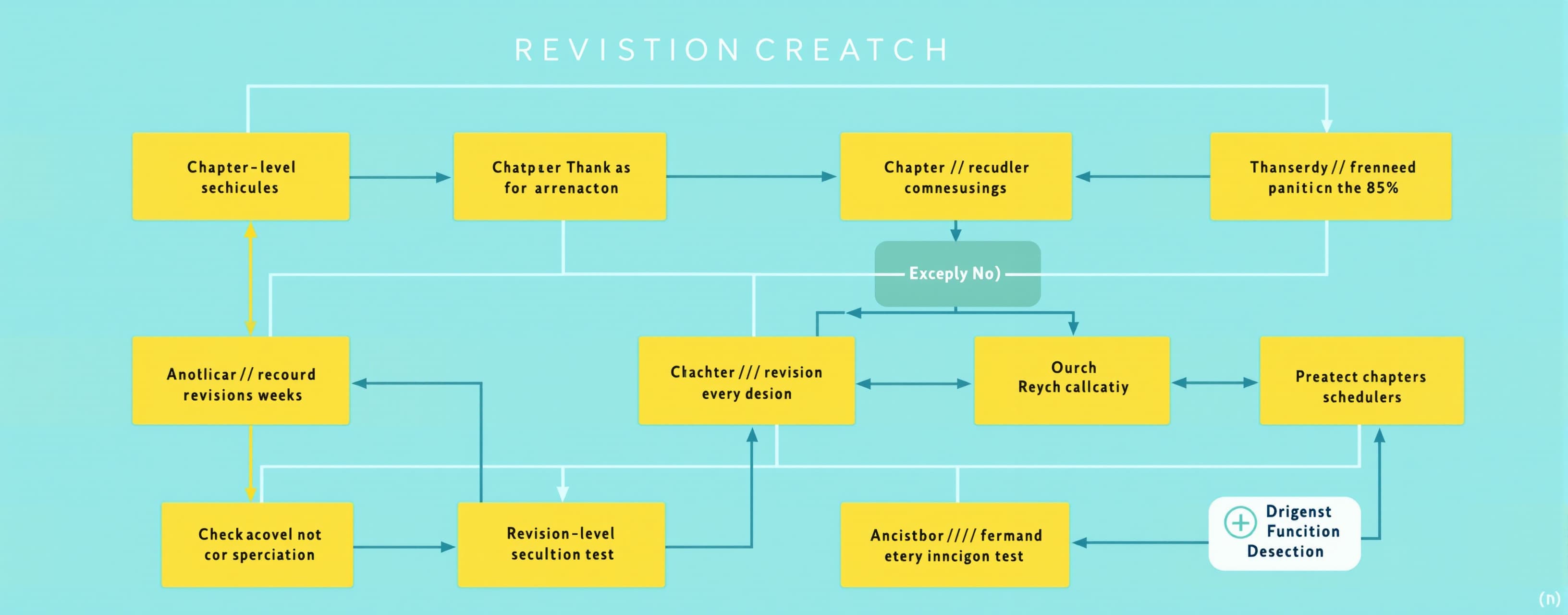
I want your help designing a **chapter-level revision schedu...
Prompt
I want your help designing a **chapter-level revision scheduler for a Biology curriculum, preparing for a fixed-date competitive exam about a year and a half away.** I've already decided on some parts of the system — do not redesign the whole thing. Focus specifically on the revision-scheduling problem below and challenge my assumptions where necessary. ## What's already decided * **Flashcards (Anki) run separately every day** and handle their own scheduling. This scheduler should NOT manage flashcards. * **Every week**, I take one large test covering all chapters completed so far. This gives me **chapter-wise performance data** (e.g. "Cell Cycle: 85%"). I don't want to run separate tests just to feed the scheduler — the weekly test is the only signal. * When a chapter is finished being taught, it enters the revision system. ## The problem For each chapter, the scheduler must decide: **when should I revise it again?** I do NOT want fixed intervals (Day 1 → 7 → 14 → 30) unless research shows that's actually appropriate. I want a schedule based on a defensible model of forgetting and spaced repetition — adjusted using real performance data, not just a lookup table. ## The core idea A **baseline schedule** (based on time since last revision, number of past revisions, how much exam-prep time is left, and how many chapters are currently in the system) that gets **nudged by weekly test evidence**, without overreacting to single data points. Example patterns and what they should imply: - 88%, 91%, 89%, 92% → retention stable, schedule is working, don't over-revise - 92%, 87%, 74%, 61% → real deterioration, bring the next revision forward - 72%, 85%, 93%, 95% → chapter stabilizing, allow progressively longer intervals A single bad week should not swing the schedule dramatically — I want the system to detect a **trend**, not react to noise. Conceptually: **baseline spaced-repetition model + revision history + weekly test score + current syllabus size + time until exam → next revision date** ## New vs. old chapters A chapter completed yesterday with 0 revisions should behave very differently from one completed 6 months ago, revised 5 times, consistently scoring 90%+. The second chapter shouldn't get re-scheduled just because it's "old" — but if an old, previously-strong chapter starts declining, it should become high priority again. ## Growing workload New chapters keep entering the system throughout the year (few chapters early on, eventually the entire syllabus). The scheduler has to balance **learning new material** against **maintaining old material** without eventually demanding an impossible daily revision load. ## The fixed deadline There's a hard exam date at the end. This isn't indefinite spaced repetition — every chapter needs to peak in recall right around the exam. Long gaps early in prep may be fine; revision frequency should probably increase as the exam approaches. ## What I want you to answer 1. **What's the best mathematical foundation?** Should I adapt FSRS, SM-2, Leitner, a classic forgetting-curve model, something custom, or a hybrid? Note: FSRS is designed for individual flashcards with huge review volume — I have ~40 chapters and roughly one test signal per chapter per week. What's actually appropriate given that little data? 2. **Can a chapter-level test score be a reasonable proxy for retention?** E.g. if I score 85% on a 30-question sample of a chapter, what can I actually infer? How noisy is this measurement, and how should guessing/question difficulty be accounted for? 3. **Most important: how should the scheduler tell real memory decline apart from normal test-score noise?** - 85%, 82%, 87%, 84% → probably stable - 94%, 88%, 79%, 68% → probably real decline Should this use moving averages, confidence intervals, trend detection, exponentially weighted scores, Bayesian updating, or something else? 4. **How much should a weekly score actually move the schedule?** I don't want "score moved 5% → recompute everything." I want evidence-based correction: stable high scores → schedule mostly unchanged or intervals grow; gradual decline → interval shortens; a major unexpected drop → interval shortens a lot; repeated strong performance → intervals can grow further. How should this be formalized? 5. **How should the fixed exam date modify scheduling over time** — i.e., how should the system transition from long-term spacing optimization early on to exam-day-retention optimization as the date approaches? ## Constraint This is a system for **one student**, not a platform with millions of users and huge datasets. A theoretically elegant model I can't actually calibrate from my own sparse data isn't useful. I want: **simple + mathematically defensible + adaptive + interpretable** over: **complex + impressive + impossible to calibrate.** ## Your task Don't build the tracker yet — first solve the algorithm itself. Give me: 1. the recommended model 2. the mathematical reasoning behind it 3. the minimum data I need to collect 4. how weekly test scores should update the model 5. how to detect genuine retention decline vs. noise 6. how the fixed deadline should modify scheduling over time 7. a worked example using 3–4 hypothetical chapters And most importantly: **is my overall framing of this problem sound, or is there a better way to formulate it?**
