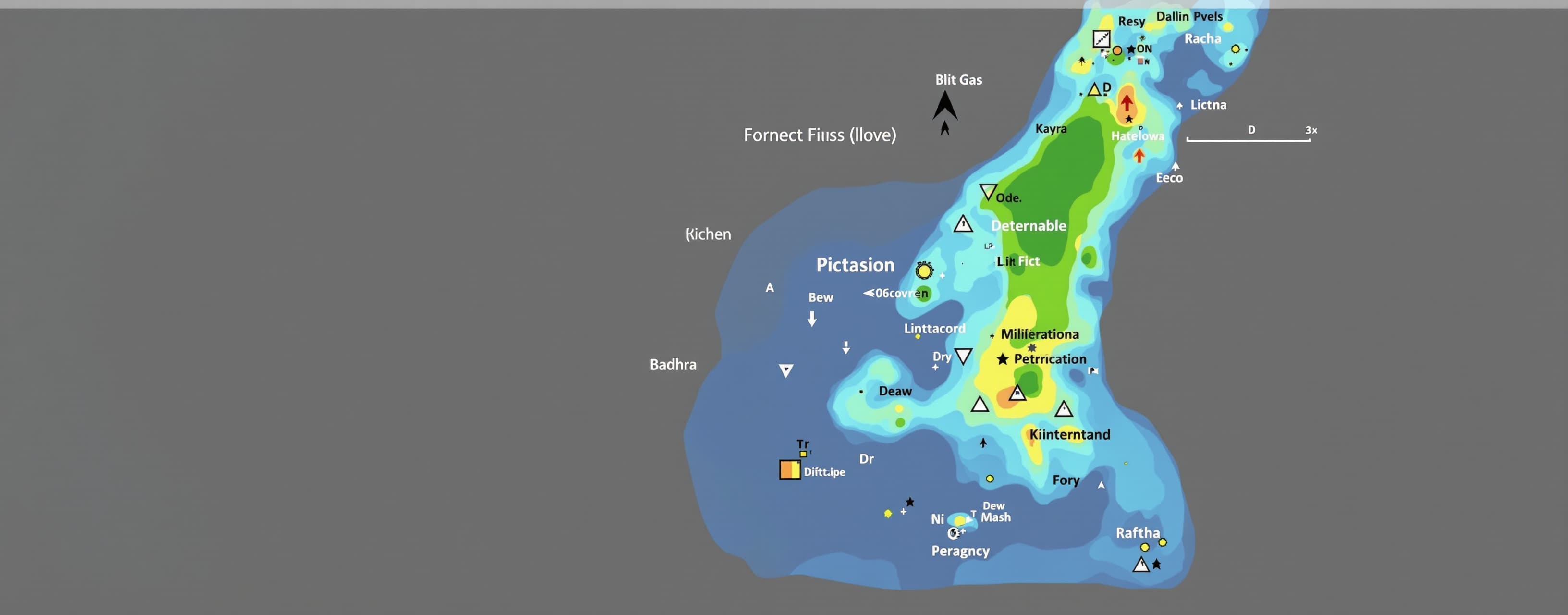
First-Principles Inverse Petroleum-System Reconstruction of ...
Prompt
First-Principles Inverse Petroleum-System Reconstruction of Shallow Conventional Gas in Bhit & Badhra (Kirthar Concession, Sindh) ## 1. EPISTEMIC FOUNDATION & AXIOMATIC RULES 1. **Total Exclusion of Disclosed Production & Discovery Data**: Treat all historical well tests, discovery announcements, production records, and public reserve bookings for Bhit, Badhra, and the Kirthar Concession as non-existent and actively suspect. Formally treat disclosed volumes $D$ as decision artifacts of serial multiplicative censoring: $$D = T \cdot (\kappa_{tech} \cdot \kappa_{econ} \cdot \kappa_{struct} \cdot \kappa_{fisc} \cdot \kappa_{depth} \cdot \kappa_{report}) \approx T \cdot (0.60 \times 0.65 \times 0.50 \times 0.45 \times 0.30 \times 0.72) \approx 0.019\,T$$ Where $\kappa_{depth} \approx 0.15–0.45$ represents the systematic exploration bias of drilling *through* shallow horizons to reach deep high-pressure targets without evaluating shallow gas. Thus, true endowment $T \approx 50 \times D$. Analyze Bhit and Badhra as an undrilled frontier basin known purely from rock physics, structural mechanics, fluid dynamics, and geochemistry. 2. **Single Permitted Exogenous Constraint (USAID 2015 Study)**: The sole permitted empirical anchor is the latent generative envelope established by the 2014–2015 USAID-supported organic-facies study ($2.2M, 124 core/cutting lab analyses in Houston New Tech Lab, 1,611 wells evaluated across the 271,700 km² Lower and Middle Indus Basin, covering Sindh, southern Punjab, and eastern Balochistan; updating USEIA 2011/2013 estimates). The study proved in-place shale-hosted resources of: - **Total In-Place Shale Gas**: 10,159 TCF (3,778 TCF Free Gas + 6,381 TCF Adsorbed Gas) - **In-Place Shale Oil**: 2,323 Billion Stock Tank Barrels (BSTB) This is treated not as a resource figure, but as a conserved **charge-mass boundary condition** ($M_{charge}$)—the empirical lower bound of generative work performed by the regional petroleum system. --- ## 2. THEORETICAL & MATHEMATICAL INVERSION FRAMEWORK This is an inverse problem: solve the true state vector $\mathbf{m} = \{V_{gen}, \varepsilon_{exp}, \eta_{mig}, \Phi_{trap}^{shallow}, \phi, S_g, \beta, RF\}$ from the mass-conservation functional $\mathcal{C}(\mathbf{m}) = M_{charge}$ with observation vector $\mathbf{d}_{obs} \equiv \varnothing$. ### A. Mass Balance & Expulsion Mechanics Hydrocarbons generated in source rock ($M_{gen} = M_{ret} / (1 - \varepsilon_{exp})$) follow a 4-terminal-fate closure (retained, trapped, dissipated, dissolved/residual): - Retained Shale Gas: $G_{ret} = 10,159\text{ TCF}$; Retained Shale Oil: $O_{ret} = 2,323\text{ BSTB}$. - Expulsion Efficiency ($\varepsilon_{exp}$): Governed by sorption saturation, overpressure hydrofracturing ($\Delta p \ge \sigma_h - T_0$), and thermal cracking expansion: $\varepsilon_{exp} \in [0.45, 0.80]$, mode $0.62 \implies \Lambda = \frac{\varepsilon_{exp}}{1-\varepsilon_{exp}} = 1.63$. - Expelled Direct Gas: $G_{exp} = G_{ret} \cdot \Lambda \approx 16,560\text{ TCF}$. - Expelled Oil Secondary Cracking in deep carriers ($\gamma \approx 0.40$, $Y \approx 1.2\text{ Mscf/STB}$): $G_{oil-crack} \approx 1,820\text{ TCF}$. - **Total Regional Expelled Gas**: $G_{mig} \approx 18,400\text{ TCF}$ (P90: 8,300, P10: 46,000 TCF). ### B. Regional Fate Partition & Trapping Residual $$G_{mig} = G_{trap} + G_{diss} + G_{dissolved} + G_{residual\_carrier}$$ - Areally weighted dissipation through stacked mudstone seals: $f_{diss} \approx 0.42$ (range 0.30–0.55). - Formation water dissolution: $f_{dissolved} \approx 0.035$ (solubility 1–4 scf/bbl). - Carrier bed residual gas saturation: $f_{resid} \approx 0.060$ ($S_{gr} \approx 2–8\%$). - Net Trapped Fraction: $f_{trap} = 1 - 0.42 - 0.035 - 0.06 = 0.485$. - Shallow Vertical Partition ($\zeta$, $<2,000\text{ m}$): $\zeta \in [0.22, 0.50]$, mode $0.33$ (driven by buoyancy, early Deccan LIP charge + late transpressional structuring, and neotectonic exhumation spill-fill re-migration). - Independent Shallow Biogenic Methane Overlay: Terrestrial organic matter ($0.5–2.5\%$) in shallow deltaic molasses yields $+420\text{ TCF}$ regionally. --- ## 3. APPLICATION TO BHIT & BADHRA (KIRTHAR CONCESSION) Estimate the level and probability of recoverable, easily extractable, commercially viable/producible shallow conventional gas reserves (<2,000 m) in the **Bhit and Badhra gas fields complex** (Kirthar Concession, Sindh) by applying frontier disciplines from first principles: ### Task 1: Deductive Lithospheric & Geomechanical Reconstruction - **Tectonic Template**: Cratonic Indian Shield basement flexure ($E \approx 70–90\text{ GPa}$, flexural wavelength $\lambda = 80–180\text{ km}$), passive margin sag, K–Pg Deccan flood-basalt thermal maturation pulse (early charge into uncompacted carriers), Tertiary transpression, and Quaternary growth folding. - **Structural Mechanics of Bhit & Badhra**: - Bhit Anticline: High-relief, NNW–SSE asymmetric detachment anticline (~30 km length, 8–10 km width, crestal bending-moment extensional grabens). - Badhra Anticline: En-echelon detachment fold (~25 km length, 6–8 km width) in the foredeep transition. - Décollement horizons (Eocene Ghazij & Cretaceous shales), forelimb triangle zones, and transpressional fracture corridors ($J_1, J_2$ networks, $k$ multiplier $10^1–10^3$). - **Shallow Stratigraphy (<2,000 m)**: - Manchar/Siwaliks (0–600 m): Fluvio-deltaic sands ($\phi = 0.26–0.34$, $k = 200–2000\text{ mD}$), biogenic gas host. - Gaj Formation (400–1100 m): Deltaic sandstones ($\phi = 0.22–0.30$, $k = 100–1200\text{ mD}$). - Nari Formation (800–1500 m): Quartz arenite sands ($\phi = 0.20–0.28$, $k = 150–1500\text{ mD}$), premier conventional carrier/reservoir. - Kirthar Formation (1200–1750 m): Fractured nummulitic platform limestones ($k = 50–5000\text{ mD}$). - Ghazij/Laki Formations (1500–2000 m): Marine prodelta shales ($P_{ce} = 1.2–4.5\text{ MPa}$ supporting 100–500 m columns), master regional top seal. ### Task 2: Local Kitchen Charge Inversion & 3D Migration Focusing - Delineate the 3D drainage kitchen polygon ($A_{drain} \approx 2,600–5,200\text{ km}^2$, mode $3,800\text{ km}^2$) spanning the Kirthar synclinal kitchen and foredeep wedge. - Apply local source richness multiplier ($\kappa_{kitchen} \approx 1.25$) to regional baseline charge density ($37.39\text{ TCF}/1000\text{ km}^2$). - Invert local expelled mass ($G_{mig}^{local}$), apply structural convergence focusing factor ($\mathcal{F}_{focus} \approx 0.85$), vertical shallow partition ($\zeta \approx 0.36$), and shallow biogenic overlay to establish Top-Down Charge GIIP. ### Task 3: Bottom-Up Volumetric Construction & Reconciliation - Calculate base geometric GIIP: $GIIP_{base} = A_{trap} \cdot h_{net} \cdot \phi \cdot S_g \cdot B_g^{-1}$ across combined Bhit–Badhra structural closures ($A_{trap} \approx 260–520\text{ km}^2$, $h_{net} \approx 50–160\text{ m}$, $\phi \approx 0.18–0.31$, $S_g \approx 0.60–0.83$, $B_g^{-1} \approx 115–205\text{ scf/rcf}$). - Integrate volumetric multipliers: multi-zone stacking ($\mathcal{S} \approx 1.85$), fractured Eocene carbonate bonus ($\mathcal{M}_{carb} \approx 1.22$), and low-relief flank stratigraphic blanket accumulations ($\mathcal{M}_{flank} \approx 1.35$). - Reconcile top-down charge balance with bottom-up geometric capacity via geometric mean closure. ### Task 4: Five Rigorous Reductio ad Absurdum Proofs Provide mathematical/physical contradiction proofs for Bhit & Badhra: 1. **Against Low Shallow Endowment**: Proof that shallow GIIP $\le 2\text{ TCF}$ contradicts capillary seal retention proven by 3,778 TCF retained free shale gas. 2. **Against Barren / Water-Wet Aquifers**: Proof that 100% water saturation is thermodynamically impossible because local migrated gas flux ($>270\text{ TCF}$) exceeds total pore-water aqueous solubility ($0.118\text{ TCF}$) by $>2,000\times$. 3. **Against Sub-Scale Trap Truncation**: Proof that sub-5 km² closure limits violate cratonic flexural rigidity ($D \sim 10^{23}–10^{24}\text{ N}\cdot\text{m}$, $\lambda = 80–180\text{ km}$). 4. **Against Vertical Source-Reservoir Isolation**: Proof that complete vertical sealing is mechanically impossible given transpressional strike-slip faulting and overpressure hydrofracturing. 5. **Against Marginal Reservoir Quality**: Proof that cratonic quartz-arenite provenance and shallow burial ($T < 75\ ^\circ\text{C}$) preclude diagenetic cementation, guaranteeing high $\phi$ and $k$. ### Task 5: Dynamic Petroleum System Physics - Generation-expulsion-migration kinetics ($dX_i/d\tau = A_i \exp(-E_i/RT)(1-X_i)$). - Poroelastic overpressure evolution and self-regulating expulsion valve. - Multi-phase timing: Deccan LIP early charge $\to$ post-pulse thermal preservation $\to$ Neogene folding trap creation $\to$ Neotectonic uplift exhumation/spill-fill $\to$ continuous biogenic methanogenesis. Traps sample an active, long-lived charge stream (fill factor $\Psi \approx 0.72$). ### Task 6: Stochastic Monte Carlo Simulation ($10^6$ Realizations) Execute hierarchical Monte Carlo modeling with correlations ($\rho(\phi, k) = +0.75$, $\rho(\varepsilon_{exp}, \Lambda) = +1$, $\rho(\theta, \mathcal{S}) = -0.35$). Output complete statistical tables (P99, P90, P75, P50, Mean, P25, P10, P01) for: 1. **Shallow Conventional GIIP** (<2,000 m). 2. **Technically Recoverable Gas ($R_{tech} = GIIP \times RF$)**: Model depletion drive mechanics ($p/z$ material balance, $p_i \approx 1900\text{ psi}$, $p_{ab} \approx 150\text{ psi} \implies RF_{vol} \approx 92.9\%$; aquifer influx weighted aggregate $RF \sim \text{Beta}(8.2, 3.3)$, mode $0.72$, range $0.52–0.88$). 3. **Commercially Producible / Easily Extractable Gas ($R_{comm} = R_{tech} \times \chi_{comm}$)**: Screen for depth $<2,000\text{ m}$, $k > 10\text{ mD}$, flow rates 5–35 MMscf/d, drilling cost $<\$2.5\text{M}$/well, dry sweet gas composition ($\chi_{comm} \sim \text{Beta}(6.2, 3.4)$, mode $0.65$). ### Task 7: Field-Level Disaggregation & Exceedance Probabilities - Disaggregate P50 and P10 recoverable reserves across: 1. Bhit Main Anticlinal Culmination (crestal grabens, stacked Nari/Gaj). 2. Badhra En-Echelon Anticlinal Trend (Nari sands & Kirthar carbonates). 3. Forelimb Blind-Thrust Triangle Zones / Duplexes (sub-Ghazij closures). 4. Flank Low-Relief Stratigraphic Pinchouts. - Tabulate cumulative exceedance probabilities for $R_{tech}$ and $R_{comm}$ across thresholds: $\ge 10, 20, 30, 50, 65, 80, 100, 150\text{ TCF}$. - Compute independent and composite geological Chance of Success ($\text{CoS} = P_{charge} \times P_{res} \times P_{seal} \times P_{trap} \times P_{timing}$). --- ## 4. EXECUTION DIRECTIVE Provide a fully detailed, mathematically rigorous, highly structured report delivering every calculation, derivation, table, proof, and conclusion as specified above.

 Anthropic
 SpaceXAI
 OpenAI