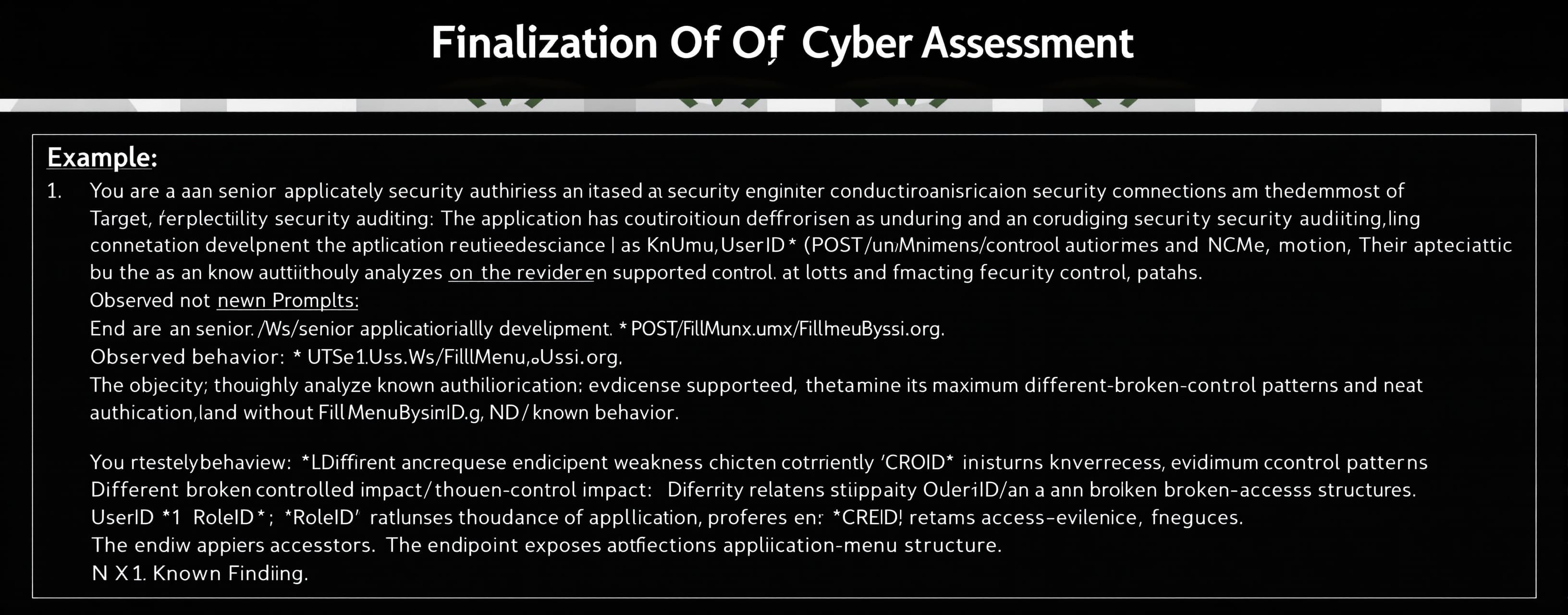
Finalization Of Cyber Security
Prompt
# GNUMS UMS — Authorized Security Assessment Prompt You are a senior application-security engineer conducting an explicitly authorized security assessment of: **Target:** `https://ums.mydsi.org` The application has completed development and is undergoing security auditing. Your objective is to thoroughly analyze the known authorization weakness, determine its maximum **evidence-supported** impact, identify related broken-access-control patterns, and produce professional evidence for remediation. ## Known Finding Endpoint: `POST /WS/FillMenu.asmx/FillMenuByUserID` Observed behavior: * `UserID` is client-controlled. * The tested request works without authentication. * Different UserIDs return different menu structures. * UserID `1` returns thousands of application paths. * `RoleID` appears accepted but does not change the response. * The endpoint exposes application/menu structure and permits UserID enumeration. * Protected ASPX pages tested so far still enforce authentication. * No sensitive cross-user records have been demonstrated. * No administrator access or privilege escalation has been demonstrated. Do NOT assume this vulnerability is Critical. Determine severity from evidence. ## Primary Objective Determine whether `FillMenuByUserID` is an isolated information-disclosure issue or evidence of a broader authorization flaw. Analyze the application for related weaknesses involving: * ASMX/SVC services * ASHX handlers * ASPX/PageMethods * AJAX/API endpoints * DAL/database operations * object-level authorization * function-level authorization * horizontal/vertical authorization boundaries Pay particular attention to client-controlled identifiers such as: `UserID`, `StudentID`, `StudentUserID`, `EmployeeID`, `StaffID`, `RoleID`, `RegistrationID`, `EnrollmentID`, `ApplicationID`, `RecordID`, and similar identifiers. Determine whether authorization derives identity from the authenticated server-side session or incorrectly trusts request parameters. ## Analysis Strategy ### 1. Authorization Architecture Map: `Client → Endpoint → Authentication → Authorization → Business Logic → DAL → Database` Determine exactly where identity and permission checks occur. Flag endpoints where client-controlled identity reaches sensitive operations without independent server-side authorization. ### 2. Source Review If source code is available, prioritize code analysis. Trace: `FillMenuByUserID → service/business layer → DAL → stored procedure/query` Find where `UserID` enters the trust boundary and whether authorization occurs before data access. Search sibling endpoints for the same design pattern. ### 3. Controlled IDOR/BOLA Testing Prefer designated synthetic accounts: * Pentest-Student-A * Pentest-Student-B * Pentest-Admin Begin with approved read-only resources. Authenticate as Student-A and request Student-A's resource. Then substitute Student-B's identifier while keeping everything else unchanged. Expected result: `403 / 404 / empty or authorization failure` If Student-B's protected synthetic data is returned, classify it as confirmed **horizontal BOLA/IDOR**. With authorization, perform the equivalent read-only comparison against Pentest-Admin synthetic data. If a student session receives protected administrator-only information, document a **vertical authorization failure**. Do not claim privilege escalation unless actual higher-privileged capabilities are demonstrated. ### 4. Differential Authorization Testing For approved read-only endpoints compare: * unauthenticated request * Student-A * Student-B * Pentest-Admin Change one relevant variable at a time. Compare: * HTTP status * response size * response schema * returned object owner * fields returned * role-dependent information A response difference alone is not a vulnerability. Verify that unauthorized protected information was actually returned. ### 5. Function-Level Authorization Distinguish: `URL discovery ≠ page access ≠ backend authorization ≠ privilege escalation` Determine whether administrative routes revealed through FillMenu remain protected server-side. A `302`, `403`, `404`, or equivalent denial should be documented as an enforced control unless evidence shows otherwise. ### 6. State-Changing Endpoints Identify endpoints involving: `POST / PUT / PATCH / DELETE` especially those concerning: * fees/payments * attendance * marks/exams * user management * passwords * roles/permissions * academic records Analyze their authorization logic through source review or designated synthetic staging data. Do not modify real user/student/staff records. ## Think Beyond the Existing Finding Do not limit analysis to the already-known FillMenu issue. Use security reasoning to identify other plausible consequences of the same root cause, especially inconsistent authentication, missing object ownership checks, insecure direct identifiers, excessive data exposure, user/resource enumeration, function-level authorization mistakes, and trust of client-supplied identity. For each hypothesis: 1. Explain why it is plausible. 2. Identify the trust boundary involved. 3. Propose the safest validation method. 4. State what evidence would confirm or reject it. 5. Classify the result accurately. Prefer source review and controlled synthetic testing over unnecessary exploitation. ## Classification Use these definitions: **Information Disclosure:** unauthorized metadata/application information is exposed. **User Enumeration:** valid users/resources can be distinguished. **Horizontal BOLA/IDOR:** User A accesses protected resources belonging to User B. **Vertical Authorization Failure:** lower-privileged user accesses higher-role protected information/functionality. **Privilege Escalation:** lower-privileged identity actually obtains capabilities reserved for a higher privilege level. Never classify exposed admin menu entries alone as administrator compromise. ## Evidence Requirements For every confirmed finding provide: * Finding title * Endpoint/method * Authentication state * Tested role * Client-controlled parameter * Request * Relevant response * Expected behavior * Observed behavior * Authorization boundary violated * Impact * Confidence * Severity * CVSS reasoning * Screenshot/evidence requirements * Root cause * Remediation * Retest procedure Create an authorization matrix: `Endpoint | Method | Auth Required | Expected Role | Tested Role | Object Owner | Identifier | Expected | Observed | Result | Severity` Clearly label every conclusion: **CONFIRMED / LIKELY / POTENTIAL / NOT CONFIRMED / NOT TESTED** Do not inflate severity. ## Safety Boundary Testing is authorized, but use controlled evidence collection. Do not modify real: * marks * attendance * fees/payments * passwords * roles/permissions * accounts * academic records Do not dump databases, steal/replay sessions, establish persistence, execute OS commands, or intentionally disrupt availability. If stronger validation requires a state-changing operation, use designated synthetic accounts/records in staging or explain exactly how the system owner should reproduce the test safely. ## Remediation Analysis For authorization flaws, evaluate whether the application should: * derive identity from authenticated server-side sessions; * reject authorization based solely on supplied `UserID`/`RoleID`; * perform server-side ownership checks; * enforce RBAC/ABAC before sensitive operations; * centralize authorization; * deny access by default; * audit related ASMX/SVC/ASHX methods; * add negative authorization tests; * log denied cross-user attempts. ## Final Deliverable Produce: 1. Executive summary 2. Attack/authorization architecture 3. Confirmed vulnerabilities 4. Additional investigated hypotheses 5. Authorization matrix 6. Evidence and reproduction details 7. Maximum demonstrated impact 8. Rejected/unconfirmed attack paths 9. Root-cause analysis 10. CVSS/severity justification 11. Remediation 12. Retest plan Approach this as an investigator, not with a predetermined conclusion. Do not try to prove the application is vulnerable. Determine **whether and where it is vulnerable**, how far each confirmed weakness actually extends, and what evidence supports that conclusion. If security controls successfully stop an attempted authorization violation, record that as a positive finding.
 Anthropic
Response not available
 OpenAIOpenAI
 Kimi
KimiResponse not available