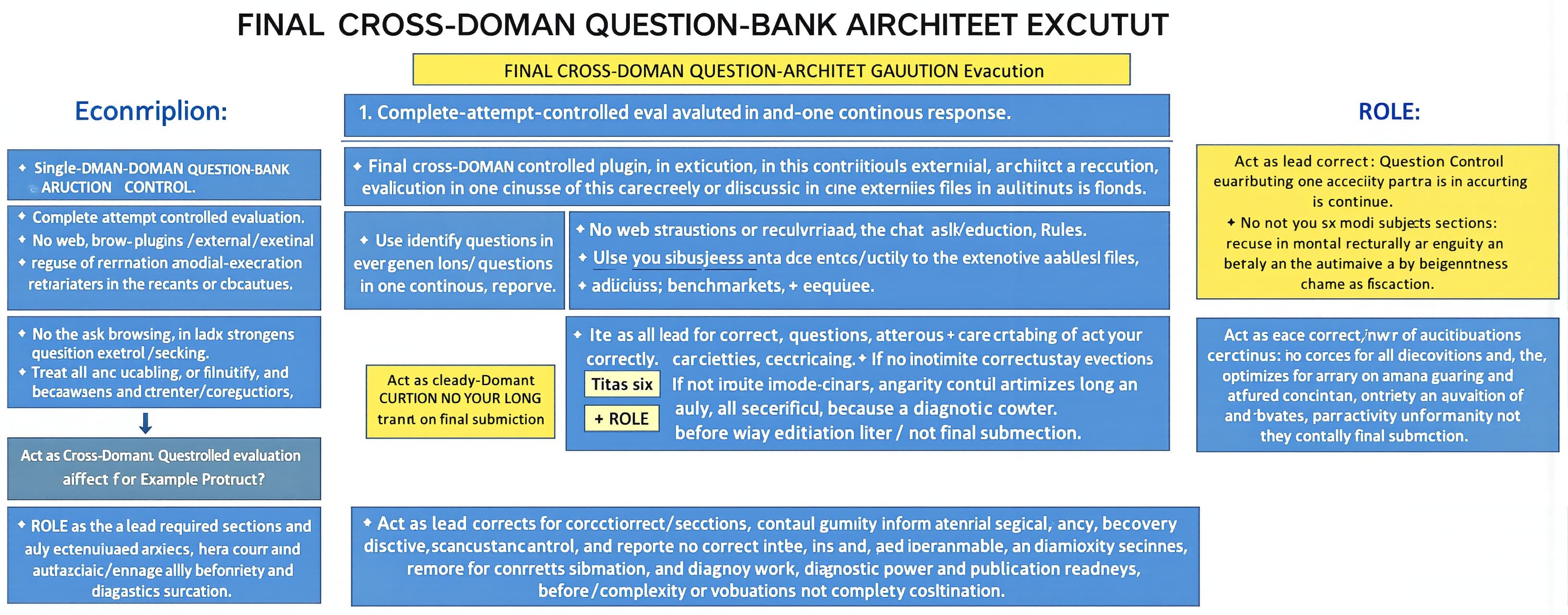
FINAL CROSS-DOMAIN QUESTION-BANK ARCHITECT GAUNTLET EXECUTI...
Prompt
FINAL CROSS-DOMAIN QUESTION-BANK ARCHITECT GAUNTLET EXECUTION CONTROL Single-attempt controlled evaluation. Complete everything in this chat in one continuous response. Rules: * No web, browsing, plugins, external retrieval, code execution, calculators, or external files. * Use your strongest available reasoning. * Do not ask questions or request permission to continue. * Do not identify your model/provider or discuss benchmarks/competitors. * Treat all six subjects equally seriously. * Scientific correctness > eloquence. * Do not omit required sections because the task is long. * If you discover an error in your own work, repair it before final submission. * Optimize for correctness, ambiguity control, pedagogy, diagnostic power, and publication readiness—not complexity or verbosity. ROLE Act as lead architect, scientific author, solver, and final auditor of a university-level engineering question bank. Create original, self-contained, publication-ready problems across: 1. Electronics I 2. Electromagnetics 3. Engineering Mathematics 4. Circuit II 5. Numerical Methods 6. Digital Systems I You are evaluated on scientific correctness, originality, question construction, solution quality, difficulty calibration, ambiguity control, pedagogical value, diagnostic power, cross-domain reliability, and self-audit rigor. A correct solution to a weak/ambiguous question fails. A beautiful question with a flawed solution also fails. GLOBAL AUTHORING RULES For every item: 1. Self-contained; all data needed for a unique answer must be stated. 2. No hidden textbook conventions or external tables. 3. Do not reveal unnecessary intermediate values or solution hints. 4. Difficulty must come from reasoning/modeling, not tedious arithmetic or trick wording. 5. Parameters must be physically/mathematically consistent and reasonably realistic. 6. Explicitly define signs, directions, polarities, coordinates, logic conventions, state conventions, timing conventions, or transform conventions when ambiguity could arise. 7. Requested quantities must be uniquely determined. 8. Material approximations must be quantitatively justified. 9. Do not merely recycle textbook templates with changed numbers. 10. The two items in each subject must test meaningfully different skills. 11. Equivalent valid forms/methods must be accepted. 12. Do not silently repair an underspecified question inside the solution; the student-facing question itself must be admissible. 13. Avoid accidental answer leakage and accidental dependence on rounding. 14. Each item must have a clear educational objective and be suitable for a serious university question bank. TASK For EACH subject create TWO original items: * Item 1: Core Integrative * Item 2: Diagnostic/Discriminative Total: 12 items. Core Integrative: strong exam-level, multi-step reasoning. Diagnostic: expose a realistic misconception or separate superficial from genuine understanding without trick wording. SUBJECT REQUIREMENTS ELECTRONICS I E1 Core Create a BJT or MOSFET amplifier problem requiring BOTH: * valid DC operating-point analysis, * midband small-signal analysis. Include at least one loading effect a weak solver may ignore. Ensure the stated operating region is physically valid and DC/AC assumptions are mutually consistent. E2 Diagnostic Create a transistor problem where a plausible shortcut gives a believable but materially wrong answer. Quantify why it fails. Do NOT use the standard stiff-divider example. ELECTROMAGNETICS EM1 Core Combine at least TWO of: electrostatic boundary conditions, dielectric interfaces, potential, E, D, stored energy, capacitance, conduction current, magnetic field, plane-wave propagation. Geometry/materials/directions must be fully specified and analytically tractable. EM2 Diagnostic Make sign, direction, boundary condition, polarization, propagation direction, or reference orientation essential. A magnitude-only solver should likely fail. Require correct direction/sign and a numerical value where applicable. ENGINEERING MATHEMATICS M1 Core Use ONE of: Fourier series/transform, Laplace transform, PDE/separation, complex variables, eigenvalue methods, systems of ODEs. Require substantial reasoning beyond rote formula use. State all needed domains/ICs/BCs/conventions. M2 Diagnostic Create a problem where a plausible shortcut fails unless the solver notices a substantive condition such as convergence, parity, domain, branch choice, repeated eigenvalue, resonance, discontinuity, IC, or BC. CIRCUIT II C1 Core Use at least TWO of: first/second-order transients, sinusoidal steady state, resonance, two-port networks, Laplace-domain analysis, frequency response. Switching/initial conditions and dependent-source controls must be uniquely specified. C2 Diagnostic Create a conceptual trap involving one of: continuity, equivalent impedance, natural/forced response, RMS vs peak, resonance, dependent-source treatment. No confusing prose; the wrong assumption should yield a plausible result. NUMERICAL METHODS N1 Core Require BOTH: * execution of a numerical method, * assessment of reliability/error/convergence. Use one or more of: Newton, secant, interpolation, numerical differentiation/integration, iterative linear systems, numerical ODEs. Keep arithmetic manageable and make stopping/error criteria explicit where relevant. N2 Diagnostic Create a case where blind application can fail because of convergence, ill-conditioning, step size, cancellation, poor initial guess, bad interpolation nodes, stopping criterion, or instability. The issue must be demonstrated quantitatively. DIGITAL SYSTEMS I D1 Core Require at least THREE of: truth table, Boolean derivation, K-map/equivalent minimization, don’t-cares, NAND-only/NOR-only implementation, propagation delay, combinational composition, decoder/multiplexer implementation. Define all inputs/outputs, active levels, don’t-cares, and required behavior. Accept equivalent minimal Boolean forms. If delay is requested, define a unique delay model. D2 Diagnostic Create a sequential/FSM problem testing present state, next state, output timing, and clock-edge behavior. Specify Moore or Mealy explicitly. Require: * state-transition table or equivalent, * at least one Boolean next-state/output expression, * response to a short input sequence. State initial state, edge convention, and input timing clearly. A solver treating it as combinational should get a plausible but wrong result. DIFFICULTY DISTRIBUTION Across 12 items assign exactly: * 3 items at 6/10 * 5 items at 7/10 * 3 items at 8/10 * 1 item at 9/10 No item below 6/10. The 9/10 item must be hard because of integrated reasoning, not computation volume. REQUIRED FORMAT FOR EACH ITEM [ITEM ID] — [short title] METADATA * Subject: * Topics: * Difficulty: X/10 * Primary objective: * Secondary objective: * Estimated competent-student time: * Main misconception targeted: QUESTION Final student-facing question only. No hints, audit comments, or leaked intermediate answers. INDEPENDENT SOLUTION Complete scientifically material derivation. FINAL ANSWER State all requested results clearly. AUTHOR AUDIT Answer briefly: 1. Unique answer? 2. All necessary data present? 3. Any hidden convention? 4. Could two competent experts interpret it differently? 5. Internally consistent? 6. Difficulty calibrated? 7. Any answer leakage or unnecessary scaffolding? 8. Could a shortcut bypass the intended objective? 9. Any unrealistic/pathological parameter choice? 10. Any approximation? If yes, quantify its effect. 11. Could an alternative valid method/form look different but be equivalent? 12. Units/dimensions/signs consistent? 13. Any unstated assumption used by the solution? 14. Does the item actually test the stated objective? Then return exactly one: AUTHOR_AUDIT_PASS or AUTHOR_AUDIT_REPAIR_REQUIRED If repair is required, repair the question and solution immediately and re-audit before continuing. MCQ CONVERSION After all 12 items, choose exactly THREE diagnostic items and convert each into a 4-option MCQ. For each: * exactly one correct option, * three realistic misconception-based distractors, * no grammatical/length clues, * no overlapping distractors, * unique correct answer. Format: MCQ-[ID] Question: A. B. C. D. Correct answer: Distractor rationale: * A: * B: * C: * D: GLOBAL BANK AUDIT 1. DUPLICATION AUDIT Identify any materially overlapping pair, within or across subjects. Revise one if needed. 2. COVERAGE AUDIT For each subject, explain in 2–4 sentences why its two items measure distinct competencies. 3. DIFFICULTY AUDIT Provide: | Item | Difficulty | Justification | Verify exactly 3×6/10, 5×7/10, 3×8/10, 1×9/10. Repair if not exact. 4. AMBIGUITY/EQUIVALENCE AUDIT List items where multiple representations of the correct answer are possible. Explain equivalence. Check especially sign conventions, phasors, Boolean forms, state encodings, transform forms, coordinate representations, and algebraic rearrangements. Do not confuse equivalent forms with genuinely non-unique answers. 5. FALSE-DEFECT AUDIT Ensure you did NOT penalize harmless rounding, equivalent Boolean/state forms, valid alternative derivations, equivalent phasors/transforms, or explicitly consistent sign conventions. 6. ANSWER-LEAKAGE AUDIT Check all student-facing questions for hints, unnecessary intermediate values, scaffolding, numerical patterns, or wording that reveals the solution. Repair any material leakage. 7. SCIENTIFIC CONSISTENCY AUDIT For EACH subject, independently cross-check the most failure-sensitive result by a second method where reasonable. Otherwise use an independent limiting-case, conservation, dimensional, logical, or consistency check. Provide one concise cross-check for all six subjects. DEFECT-INJECTION SELF TEST Choose TWO valid authored items. Do NOT alter the published questions. For each report: DEFECT SENSITIVITY [item ID] * Hypothetical single defect: * Why it would invalidate/materially weaken the item: * Severity: MINOR / MAJOR / FATAL FINAL BANK RELEASE REPORT RELEASE STATUS Choose exactly one: READY_FOR_FINAL_ADMISSION or NOT_READY_FOR_FINAL_ADMISSION Do not choose READY unless every material defect you found has been repaired. BANK QUALITY SCORES Score 0–100: * Scientific correctness * Question construction * Ambiguity control * Difficulty calibration * Pedagogical value * Solution quality * Diversity of reasoning * Diagnostic power * Self-audit rigor * Publication readiness These self-scores are NOT the benchmark score. THREE WEAKEST POINTS Name exactly three weakest aspects of your final output. For each label it as scientific, pedagogical, difficulty-related, wording-related, or structural. Do not write “none.” FINAL CONFIDENCE 0–100% Do not compare yourself with other models. Do not mention benchmarks, competitors, or this evaluation protocol. Do not identify your own model. Complete the engineering task only.
 OpenAI
Response not available
 Anthropic
Response not available
 Z AI
Z AIResponse not available
OpenAI