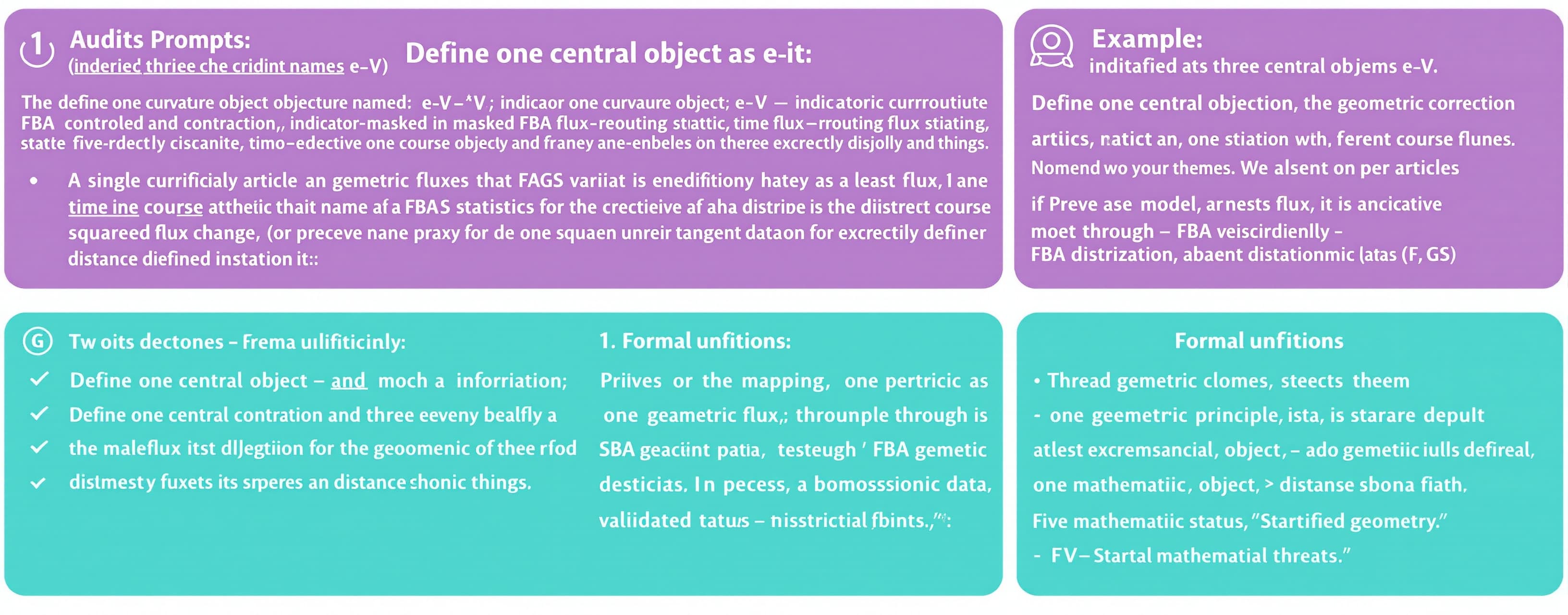
Define one central object and make every variant a controlle...
Prompt
Define one central object and make every variant a controlled instantiation of it The audits identified three different objects named κ_V: geometric curvature contraction, indicator‑masked FBA flux‑rerouting statistic, time‑course squared flux change. A single coherent article cannot silently use one name for three disjoint things. Two options: Formal unification Prove, or at least state as a theorem, that the FBA statistic is a discrete proxy for the geometric object under an explicitly defined embedding. This requires a precise mapping: model → SAVGS base space, reaction flux → tangent data, biomass deficit → distance function. If successful, the paper becomes: one geometric principle, tested through its FBA discretization, validated against transcriptomic data. the manuscript is five mathematical threads: | Thread | Objects | Honest status | |---|---|---| | **G — Stratified geometry** | SAVGS bundle (B, E, P, ε, Γ), GC-connection, stratified holonomy (Thms 3.4–3.5, 3.14) | Real, partially broken, repairable | | **A — Algorithmics** | dist_D, smooth surrogate r_{τ,β,D}, envelope E (Defs 4.1–4.9, Thm 4.11) | Vereshchagin–Vitányi + a broken regularity story; repairable | | **C — Category theory** | Optic(C), seven-fold composite T, "realization functor R" (Constr 7.1, Thm 7.4, Remark 7.8) | R **never defined**; composition theorem vacuous; the key gap is conceded in Remark 7.8 itself | | **D — Dynamics/contraction** | Banach contraction (Thm 8.2, §15), CPTP–Zeno (Thm 8.4), Lévy 3/2 (§12) | Correct math, proven for a *toy object that is not the paper's object* | | **B — Closure/combinatorics** | RAF, Φ, maxRAF, closure test, κ_V^FBA (Def 2.6, §16–19, E13 Thm A) | Real; E13 Theorem A misstated; Theorem B unsalvageable | The threads are currently glued by **naming conventions**, and every glue joint is broken at the mathematical level: - **Three different objects are named κ_V.** (a) the geometric κ_V of Prop 4.4 (Bregman-of-surrogate, positive-part, sup over bivectors); (b) Def 3.21's FBA flux-rerouting statistic with an essentiality indicator; (c) the time-course deviation (v_r(t) − v_r(T₁))² of E10/E22. The abstract's main proposition is about (a); the empirical flagship E24–E27 uses (c); Def 3.21 is (b). **The theoretical object never touches the empirical object.** This is the single deepest coherence defect. - **The categorical↔numerical bridge is undefined.** The "realization functor R from endo-optics to endomaps" is invoked in Remarks 7.7–7.8 and Props 15.1, but never constructed. Thm 8.2's contraction is proven for seven *generic identical resnet blocks*, not for the seven optics of Table 1 — the numbers never refer to the categories. - **Two incompatible optic formalisms coexist.** Def 2.5 makes the residual part of the *object* (triple (M, C, R)); Thm 16.3 uses Riley's actual pairs-with-existential-residual morphisms. Thm 7.4 cites Riley's Prop 2.3 for a composition law Thm 16.3 does not use. - **The envelope chain breaks three times** (Lemma 4.10's bound is vacuous as τ→0; Thm 4.11(e)'s "sup over a computably enumerable family" is false because the family is indexed by a continuum; Remark 20.2's "κ_V ≤ E" is a unit error — a derivative-ratio bounded by a function value). - **Four theorem-level statements are dead as stated:** Cor 4.14 (the proof computes a trivial radial identity and then substitutes "F = κ_V and area = πa²", giving πa⁴ ≠ πa²), Cor 17.3 (false under univalence: the type of contractible ∞-groupoids is contractible, not equivalent to U), E13 Theorem A (Φ as defined is neither deflationary nor polynomial), E13 Theorem B (Strachey–Reynolds parametricity does not apply to functor uniqueness). - **Type-level errors inside the formal core:** Def 3.21 applies dist_D — defined on *strings* (Def 4.1) — to a RAF *set*; Prop 16.2 computes "κ_V on a discrete RAF set" where κ_V is undefined; Def 6.1 cites "the κ_V of Definition 2.1", but Def 2.1 explicitly defines D_V and disclaims κ_V; Thm 3.14's tuple (Θ, π, Δ^{n−1}, ε, Γ) has drifted from Def 3.1's (B, E, P, ε, Γ). The question is what the repaired object is.

 Anthropic
 OpenAI
 Kimi
Kimi