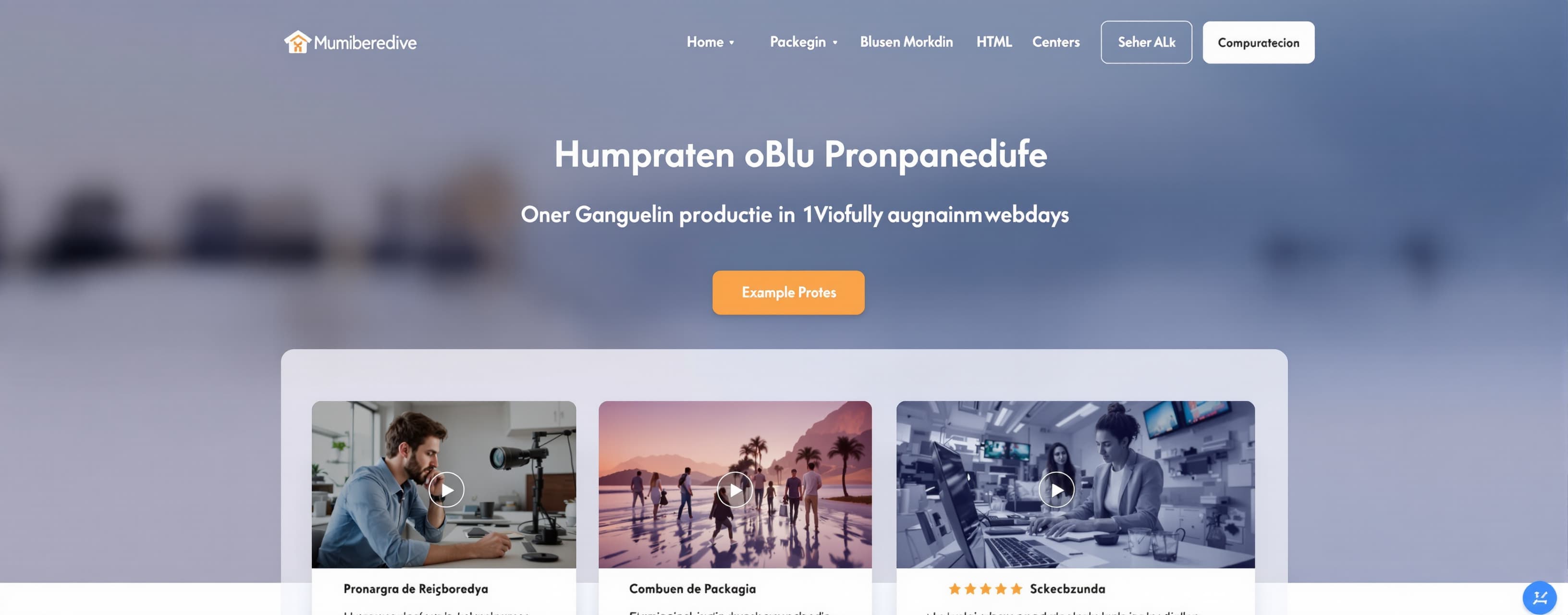
Create a complete, production-ready, mobile-first web applic...
Prompt
Create a complete, production-ready, mobile-first web application as a single static HTML entry point with fully integrated CSS and JavaScript, plus any required local asset files, implementing a Hungarian-language commercial landing page that sells multiple video-based packages and allows users to book appointment times through an in-page scheduling interface. Build the entire system from scratch from beginning to end, preserving the full functional scope, user flows, structure, and real content of the provided technical description, but replace all incomplete, broken, placeholder, simulated, dummy, mock, or non-production behavior with fully implemented, working production code.[1] Construct the application around these major subsystems: a fixed branded header with title and subtitle; a call-to-action button that opens an appointment-booking modal; multiple full-screen blurred background videos that rotate automatically; a horizontally scrollable package-card carousel near the bottom of the viewport; individual package cards with looping preview videos, labels, descriptions, prices, and purchase buttons; a modal checkout flow for selected packages; a calendar and time-slot reservation flow; toast-style feedback messages; and complete responsive behavior for mobile and larger viewports. Use the Hungarian copy, package names, package descriptions, prices, button labels, accessibility labels, and core page text from the technical description wherever those values are explicitly defined, and preserve all real content instead of replacing it with generic substitutes.[1] Start by defining the document structure with valid HTML5 semantics, correct metadata, viewport configuration, language declaration, title handling, and accessibility-friendly layout containers. Rebuild the visual system using a coherent production-grade design layer inspired by the described interface: dark immersive gradients, cyan-blue emphasis, glassmorphism-like surfaces, blurred overlays, animated transitions, fixed header, fixed bottom carousel region, modal layering, and responsive card sizing. Keep the visual intent but refactor the styling into maintainable, conflict-free, standards-compliant CSS with predictable tokens for colors, gradients, spacing, radii, shadows, transitions, z-index layers, and typography.[1] Implement the rotating background video system so that multiple video sources can be declared, preloaded appropriately, faded in and out cleanly, and cycled on a timed interval without visual glitches, layout jumps, or inaccessible behavior. Ensure the videos remain decorative background media, stay muted, loop inline on mobile, and degrade gracefully if a source fails. Preserve the concept of three background videos tied to the visual atmosphere of the page and the use of package preview videos inside the cards, but harden the media-loading logic and avoid redundant or brittle code paths.[1] Build the package carousel as a touch-friendly horizontally scrollable list with snapping behavior, keyboard accessibility, proper focus management, and responsive dimensions. Recreate all package cards found in the description, including badge variants, titles, descriptions, price presentation, purchase buttons, embedded looping videos, and distinct labeling such as basic, highlighted, and popular states. Preserve the real package metadata and pricing from the source description, and ensure that selecting a package consistently opens the checkout modal with the exact corresponding title and amount populated dynamically.[1] Implement the appointment-booking modal as a complete, production-ready scheduling interface with deterministic state management. Include the quick-date flow for “today” and “tomorrow,” the expandable calendar navigation flow, the weekly view option, date selection, time selection, back navigation between phases, selected-date display, success confirmation, and modal dismissal behavior. Refactor all date logic so it is internally consistent, locale-correct for Hungarian, independent of hardcoded stale dates, and robust against missing event objects or invalid state transitions, because the source description currently mixes direct event usage, partially implemented weekly generation, and inconsistent view handling.[1] Implement the checkout modal as a fully working payment interface. Preserve the visible flow defined in the source description, including a payment-method selector with card and bank-transfer-style options, a total summary section, loading state, error region, and success feedback, but do not leave any nonfunctional frontend-only payment calls in place. Replace the incomplete payment architecture shown in the source with a real production implementation that includes all required files and code for the frontend and the backend components necessary to securely create and confirm payment intents, process card payments, support redirect-based payment methods where applicable, validate amounts server-side, and return users to a success state safely. Do not use fake endpoints, undefined routes, or browser-only secret handling; build the complete working payment stack in full code, with environment-variable configuration, secure server logic, request validation, error handling, and end-to-end integration.[1] Preserve the source behavior where the payment modal is initialized dynamically from the selected package, but eliminate all duplicate listeners, accidental remounting issues, memory leaks, and invalid element reuse. Ensure payment elements are mounted and destroyed safely across repeated modal openings, and that switching between payment methods updates the interface correctly without leaving stale components or broken DOM state. Maintain support for wallet-style payment request buttons only if they are truly functional in the completed architecture; otherwise implement the feature correctly or omit it rather than leaving partial behavior.[1] Refactor the JavaScript into a clear module or equivalent structured architecture with explicit state containers, initialization order, DOM query isolation, event binding, modal controller logic, booking controller logic, media controller logic, checkout controller logic, and utility functions for formatting, date math, toast rendering, and cleanup. Remove reliance on implicit globals, inline event-handler fragility, and hidden coupling between UI regions. Preserve every real user-facing feature from the description, but make the internals deterministic, maintainable, and production safe.[1] Keep the interface fully localized in Hungarian for all visible UI text that appears in the technical description, including booking labels, pricing labels, payment labels, error and success messaging, navigation labels, and accessibility attributes. Maintain or improve the accessibility baseline by adding semantic landmarks, dialog semantics, focus trapping in modals, escape-key support, click-outside dismissal where appropriate, visible focus indicators, screen-reader labels, reduced-motion considerations, and keyboard-operable controls for cards, booking, and checkout interactions.[1] Teljes kódot kijavítva vissza küldöd. minden egyes karaktert leírsz, nem rövidítesz. minden hibát kijavítasz. egy fájl marad. ne írj semmi mást csak a teljes kódot es kommentek nem lehetnek benne! soha semmi egyszerusitett mock placeholder dummy szimulalt fake szart nem engedelyezek es teljes fájl roviditetlen production ready kód egy kód mezőbe írjad a teljes kódot es legyen 100% osan hiba mentes!
A system prompt was added to support web rendering
 OpenAI
Response not available