Construct a complete, production-ready software system that ...
Prompt
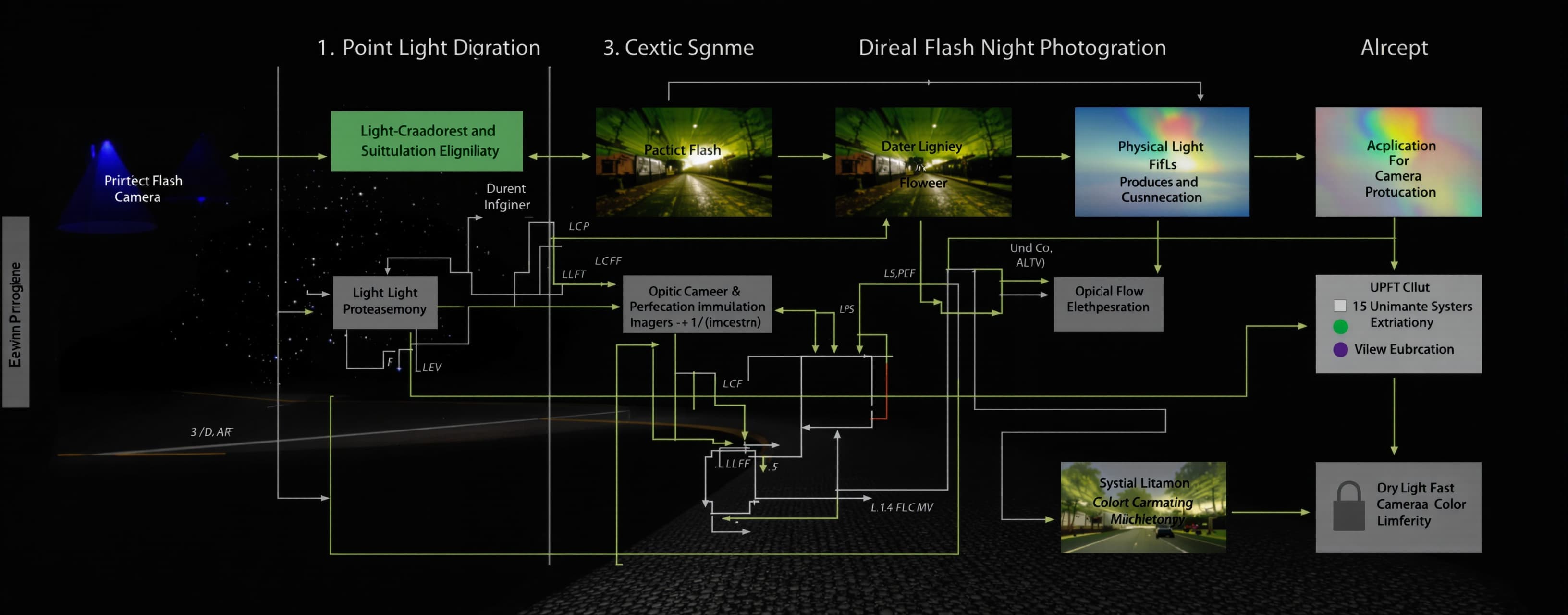
Construct a complete, production-ready software system that simulates direct-flash camera optics, physical light propagation, and digital image post-processing to generate high-fidelity direct-flash night photography. The system must be built from scratch in complete, unabridged code without any placeholders, mock functions, or simplified logic. --- ### System Architecture and Implementation Plan Build the system as a modular, fully executable software pipeline consisting of four primary components: 1. **Light Engine & Spatial Propagation Module** 2. **Optical Camera & Sensor Simulation Engine** 3. **Digital Post-Processing & Color Grading Pipeline** 4. **Execution Pipeline & System Interface** --- ### Step-by-Step System Specifications #### Step 1: Light Engine & Spatial Propagation Module Develop a dedicated lighting module that models physical light behavior for on-camera flash illumination: * **Point Light Source Modeling**: Implement an un-diffused point-light source positioned strictly on-axis or co-axial with the camera lens optical axis. * **Diffusion Elimination**: Ensure zero light diffusion. Do not apply softbox filters, reflector cards, bounce angles, or light-shaping modifications. * **Inverse-Square Law Attenuation**: Implement precise radiometric falloff governed by $I(r) = \frac{I_0}{r^2}$, where $r$ is the distance from the flash source to the geometry surface. * **Exposure Value Falloff**: Calculate spatial light decay such that objects located in the primary foreground ($1.0\text{ m} - 1.5\text{ m}$) receive full direct exposure, while background surfaces at distances $\ge 3.0\text{ m}$ experience extreme light drop-off resulting in $EV \le 0 - 2$. * **Shadow Geometry**: Calculate hard shadow casting along the lens-flash projection vector, generating tight, sharp silhouette shadows immediately behind occluding foreground geometry without soft penumbra transitions. #### Step 2: Optical Camera & Sensor Simulation Engine Build an engine that simulates the optical characteristics of a wide-angle lens paired with a digital image sensor: * **Focal Length & Distortion**: Simulate a $24\text{mm} - 35\text{mm}$ equivalent focal length, incorporating subtle radial barrel distortion characteristic of wide-angle event framing. * **Aperture & Depth of Field**: Implement aperture control configured between $f/4.0$ and $f/8.0$. Calculate a deep depth-of-field field map maintaining optical sharpness across foreground and midground targets while reducing ambient photon accumulation. * **Shutter Speed & Motion Freeze**: Implement shutter synchronization set between $1/125\text{ s}$ and $1/250\text{ s}$ (Flash Sync Speed). Calculate ambient light suppression to isolate the exposure exclusively to the instantaneous duration of the flash pulse. * **Sensor Sensitivity**: Model sensor sensitivity calibrated at low ISO ($100 - 400$) to guarantee low signal noise in the primary exposure area. * **White Balance Color Matrix**: Apply a daylight/flash color transformation matrix calibrated to $5500\text{ K} - 6000\text{ K}$, imparting a cool daylight baseline that enhances the natural warmth of illuminated skin tones. #### Step 3: Digital Post-Processing & Color Grading Pipeline Develop a pixel-processing pipeline operating on high-dynamic-range image buffers: * **Specular Highlight Clipping Engine**: Detect specular reflection maps on glossy material properties (skin lipids, lip gloss, polished metals, jewelry). Apply a thresholding transfer function that intentionally clips these peak reflections to pure white ($RGB = [255, 255, 255]$). * **Black Point Crushing & Tone Curve**: Apply a steep non-linear tone-mapping S-curve that compresses low-luminance background values below threshold directly into pure black ($RGB = [0, 0, 0]$). * **Micro-Contrast & Sharpening Filter**: Implement a spatial unsharp mask and high-pass micro-contrast filter to enhance edge acutance across structural boundaries, fabric textures, and hair strands. * **Color Saturation Mapping**: Apply color space transformations that boost chromatic saturation for warm color vectors (pinks, reds, tan/brown skin tones) while maintaining neutral, crushed backgrounds. #### Step 4: Execution Pipeline & System Interface Provide a CLI and programmatic API interface that accepts scene input data (geometry, material reflectance maps, depth maps, and initial radiance values) and passes them through the complete processing chain: 1. Initialize the optical camera parameters ($24\text{mm} - 35\text{mm}$, $f/4.0 - f/8.0$, $1/125\text{s} - 1/250\text{s}$, ISO $100 - 400$, WB $5500\text{K} - 6000\text{K}$). 2. Compute on-axis hard point-light radiometry and spatial $1/r^2$ attenuation. 3. Rasterize optical depth, sharp hard shadows, and material specularities. 4. Apply the post-processing pixel pipeline (specular clipping, black crushing, micro-contrast enhancement, and warm color saturation boosting). 5. Output the rendered, fully processed image file. --- ### Output Requirements Deliver the complete, unabridged, production-ready source code for all modules across all necessary files. Do not omit any implementation details, use `TODO` comments, or employ mock data. Every function, algorithm, mathematical transform, and file required to run the pipeline end-to-end must be fully implemented.

 Alibaba
 Anthropic
 OpenAI