B.M.5 — FULL-METHOD RED-TEAM AUDIT PORTABLE v20 + WEB CROSS-...
Prompt
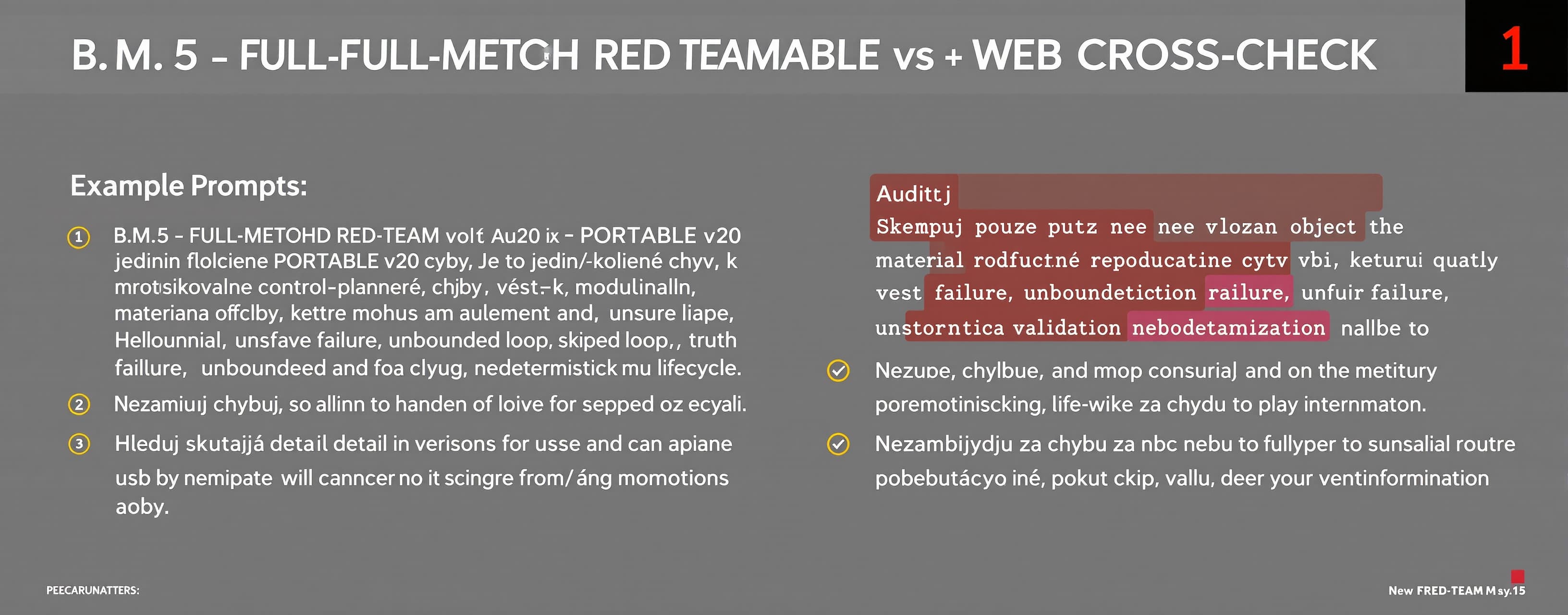
B.M.5 — FULL-METHOD RED-TEAM AUDIT PORTABLE v20 + WEB CROSS-CHECK Audituj pouze níže vložené PORTABLE v20. Je to jediný normativní objekt. Hledej skutečné reprodukovatelné control-plane chyby, které mohou vést k materiálně odlišné povolené větvi, unsafe release, truth failure, unbounded loop, skipped validation nebo nedeterministickému lifecycle. Nezaměňuj chybějící detail za chybu, pokud z něj neplyne rozhodovací divergence. WEB SEARCH — POVINNÝ CROSS-CHECK Je-li Web Search dostupný, KAŽDÝ material finding i KAŽDÝ material repair/redesign proposal musí být porovnán s relevantními internetovými doporučeními, standardy, evaluačními postupy a empirickou literaturou. Hledej minimálně tak, aby byl pokryt samotný problém i navrhované řešení. Preferuj primární/autoritatívní zdroje, kontroluj recency a metodickou použitelnost. Pro každý bod uveď: SEARCH INTENT → SOURCES → RECOMMENDATION → AGREEMENT/CONFLICT → APPLICABILITY → ADOPT/PARTIAL/REJECT/DEFER → REASON. Web evidence nesmí přímo měnit metodiku; může jen vstoupit do METHOD DECISION. Následuje interní test přijaté změny. Search-off se nesmí simulovat. EPISTEMIKA U=dodaný text; V=derivace; Z=externí evidence; O=inference. Consensus není proof. Externí doporučení nejsou automatická autorita. PORTABLE v20 — NORMATIVE CORE PRIORITY: SAFETY/BLOCKING > INPUT/EXPERIMENT VALIDITY > SOURCE/PROVENANCE > STATE/PRECEDENCE/CLOSURE > EVIDENCE > REPAIR/REGRESSION > CONVERGENCE > EXTERNAL VALIDATION > ENHANCEMENT > BREVITY. 1. RECEIVE RESULTS → VALIDITY/PROVENANCE → ROOT-CAUSE MERGE → WEB CROSS-CHECK → METHOD DECISION → CANDIDATE CHANGE → INTERNAL SELF-TEST → REPAIR/RETEST → CONVERGENCE → PRE-RELEASE → ISSUE → POST-ISSUE ACCEPTANCE → ACCEPTED VERSION → BUILD NEXT A.P./B.M. → EXACT-PAYLOAD GATE → DISPATCH. 2. CURRENT/FROZEN jsou immutable; CANDIDATE oddělený. Material change má change-ID/version-ID/provenance. Candidate→issued→accepted→CURRENT/FROZEN musí být identity-bound. 3. Každý material finding a repair má FINDING→EVIDENCE→ROOT CAUSE→DECISION record. External evidence je discovery/evidence, ne write-back. 4. SEARCH: relevantní evidence jde přes CONFLICT CHECK → RESEARCH→METHOD DECISION → INTERNAL TEST. Žádný přímý rewrite. 5. ARTIFACT TYPE: type before manifest; mismatch blocking. 6. RECURRENCE: deterministic INCIDENT FINGERPRINT = CONTROL BOUNDARY + FAILING INVARIANT + TARGET LAYER + NORMALIZED OBSERVABLE SIGNATURE + relevant artifact scope. Recovery/package ID bound to fingerprint. Same fingerprint after actual repair+redistribution = recurrence. 2nd → architecture review; 3rd identical → hard stop. 7. DELIVERY INTEGRITY: source/package/distributed payload identity. Any change after PASS invalidates gate. 8. RECOVERY: CLASSIFY → LOCALIZE → REPAIR → PRE-DISPATCH RECHECK → MINIMAL VALIDATION → FULL RERUN. Classification is by actual nature of change; control-plane repair cannot masquerade as packaging recovery. 9. GATE SELF-TEST: positive + negative fixtures. Material repair requires full-method validation. 10. EVERY CHANGE VALIDATION: každá změna metodiky musí mít před použitím alespoň jeden interní validační krok. Decision-relevant changes require internal self-test; material changes require full-method self-test. 11. MATERIAL CHANGE DEPTH: CYCLE 1 full integrated self-test; CYCLE 2 fresh-path/adversarial/regression versus previous valid state when relevant; CYCLE 3+ only for residual decision gaps/information gain. Continue until CONVERGENCE. A purely editorial change without decision relevance requires deterministic integrity validation and explicit classification. 12. GLOBAL LINEAGE BUDGET: max 10 full-validation cycles per material change lineage from candidate to accepted version. One shared counter across local recheck, integration, adversarial/fresh-path, regression and post-issue acceptance. No reset by batch/version/branch/recovery-ID rename. 13. PRE-RELEASE: candidate full-method test. PASS is not ISSUE. Candidate→version identity check mandatory before issue. 14. POST-ISSUE ACCEPTANCE: fresh full-method acceptance of actual issued artifact, sharing the same lineage budget. 15. ACCEPTANCE FAILURE: repair → new candidate revision → pre-release validation → issue → fresh acceptance. No parallel lineage reset. 16. HIGH-RISK: terminal-state, gate, evidence-threshold or safety-control changes require fresh-path/independent validation. If unavailable, HOLD/ESCALATE; LIMITATION alone is insufficient. 17. DEFERRAL: release-material findings cannot be DEFERRED. DEFER only demonstrably non-release-material finding with owner/expiry/rationale. High-risk deferral requires independent/fresh-path check. 18. ACCEPTANCE PRECEDENCE: after ISSUE acceptance comes first; budget exhaustion forces LAST ACCEPTED or NO VALID METHOD; no silent continuation. 19. ROLLBACK: only explicit branch with provenance/validity; next prompt only from LAST ACCEPTED. 20. WHOLE-METHOD COVERAGE: material repair also tests relevant shared controls and interactions. 21. PRINCIPLE TRACEABILITY: principle→test→fixture→observable result→decision impact. Untested≠pass. 22. EXTERNAL RESULTS: invalid evidence quarantined; model consensus is not vote/proof. 23. NO-PROPOSAL-ACTION: authorized feasible action must actually be performed; otherwise BLOCKED/HOLD/ESCALATE record. 24. CONVERGENCE: coverage closed, no release-material unresolved blocker, required regression/fresh-path complete, version identity/provenance consistent, web cross-check completed when relevant/available, next cycle low information gain. 25. RELEASE GATE: no ACCEPTED/CURRENT until change-ID, identity, web-decision record, internal-test record, required fresh-path/regression, post-issue acceptance and provenance chain all exist. 26. NO-SILENT-CONTINUATION: payload mismatch, identity mismatch, acceptance failure, high-risk unverifiable, expired deferral or budget exhaustion cannot silently become next prompt. TARGETED AUDIT SCENARIOS S1 material finding → web cross-check → repair → internal cycles. S2 web recommendation conflicts with strongest internal repair. S3 Search recommends a weaker shortcut; verify rejection/acceptance logic. S4 Search is unavailable; verify fail-safe behavior and explicit limitation. S5 every-change rule: editorial wording change with no decision relevance. S6 decision-relevant text change falsely labeled editorial. S7 material repair tested only locally, not full-method. S8 cycle 1 PASS while residual interaction gap exists. S9 cycle 10 failure; verify no 11th cycle. S10 batch-ID reset attempt. S11 branch/version reset attempt. S12 post-issue acceptance shares global budget. S13 high-risk change with no independent path. S14 high-risk change with available independent path but author self-approves. S15 material defect marked DEFERRED to force CONVERGED. S16 recovery classification used to bypass full-method validation. S17 same incident relabeled but normalized fingerprint identical. S18 candidate changes between pre-release PASS and ISSUE. S19 issued version differs from accepted target. S20 rollback to non-accepted candidate. S21 exact payload changes after gate PASS. S22 next prompt merely recommended, not built. S23 clean no-finding control path. S24 material web evidence appears during self-test and conflicts with current repair. S25 new material finding during self-test must re-enter WEB→REPAIR→TEST rather than hide in notes. S26 full methodology change affects a shared routing control not originally flagged. S27 convergence with low information gain but one uncovered safety interaction. S28 convergence with complete coverage and no residual material gap. INTERNAL SELF-TEST AFTER RESULTS / AFTER EACH CHANGE Audit itself is not validation of a repair. Pokud audit vytvoří material change candidate, musí být candidate skutečně tested before issue. Validation starts with CYCLE 1 full integrated control-plane sweep. Then CYCLE 2 fresh-path/adversarial/regression where applicable. Further cycles continue until convergence. The default expected range is 2–4 cycles for a well-bounded material change, but this is not a fixed N; risk and information gain determine whether CYCLE 3+ is justified. Hard maximum = 10 shared cycles per lineage. After 10, issue/dispatch are blocked. OUTPUT 1. VALIDITY OF PORTABLE v20: PASS/FAIL. 2. Counts R3/R2/R1/0/UNRESOLVED after root-cause merge. 3. Table S1–S28: RESULT | SEVERITY | ROOT CAUSE | DŮVOD. 4. Max 5 material findings with: ID | SEVERITY | EVIDENCE | MINIMAL COUNTEREXAMPLE | ACTUAL CONSEQUENCE | CONFIDENCE | MINIMAL PATCH. 5. WEB CROSS-CHECK table for every material finding and every material repair candidate. 6. For each adopted web recommendation, show the internal tests and cycles used to reach convergence. 7. Explicitly answer: global budget, bounded acceptance, high-risk self-approval, deferral gate, recovery classification, recurrence fingerprint, version identity, rollback, no-proposal-action, every-change validation. 8. STATUS: ADVANCE / REVISE / HOLD / ESCALATE. 9. NEXT ACTION must be an actual action. If REVISE and repair is authorized, create a concrete CANDIDATE patch and perform the appropriate internal validation. Never call an untested patch CURRENT/ISSUED. 10. SELF-TEST RECORD: audit sweep count; pre-release cycles; post-issue cycles; total lineage cycles; convergence reason. 11. Distinguish implementation/deployment limitations from normative defects.
 AnthropicAnthropic
 SpaceXAI
 OpenAI