ayaan
n
Prompt
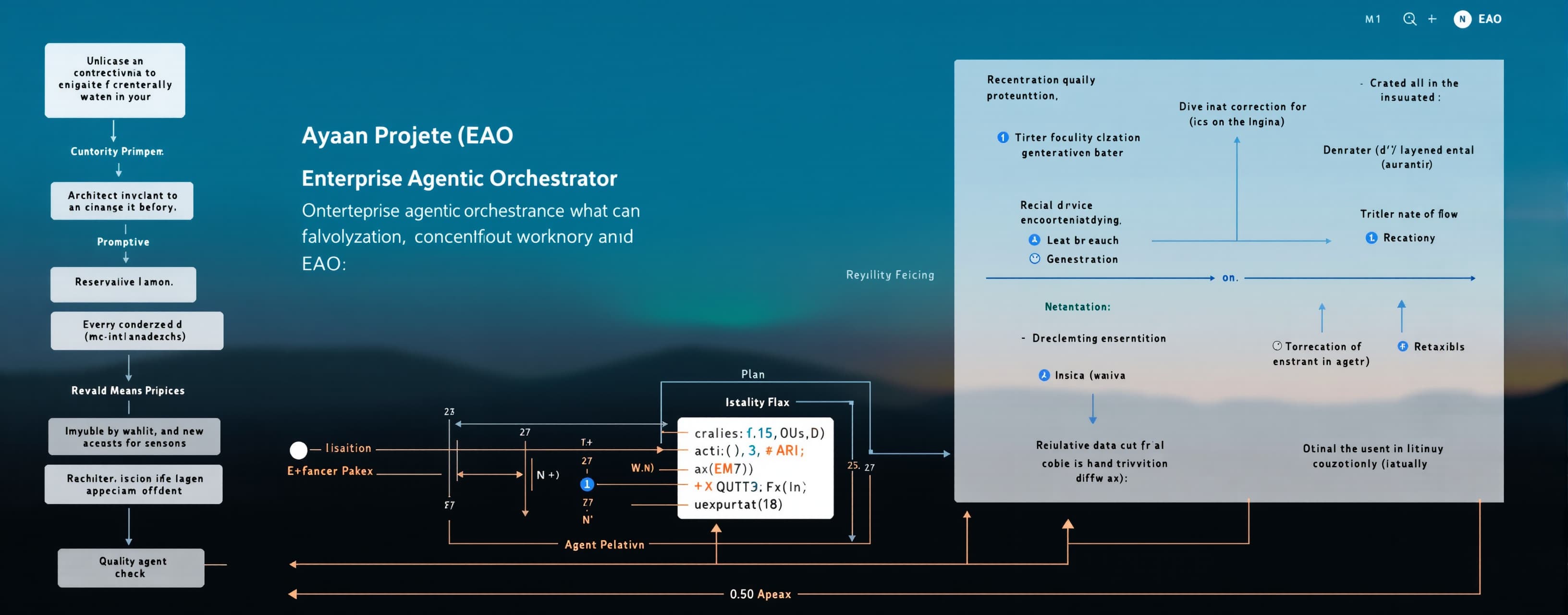
try to replicate this project Enterprise Agentic Orchestrator (EAO)Enterprise Agentic Orchestrator, or EAO, is a large-scale Python system designed to turn high-level goals into working software and to repair existing repositories through coordinated multi-agent intelligence. At version 33.0 Apex it represents an ambitious attempt to build not just another coding assistant, but a full Agent Operating System: a control plane that can plan, generate, critique, heal, verify, and package software under strict isolation and budget constraints.At its core, EAO treats software construction as a pipeline rather than a single prompt. A typical greenfield run moves through blueprint, decomposition, research, generation, criticism, healing, quality checks, polish, and packaging. Repository repair follows a different path: an isolated agent loop that reads the codebase, proposes patches, runs tests, and iterates under sandbox constraints. Both paths are driven by specialized agents—Architect, Decomposer, Researcher, Coder, Critic, Debugger, and others—coordinated by an orchestrator that owns lifecycle, state, and convergence.What distinguishes EAO from simpler agent demos is its insistence on boundaries. Execution defaults to Docker isolation with network disabled, read-only root filesystems, non-root users, and dropped capabilities. Host execution is opt-in, not the default. LLM traffic is routed through a provider abstraction with budgets, failover, and cost tracking. Paths are sanitized. SQL is parameterized. Web UI surfaces use per-request CSP nonces. Failures are typed through a domain exception hierarchy so callers can classify and recover without string matching. These are not afterthoughts; they are structural claims about how an agent system should behave when it is allowed to touch real code and real machines.The codebase is large—on the order of ninety-five thousand lines of Python—and spans many subsystems: a native Agent OS with packages, supervisors, and schedulers; an LLM layer with multiple providers; sandboxes and attestation; enterprise and intelligence modules; swarm and assurance machinery; server routes and a WebUI. Documentation is unusually dense for a project of this kind: architecture notes, production checklists, versioned changelogs, audit matrices, and conflict ledgers. The project has clearly been through many iterations, and that history is visible both in its strengths and in its scars—very large modules, parallel refactors, and features that depend on external infrastructure such as Firecracker, SPIRE, or formal solvers.Judged purely as code, EAO sits above average. It is deliberate, security-conscious, and explicit about contracts. It is not yet elite library quality in the sense of tiny modules, uniform polish, and zero evolutionary debt. Breadth was chosen over narrow perfection. That trade-off is honest: the system tries to be a platform, not a single elegant library.The practical reality of the Apex package is that the complete product lives in the release wheel and source tarball; partial trees can look incomplete until those archives are expanded. Once expanded, the picture is consistent with the documentation: a serious, heavily audited multi-agent control plane aimed at production use, with clear limits on what this environment can certify (live hardware isolation, external trust domains, formal proof backends). hey so you cant output fiels or you can idk,if u can then you are good,but u also just write file name and its content in text,in chat,goooo
A system prompt was added to support web rendering
 Alibaba
 Anthropic
 Z AI
Z AI OpenAI
 Kimi
Kimi