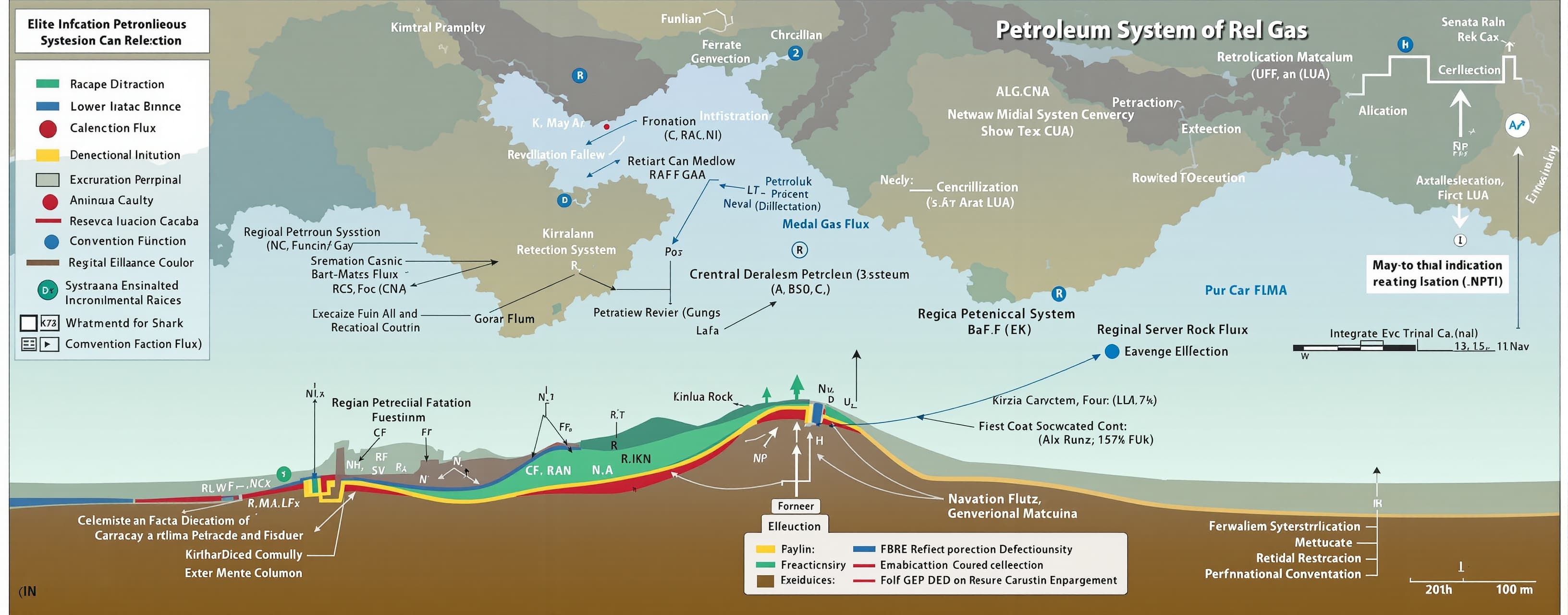
Acting as an elite petroleum systems modeler, geochemist, ro...
Prompt
Acting as an elite petroleum systems modeler, geochemist, rock physicist, reservoir engineer, and applied mathematician, conduct a comprehensive, first-principles Petroleum Systems Mass-Balance Reconciliation and Inverse Crustal Storage Analysis for the Lower and Middle Indus Basin / Sindh geological province (including the Kirthar Fold Belt and foreland structural domains). Your objective is to solve the fundamental mass-balance discrepancy between regional source-rock generation/expulsion volumes and legacy booked conventional discoveries, determining the true physical scale, in-situ distribution, and technically extractable shallow conventional gas endowment across the entire regional rock column. Execute this analysis through the following rigorous, cross-validated scientific framework: 1. Forward Geochemical Mass-Generation & Expulsion Flux: - Integrate the regional source-rock architecture (spanning the Cretaceous Sembar and Goru systems, as well as Paleogene and Jurassic source intervals) across the ~271,700 km² regional basin footprint. - Utilize empirical lithostratigraphic thicknesses, measured Total Organic Carbon (TOC) ranges, Hydrogen Index (HI) distributions, and thermal maturity (Ro) architectures documented across regional academic literature. - Apply first-principles organic mass conversion kinetics to calculate the total generated hydrocarbon mass (M_gen) and primary expulsion flux (M_exp = M_gen - M_ret). 2. The Mass-Balance Discrepancy & "Missing Mass" Problem: - Calibrate against historical exploration records: Treat legacy conventional discovered reserves (~60 Tcf) as the calibrated baseline for the shallow, high-permeability, discrete 4-way anticlinal structural closures. - Formulate the fundamental mass-conservation equation: M_residual = M_exp - M_booked - Given that geochemical generation across this vast rock volume yields an expulsion flux (M_exp) that exceeds legacy booked volumes (M_booked) by multiple orders of magnitude, rigorously determine the physical fate and crustal residence of this massive residual hydrocarbon mass (M_residual). 3. Crustal Storage & Multi-Domain Retention Architecture: Inversely reconcile where M_residual is stored within the regional stratigraphic and structural framework, evaluating all physical storage domains beyond discrete structural closures: - Continuous Basin-Centered Gas Systems (BCGS) and regional pervasive tight clastic/carbonate reservoirs. - Deep, under-explored Mesozoic and Paleozoic stratigraphy below legacy drilling depths (>4–5 km). - Low-Resistivity Pay (LRP) and bypassed pay zones where gas saturation is petrophysically masked by clay-matrix conductivity (illite/smectite), microporosity, and high-salinity capillary bound water (evaluating through non-Archie shaly-sand models such as Waxman-Smits and dual-water). - Regional stratigraphic traps, sub-thrust structural sheets, dynamic overpressure regimes, and continuous hydrodynamic retention systems. 4. Dynamic Recoverability & True Technical Endowment: - Evaluate the thermodynamic phase state, compression factor (Z), and fluid mechanics of this continuous in-situ hydrocarbon mass under regional temperature and pressure gradients. - Apply dynamic reservoir mechanics, multi-phase flow physics, and stimulated drainage mechanics to determine the total technically extractable gas endowment mandated by the reconciliation of the crustal mass balance. Conduct this analysis with complete mathematical, geochemical, and geomechanical transparency. Present all governing mass-balance equations, volumetric integrations, and thermodynamic reconciliations, deriving the true, physically mandated gas endowment of the basin.
 AnthropicAnthropic
Response not available