1. Writing Actions 1.1. ...
Prompt
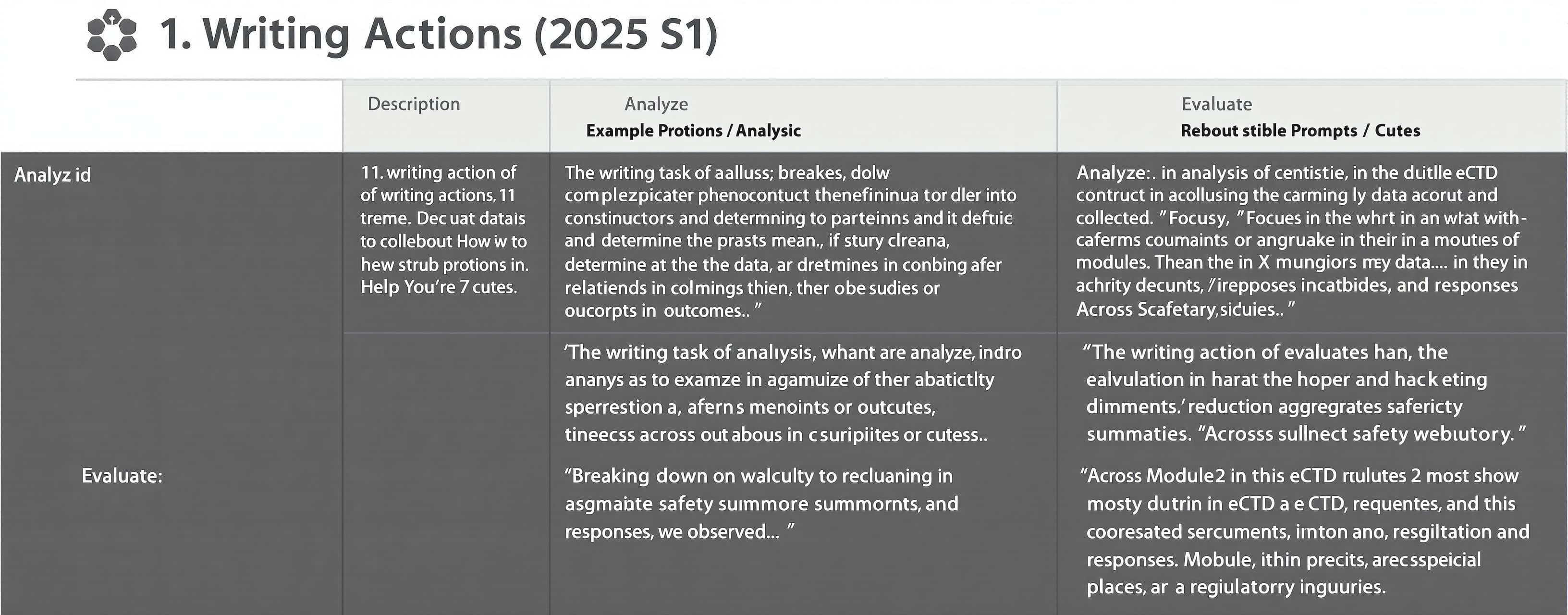
1. Writing Actions 1.1. Summary table of writing actions (2025 S1) Table 2: Writing Actions (2025 S1) Description What You’re Doing How to Recognize It Helpful Prompts / Cues Analyze The writing task of analysis breaks down complicated phenomena into constituent parts. To analyze means to deconstruct something and determine what the parts mean. Analysis is distinct from synthesis, which involves combining parts into new wholes. You might think of analysis as the primary activity occurring after all study data has been collected. Breaking down data to examine patterns, relationships, or differences Focuses on what’s happening in the data, often across subgroups, timepoints, or outcomes “The data show a trend...” “X was more frequent in Y than Z…” “Across studies, we observed…” Evaluate The writing action of evaluating is most often performed in eCTD Module 2 submission documents, aggregate safety summaries, and responses to regulatory inquiries. Within Module 2, there are specific places where the sponsor is expected to evaluate the strengths and weaknesses of the development program. The writing task is to consider sufficiency of the submitted body of work, including study design and sufficiency of study numbers, participant demographics, and data quality. Too often, we find that instead of evaluating, sponsors repeat descriptive summaries of design or results. We find sponsors are hesitant to critique their own development programs and the resultant data. However, we suggest doing so is responsive to regulatory guidance and increases credibility with regulators. Judging the quality, strength, or reliability of findings Makes a value judgment about robustness, consistency, or limitations “The evidence is limited by…” “Findings were consistent with…” “This result supports confidence in…” Interpret Interpretation goes beyond statistical analysis by using reasoning based on context to give meaning to data. Interpretation says, “Here is how these data ought to be understood and acted upon.” Interpretation involves considering the relevance of collected data and assessing how the findings contribute to existing knowledge in the field. An interpretation might discuss how the data align with previous work, establish a positive benefit-to-risk ratio, make comparisons to previous hypotheses, or discuss implications for design of first-in-human clinical trials. Interpretation translates analysis into meaningful “So what?” insights. Assigning meaning to findings based on context, hypotheses, or implications Explains why the results matter and what they suggest “These findings suggest that…” “This may reflect…” “The observed difference indicates…” 1.2. Definition and Purpose 1.2.1. Overview · Provide "big picture” perspective to set context. · Present concisely the most important information or understanding. · Help readers understand broad patterns or scope before details. · Useful in describing data sets, program structures, or topics. What Overviewing May Do · Offer a concise orientation to the topic, dataset, or development program. · Describe the scope or structure of the information before deep presentation of details. · Highlight broad patterns or high-level themes across studies or data sources. · Position detailed findings within the context of larger program objectives or scientific rationale. An overview concisely presents the most important information or understandings to give the reader a big picture perspective. An overview details key concepts in the document or related documents. An example of an overview is an informative abstract accompanying a scientific article in a journal. An effective overview includes these actions: · State the purpose or goal of the research—the question(s) to be answered by the study. · Identify the gap in therapeutic treatment the drug is meant to fill. · Provide the logic behind pursuit of the study (mechanism, predictive effects, class). · State important design parameters (study type, population, duration, comparator). · Indicate important outcomes (for example, efficacy findings, dosing determinations, confirmation of proof of concept, safety profile). Examples (Section?6.8.2) 1.2.2. Summarize A summary conveys the principal findings of research or development work in a concise and clear manner. An effective summary condenses essential details, main findings, and conclusions into a comprehensive recap of the body of work. By definition, a summary must be brief. · Condenses information into main takeaways—a comprehensive recap of the body of work. · Often used at the end of sections or documents. · Emphasizes conclusions or important results. What Previewing May Do · Reinforce the most important findings or conclusions drawn from document section or preceding set of sections. The data confirm that Drug X significantly reduced relapse rates over 12 months, with sustained benefit across all patient subgroups. Drug X reduced 12-month relapse rates from 52% to 27% and maintained remission in >70% of biologic-naïve patients, thus supporting Drug X role in long-term disease control. · Provide a clear and concise distillation of the evidence, trends, or implications. Across studies, response rates were highest at Week 12 and remained stable through Week 48, with a plateau effect observed after initial improvement. Response rates peaked at 64% at Week 12 and remained between 60% and 62% through Week 48, suggesting durable effect beyond initial induction. · Enable readers to process results and identify what matters most. These results suggest that early treatment initiation may be the most critical factor in achieving durable remission. Patients who initiated treatment within 3 months of diagnosis achieved 12-month remission rates nearly twice as high as those who started treatment after 3-month time window. · Support transitions by closing a section and signaling readiness to shift focus. Together, these findings outline the therapeutic potential of the drug. The next section examines the safety profile across the same study population. The sustained remission observed across trials—particularly in biologic-naïve patients—supports Drug XX potential as an early intervention therapy. The following section examines immunogenicity in this patient population. Examples (Section?6.8.3 ) 1.2.3. Synthesize 1.2.4. Preview · Forecast what the section or document will cover. · Orient the reader about structure or purpose. · Common in introductions, roadmap paragraphs, or opening bullets · Previewing the content of a report or a report section is essential. A strong preview orients the reader to what is to come and helps the writer keep the report on track. An effective preview acts as a guide, preparing the reader for the content ahead, and creating a foundation for effectively communicating technical details. By preparing the reader in advance, you offer an advance organizer that allows the reader to make sense of upcoming details. · Previews often form the backbone of a strong introductory section. Typical introductory moves include the following: What Previewing May Do: · State the purpose of the report. (eg. This section outlines the rationale and design of the pivotal Phase 3 trials evaluating efficacy in moderate-to-severe asthma.) · Present only the necessary background information and context to set the stage for the report. (eg, Following mixed results in early trials, this section provides context for the revised development strategy.) · Indicate the scope of the report—identifying what will be covered, or indicating what will be addressed in other documents or at other points in time. (eg, The following pages summarize findings from five efficacy trials, organized by population, dose, and duration.) · Highlight the most important findings, new understandings, or consequent actions that follow from the report. (eg, These results informed the proposed dosing strategy described in Section 4.) Examples (Section?6.8.1) 1.2.5. Analyze · The writing task of analysis breaks down complicated phenomena into constituent parts. To analyze means to deconstruct something and determine what the parts mean. · Analysis is distinct from synthesis, which involves combining parts into new wholes. 1.2.6. Justify - To justify is to present well-reasoned and logical support for a particular decision, design, interpretation, or action. - An justification supports a particular course of action. - Distinguish with argue (Section 4.2.1) & more examples (Section 6.7.1) 1.2.7. Argue · Interpretation involves considering the clinical relevance of observed changes and assessing how the findings contribute to existing knowledge in the field. · Interpretation translates analysis into meaningful “So what?” insights. · Topic sentences play a significant role, as reader report looking back to topic sentences to ensure that they have understood the text and can remember the main points conveyed in the text. Heading Bold 表格图表设计[KZ1] : - Distinguish with justifying (Section 4.2.1) & more examples (Section?6.7.2 ) · In biopharmaceutical writing, particularly when addressing regulatory readers, the strength and clarity of your argumentation is crucial. Making a simple argument involves a direct approach. The writer begins by stating a clear, concise claim and then proceeds to show how the available evidence logically supports that claim. Decisions, interpretations, conclusions, and recommendations are all claims that need to be supported by evidence. · The task is straightforward: state the claim (or position) and back up the claim with evidence. Evidence serves as the bedrock of all arguments. Whether you are making a straightforward claim or engaging in more complex reasoning, your assertions must be grounded in credible, relevant evidence. · For instance, if you assert that a particular drug reduces the risk of cardiovascular events, you would then present clinical trial data or published studies that demonstrate this reduction. The simplicity lies in the linearity of the argument: claim followed by supporting evidence. The intent is to leave little room for ambiguity or misunderstanding by the reader. · Often, regulatory writing must go beyond simple arguments. Complex arguments require the writer to consider and address potential objections, alternative claims, or weaknesses in the evidence. This is where the Toulmin model (Toulmin 2003) of argumentation becomes particularly useful. · The Toulmin model emphasizes the need to not only present a claim and its supporting evidence but also to consider how a critical or discerning reader might interpret this information. The model encourages you to consider and address the potential counterclaims or objections that a regulatory reader might have. · For example, when presenting a conclusion about the safety profile of a drug, a complex argument would also address potential counterarguments—such as concerns about long-term safety data or the generalizability of clinical trial results to broader populations. By acknowledging these alternative interpretations and building counterarguments within your writing, you preemptively respond to the questions and concerns that a regulatory reader might raise. Writing Action: Argue[KZ2] To argue is to present a position in the face of possible objections, alternatives, or regulatory concerns. Strong argumentation: Takes a stance. Uses data or precedent. Anticipates or counters skepticism. Arguing for a Single Pivotal Study Weak Argument Stronger Argument Assertion without support “We believe that one randomized study is sufficient to support approval.” This takes a position, but fails to support it. No discussion of why one study is enough. No anticipation of regulatory expectations for replication. Position + Reasoning + Anticipation “We propose that a single Phase 3 study provides sufficient evidence of efficacy to support approval. The study will enroll a representative population, use an established comparator, and is powered to demonstrate a statistically significant and clinically relevant improvement in OS. The magnitude and consistency of effect across pre-specified subgroups, along with high internal validity and robust sensitivity analyses, reduces the need for a confirmatory second trial. It is important to note that similar precedent exists in the approval of targeted agents for biomarker-defined NSCLC subpopulations.” Defensive and unclear “Although the ITT analysis did not meet statistical significance, we still consider the totality of data supports use in all patients. Weak, hedging language (“believe”) No reasoning provided Doesn’t address the core issue (lack of effect in biomarker-negative group) Rejection of alternative + Position + Data “We recommend restricting the indication to biomarker-positive patients. While the ITT population showed a trend toward improved OS, the effect was primarily driven by the biomarker-positive subgroup (HR 0.68 [0.51–0.90]) with no observable benefit in biomarker-negative patients (HR 0.94 [0.76–1.17]). Including all patients would dilute the treatment effect and risk exposing biomarker-negative patients to unnecessary toxicity without clear benefit. Aligning the indication with the demonstrated treatment-responsive population improves benefit-risk and aligns with recent FDA approvals in similar biomarker-driven settings.” regarding writing actions, there are many concepts or definitions or examples mentioned everywhere but I don't think it would be very helpful for the writing, but only concept learning or definition learning or distinguish the meaning and usage of these, so I want to integrate above content in the guidebook for clarity, and reorganize for better logic。 1. distinct individual 2. knowledge libarary first and then a quick-reference guide; 3. eCTD M2.5 and M2.7 and CSR would be useful.
 Anthropic
 OpenAI