July 24, 2026
Opus 5: Fable 5 level intelligence at a lower cost per task
See model pageClaude Opus 5 is narrowly the most intelligent model on the Artificial Analysis Intelligence Index, offering comparable intelligence to Fable 5 at 26% lower Cost per Task
We supported Anthropic to evaluate Claude Opus 5 ahead of release: it sets the highest GDPval-AA v2 and AA-Briefcase scores so far. Opus 5 (max) scores 61 on the Artificial Analysis Intelligence Index, effectively tied with Claude Fable 5 (max, 60), and ahead of GPT-5.6 Sol (max, 59), Kimi K3 (57), and Claude Opus 4.8 (max, 56)
Key takeaways:
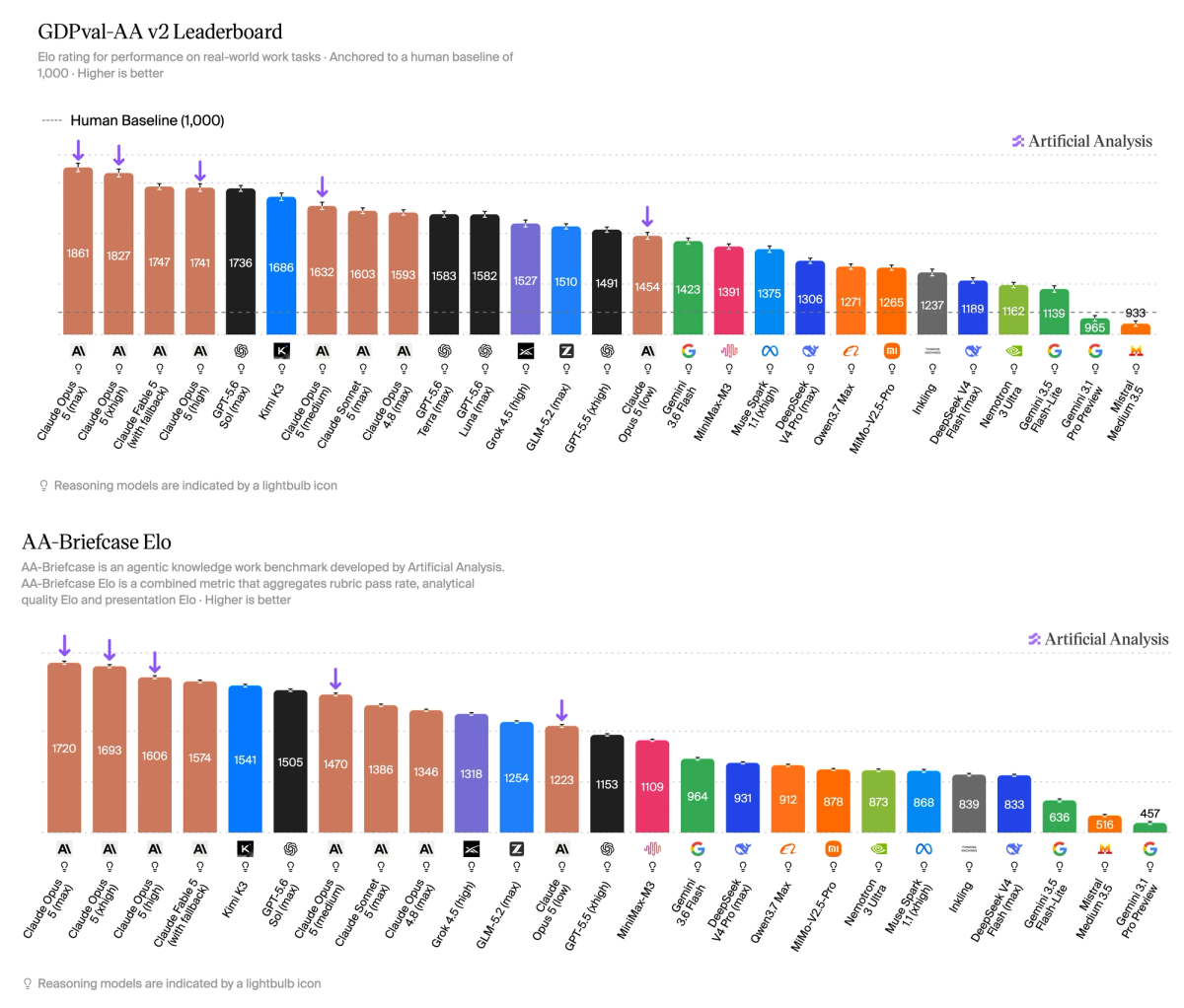
➤ New leader in agentic knowledge work: Claude Opus 5 (max) scores 1861 Elo on GDPval-AA v2, >100 points ahead of Claude Fable 5 and GPT-5.6 Sol (max). On AA-Briefcase, our agentic knowledge work benchmark, it scores 1720 Elo, +146 ahead of Fable 5. These benchmarks test the ability of models to produce accurate and well-presented professional outputs using our open source reference agent harness, Stirrup
➤ Joint first place on the Coding Agent Index: Claude Opus 5 (xhigh) with Claude Code leads the Artificial Analysis Coding Index, including the highest score on SWE-Atlas-QnA
➤ Frontier intelligence with reduced cost: Claude Opus 5 (max) costs $2.03 on average per Intelligence Index task, below Claude Fable 5 (with fallback) at $2.75, but still above Claude Opus 4.8 (max) at $1.80 and Claude Sonnet 5 (max) at $1.53. However, at high and xhigh reasoning efforts Opus 5 can outperform both Opus 4.8 and Claude Sonnet 5 at a lower cost per task
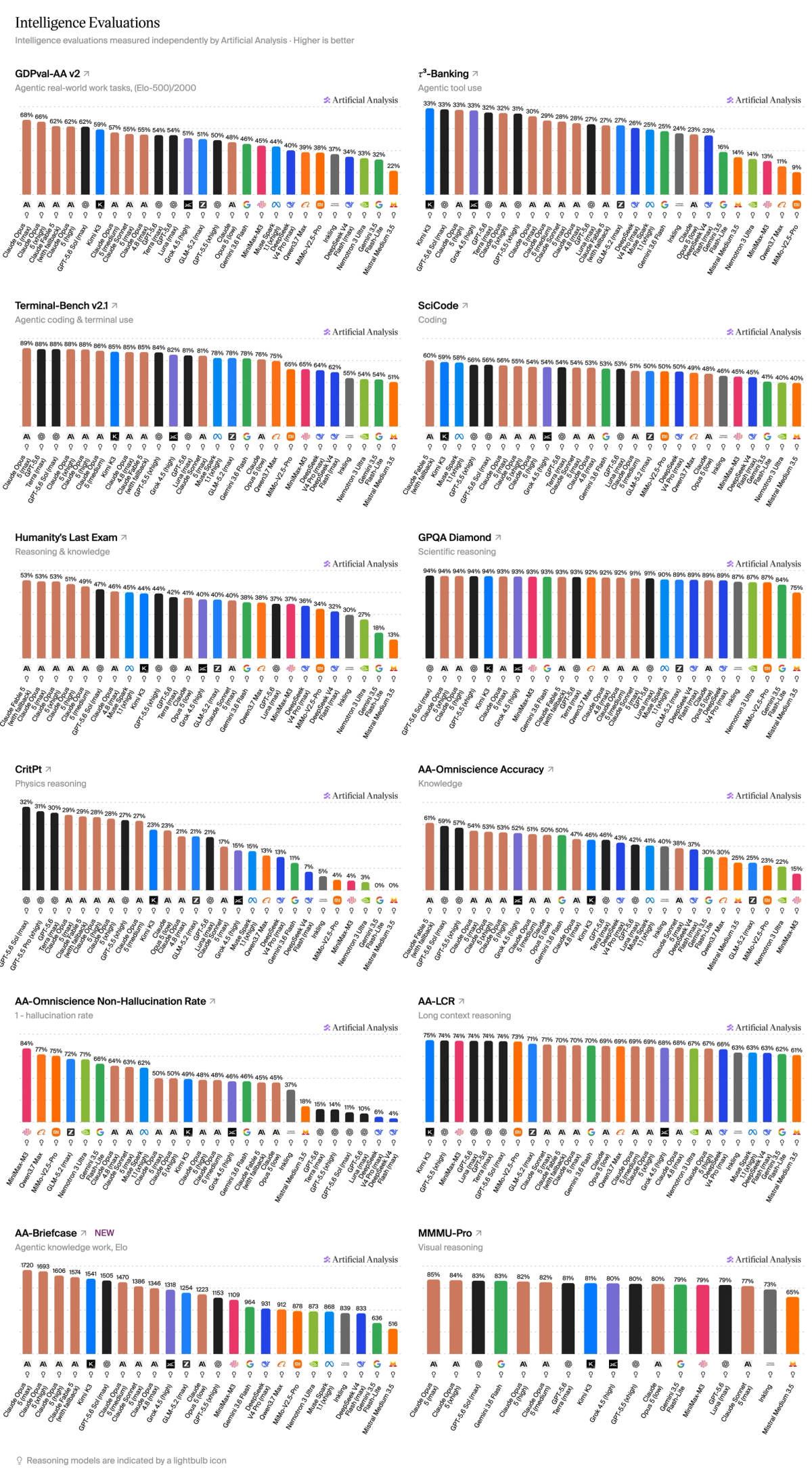
➤ Frontier agentic terminal use: 89% on Terminal-Bench v2.1 at max effort, roughly in line with the leader, GPT-5.6 Sol (xhigh)
➤ Outperformance on scientific reasoning: Along with leading agentic performance, Claude Opus 5 scores 53% on Humanity’s Last Exam in line with Fable 5; on CritPt, a frontier physics evaluation developed by Argonne and UIUC researchers, it also matches Fable 5 but sits behind GPT-5.6 Sol, GPT-5.5 Pro, and GPT-5.6 Terra
➤ Factual knowledge still lags Fable 5: As expected from the models’ size classes, Opus 5 still has lower factual knowledge on AA-Omniscience than Fable 5. It improves +7 points on AA-Omniscience Accuracy over Opus 4.8, but answers more often when uncertain - its hallucination rate rises +14 points to 50%
➤ Improving efficiency, but only on the Intelligence vs. Cost per Task Pareto frontier at high Intelligence levels: Opus 5 outperforms Fable 5 at lower cost, but at lower effort levels it sits just behind the GPT-5.6 family on the Intelligence vs. Cost per Task Frontier
Other model details:
➤ Context window: 1 million tokens (equivalent to Opus 4.8)
➤ Pricing: As with recent Opus launches tokens cost $5/$25 per million tokens of input/output; cache pricing remains at a 25% premium for cache writes ($6.25 per million tokens) with 5-minute time to live, and 90% discount for cache hits ($0.50 per million tokens)
➤ Five effort settings (low, medium, high, xhigh, max), and support for server-side fallback as with Fable 5. Intelligence Index evaluations were run with Opus 4.8 fallback enabled
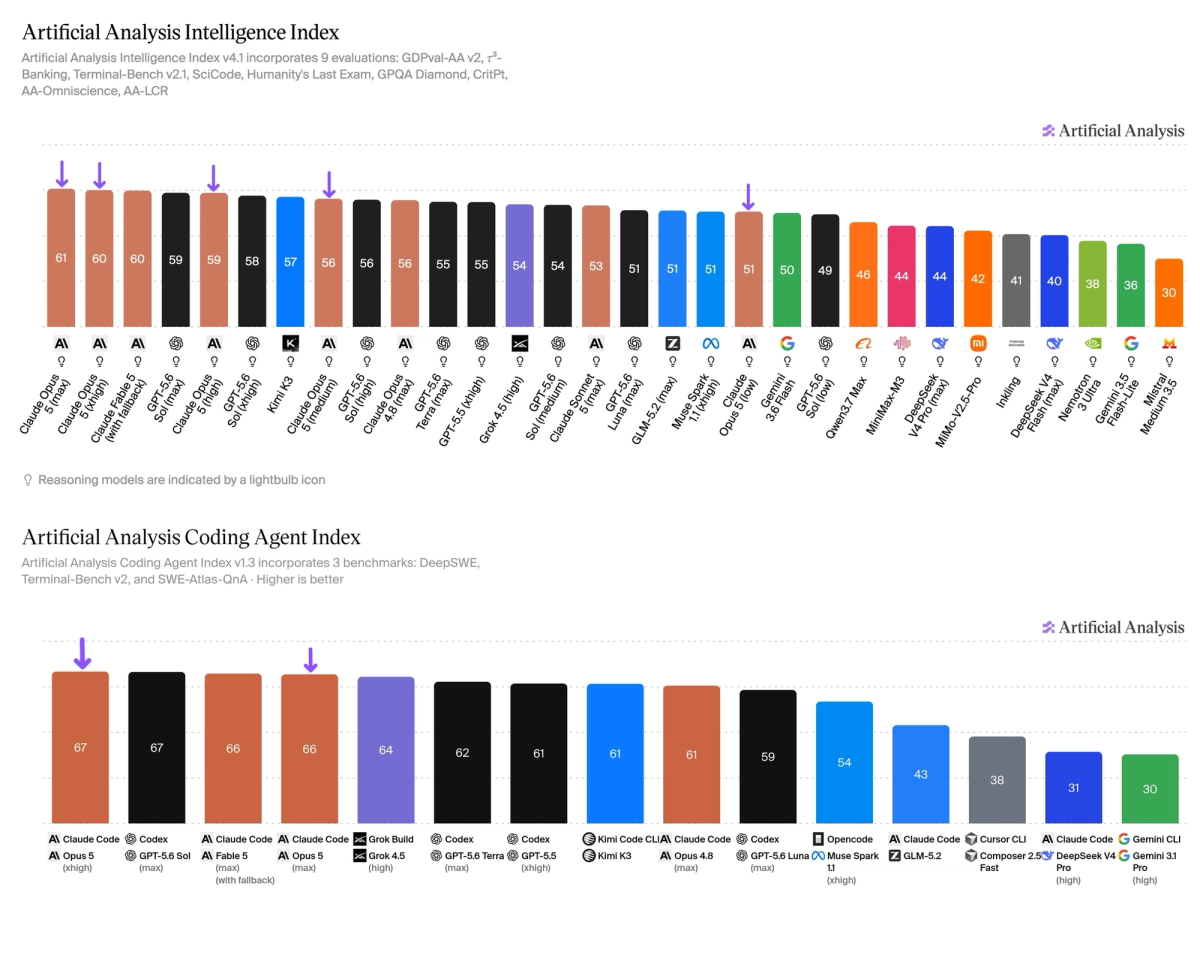
Claude Opus 5 (max) is the new leader on both GDPval-AA v2 (1861 Elo, +114 over Claude Fable 5) and AA-Briefcase (1720 Elo, +146 over Fable 5). These benchmarks test the ability of models to produce accurate and well-presented professional outputs using our open source reference agent harness, Stirrup
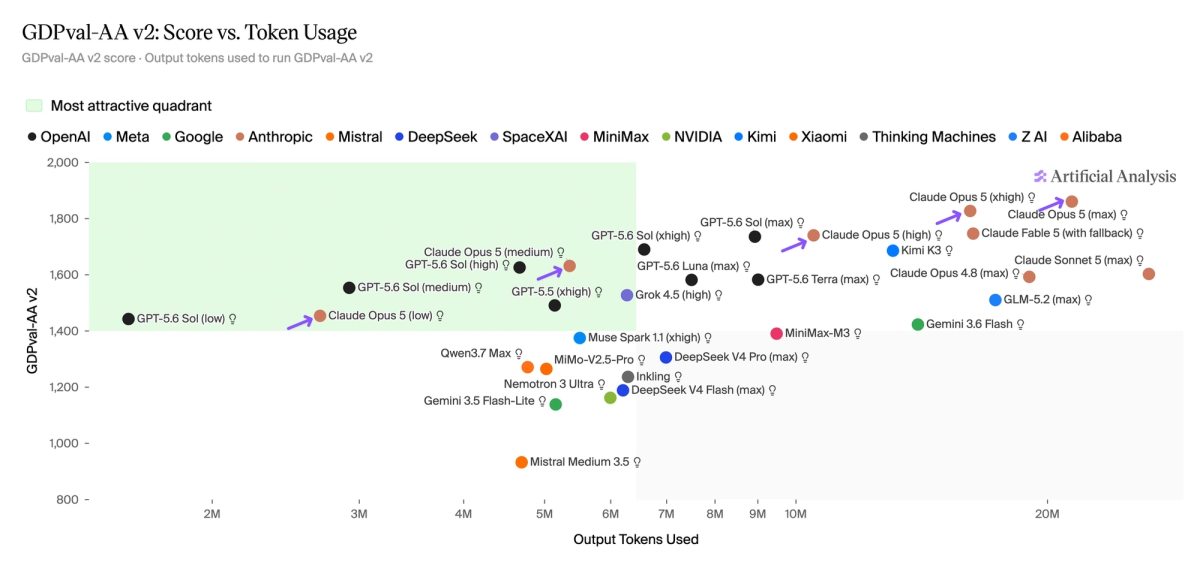
Claude Opus 5's effort setting spans a wide range of token usage-performance tradeoffs. On GDPval-AA v2, effort levels span 407 Elo points, with output token usage ranging around 8x from low to max effort. Like with GPT-5.6 Sol, this means Opus 5 can use either far fewer or far more tokens to complete the evaluation than models from other labs, depending on effort settings
Full breakdown of the individual evaluations in the Artificial Analysis Intelligence Index for Claude Opus 5 with max effort
Read the latest
First AA-AgentPerf-Local results for an NVIDIA RTX Spark N1X laptop
An NVIDIA RTX Spark N1X laptop completes our local agent workload on Qwen3.8 27B in 18.7 minutes.
October 15, 2026
NVIDIA Releases Nemotron 3.5 Super VL and Nemotron 3.5 Bolt 74B A9B
Nvidia’s Nemotron 3.5 Super VL is now the leading US open weight model, scoring 26 on the Artificial Analysis Intelligence Index
October 15, 2026

Welcome to the era of embodied AI: Introducing AA-Robotics v0.1
We are launching AA-Robotics v0.1, our research preview that measures frontier language model performance on understanding, planning, and acting in the physical world. In v0.1, each model is given control of a 6-axis robot arm (5 joints and a gripper) and a simple objective. We’re releasing results for our first eight tasks today.
October 14, 2026