August 5, 2026
Muse Spark 1.2: Improved Agentic Performance at Higher Cost per Task
See model pageMeta’s Muse Spark 1.2 scores 54 on the Artificial Analysis Intelligence Index. Its Meta's third release in four months, significantly improving agentic knowledge work capabilities over prior releases and putting Meta next to SpaceXAI in a tie for third place amongst US labs
Muse Spark 1.2 (xhigh) lands at 54, up 3 points from Muse Spark 1.1 (51) and 11 points from Muse Spark 1.0 (43, April). It enters effectively tied with GPT-5.5 (xhigh, 55) and Grok 4.5 (high, 54), narrowly behind the current frontier models Claude Opus 5 (max, 61), Claude Fable 5 (max w/ fallback, 60), GPT-5.6 Sol (max, 59), and Kimi K3 (max, 57). Meta shared access with us ahead of public release for benchmarking.
Key takeaways:
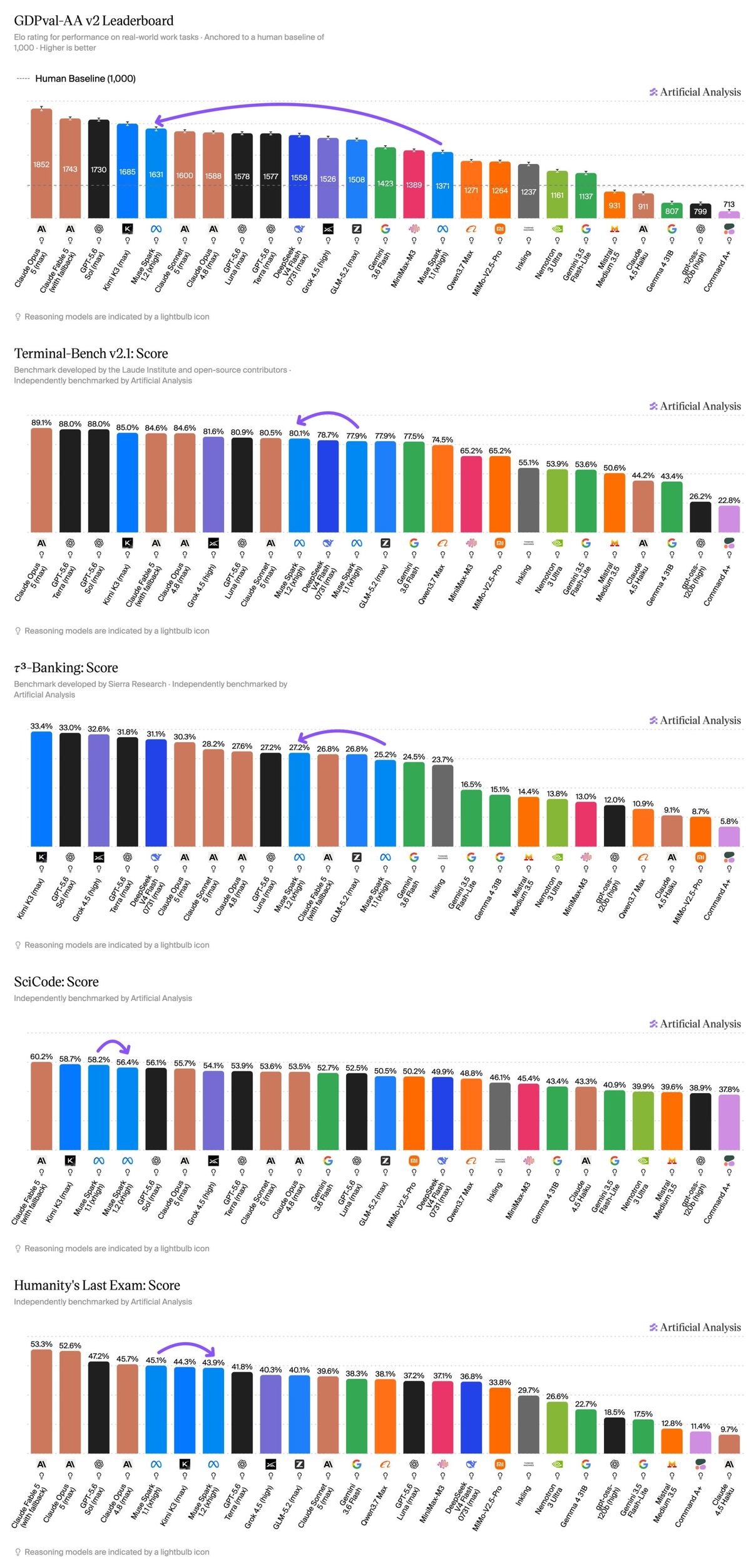
➤ Muse Spark 1.2 gets closer to the frontier on agentic knowledge work: At Muse Spark 1.1’s launch, we noted agentic knowledge work as its clearest gap; Muse Spark 1.2’s gains help to close this. Its GDPval-AA v2 Elo rose 260 points to 1631, #5 among all models we have benchmarked and ahead of Claude Opus 4.8 (max, 1588). GDPval-AA v2 is our leading metric for general agentic performance, measuring models on realistic knowledge work tasks such as preparing presentations and analysis, with shell access and web browsing capabilities in an agentic loop via our reference harness Stirrup. Terminal-Bench v2.1, which measures agentic coding and terminal use, gained 2 points (78% to 80%), and τ³-Banking, which measures agentic tool use, rose 2 points (25% to 27%).
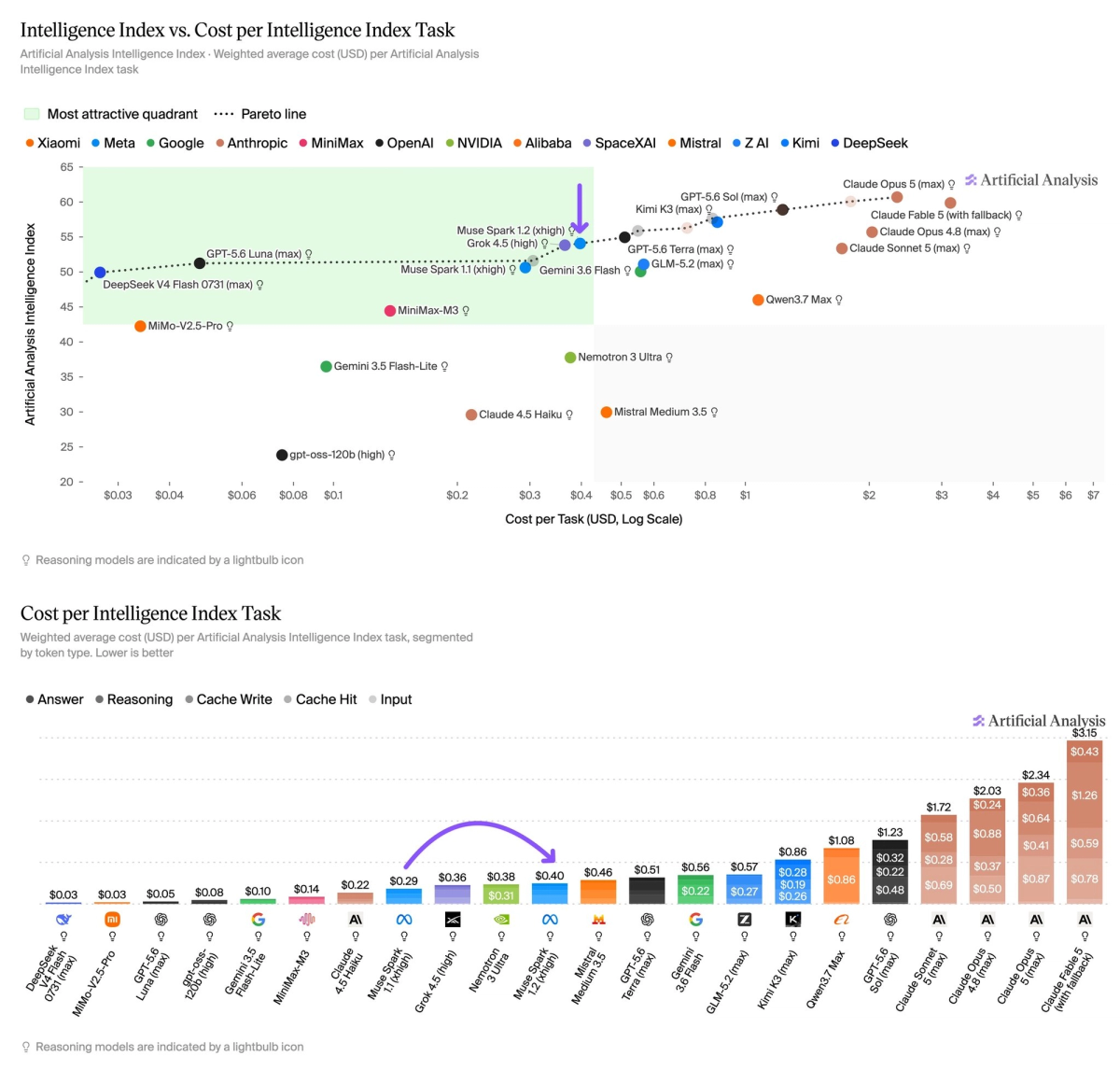
➤ Among the most cost-efficient models at its intelligence level: Muse Spark 1.2 costs $0.40 per Intelligence Index task at Meta’s unchanged $1.25/$4.25 per 1M token pricing, with only Grok 4.5 (high, $0.37) and GPT-5.6 Sol (medium, $0.39) cheaper in its intelligence cluster - GPT-5.6 Terra (max, $0.51), Kimi K3 (max, $0.86), and GPT-5.5 (xhigh, $1.18) all cost more per task. The cost increase over Muse Spark 1.1 ($0.29 per task) is driven by increased token usage per Intelligence Index task, with input tokens up ~53% and output tokens up ~36%, concentrated in GDPval-AA v2.
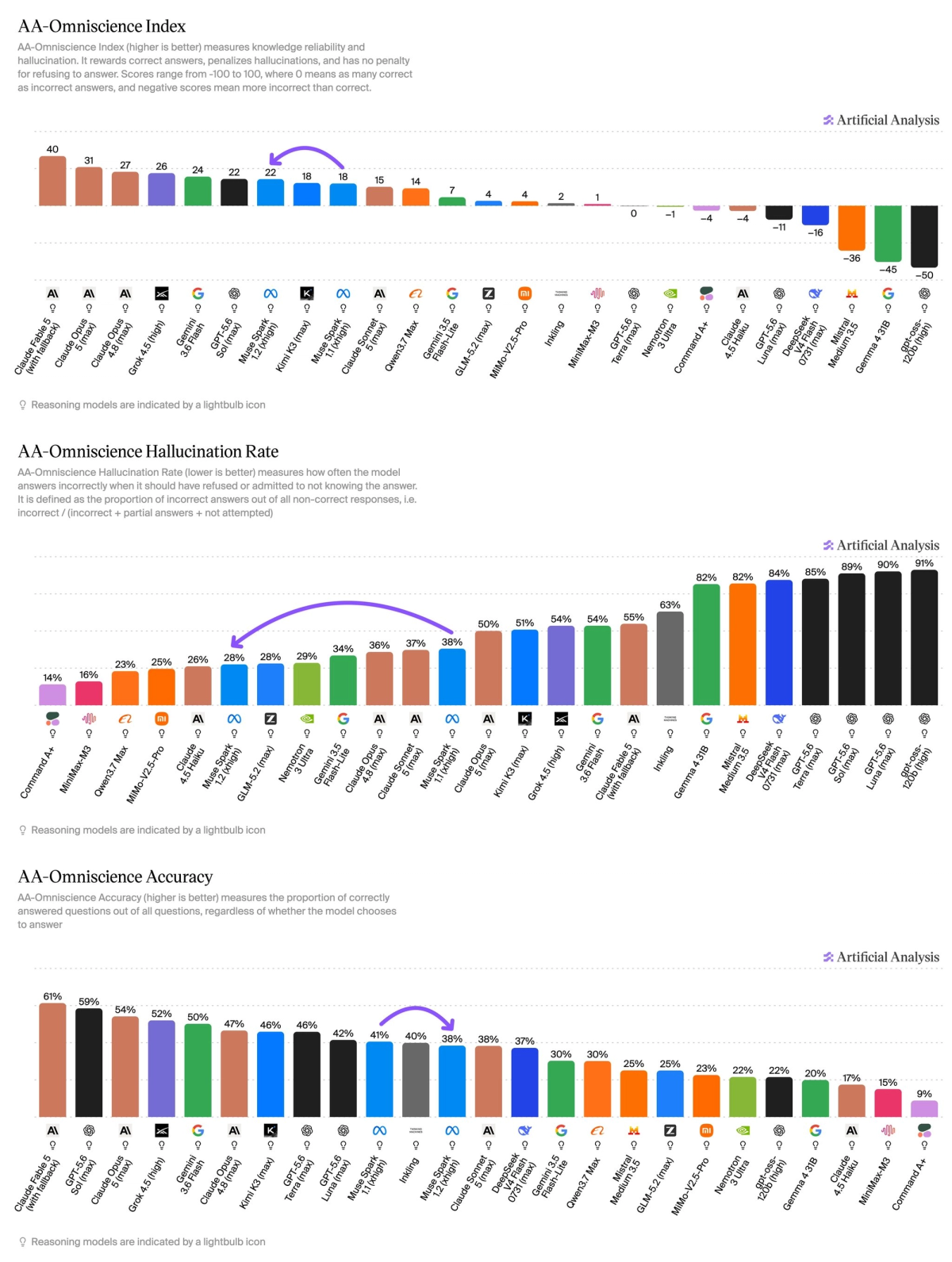
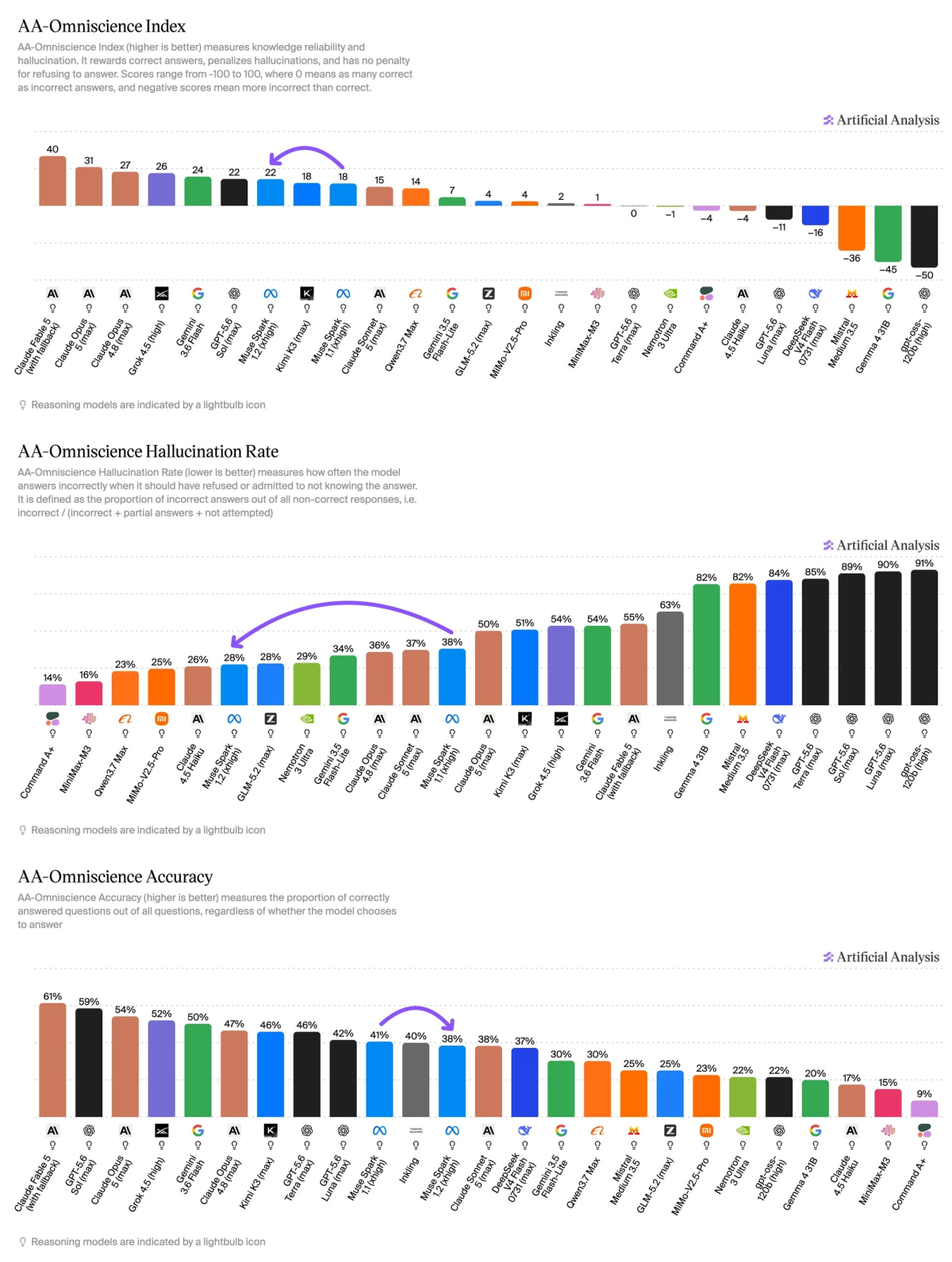
➤ AA-Omniscience abstention rate increases: The score rose from 18 to 22 as the hallucination rate fell 10 points (38% to 28%) and the attempt rate dropped from 82% to 67%. AA-Omniscience measures knowledge reliability and hallucination: it rewards correct answers, penalizes hallucinations, and applies no penalty for declining to answer. Muse Spark 1.2’s heavy abstention (not answering questions when unsure) now drives both the low hallucination rate and a lower accuracy (41% to 38%).
➤ Scientific Reasoning results remain largely unchanged: CritPt, which tests research-level physics reasoning, notably gained 3 points (15% to 18%), while SciCode fell 2 points (58% to 56%) and Humanity’s Last Exam fell 1 point (45% to 44%).
➤ Model details: Muse Spark 1.2 retains Muse Spark 1.1’s 1M token context window and pricing ($1.25/$4.25 per 1M input/output tokens, with cache hits discounted to $0.15 per 1M), and is available on Meta’s first-party API at launch.
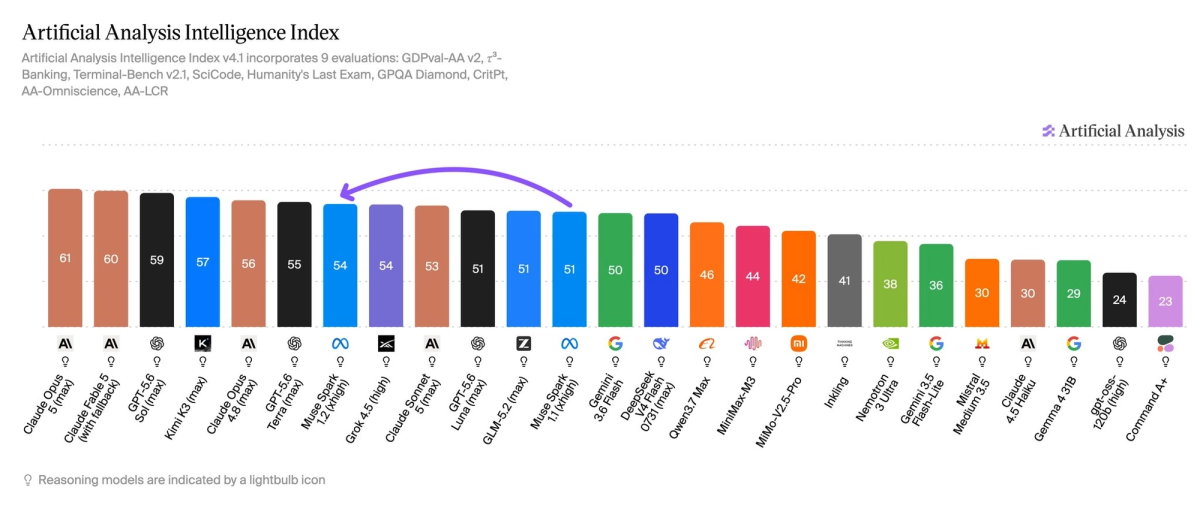
Agentic and intelligence evaluations
The 3 point gain over Muse Spark 1.1 on the Artificial Analysis Intelligence Index is concentrated in agentic evaluations: GDPval-AA v2 +260 Elo (1371 to 1631), Terminal-Bench v2.1 +2 points (78% to 80%), and τ³-Banking +2 points (25% to 27%). The minor regressions are SciCode (-2 points) and Humanity’s Last Exam (-1 point).
GDPval-AA v2 Leaderboard
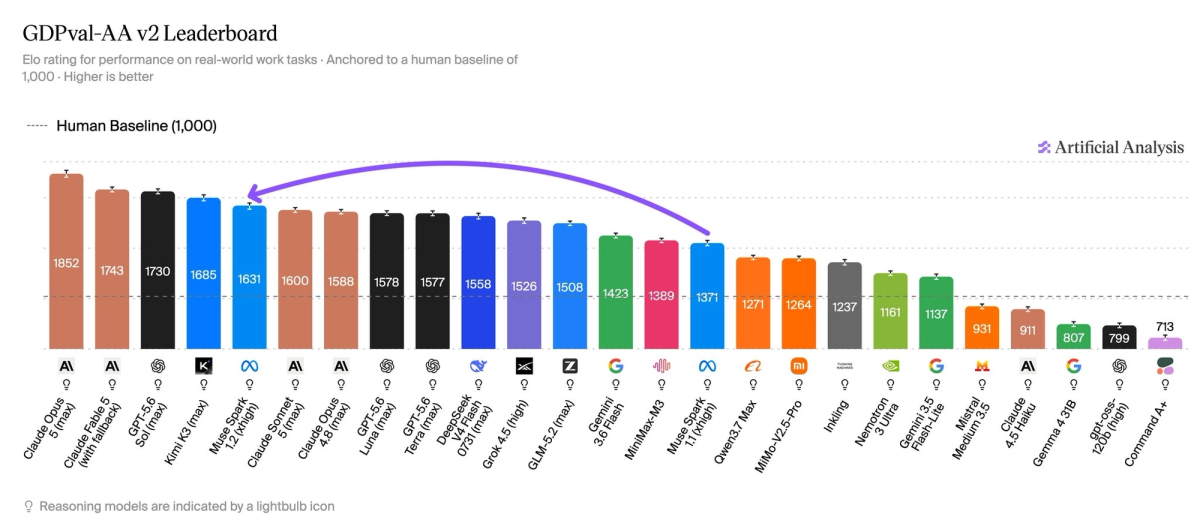
Muse Spark 1.2 ranks #5 on GDPval-AA v2 at 1631 Elo, behind Claude Opus 5 (max, 1852), GPT-5.6 Sol (max, 1730), and Kimi K3 (max, 1685), and ahead of Claude Opus 4.8 (max, 1588). Muse Spark 1.1 scored 1371 at its launch last month.
Intelligence Index vs Cost per Intelligence Index Task
Muse Spark 1.2 sits near the Pareto frontier of Intelligence vs Cost per Intelligence Index Task, at $0.40 per task.
AA-Omniscience Index
Muse Spark 1.2 continues Meta’s AA-Omniscience pattern: the score rose from 18 to 22, driven by abstention for the second consecutive release. The hallucination rate fell 10 points (38% to 28%) as the attempt rate dropped to 67%, while accuracy slipped from 41% to 38%.
Intelligence Evaluations
Full breakdown of the individual evaluations in the Artificial Analysis Intelligence Index:
See Artificial Analysis for further details and benchmarks of Muse Spark 1.2: https://artificialanalysis.ai/models/muse-spark-1-2
Read the latest
Code2Video-AA: how well do AI models design videos in code?
Artificial Analysis' implementation of HeyGen's Code2Video Bench, evaluating how well models create short product and brand videos from 114 design briefs using HyperFrames HTML.
October 26, 2026
GPT-6.1 Terra pushes the cost efficiency frontier
OpenAI has released GPT-6.1 Terra, pushing the cost efficiency frontier. It is the first Terra-class model since GPT-5.6, and is more intelligent for less than a third of the cost
October 26, 2026
Kimi K3.1 Pro launches at 4th on the Intelligence Index and will lead open weights models
Kimi K3.1 Pro launches at 4th on the Artificial Analysis Intelligence Index and will lead open weights models
October 23, 2026