May 26, 2026
OpenBMB has released MiniCPM5-1B (Non-reasoning), the leading 1B open-weights model, scoring 17.9 on the Artificial Analysis Intelligence Index
See model pageOpenBMB is a China-based lab jointly founded in 2022 by Tsinghua University's NLP Lab and ModelBest Inc. This release extends the open weights Pareto frontier for Intelligence vs. Parameters at the sub-2B scale. It sits almost 2 points ahead of the best-performing 2B open weights model, Alibaba's Qwen3.5 2B (Reasoning, 16.3), and 7 points ahead of Qwen3.5 0.8B (Reasoning, 10.5).
Unlike the recently released MiniCPM-V 4.6 1.3B Instruct, MiniCPM5-1B (Non-reasoning) does not support native multimodal input, and is text input and output only.
Key results:
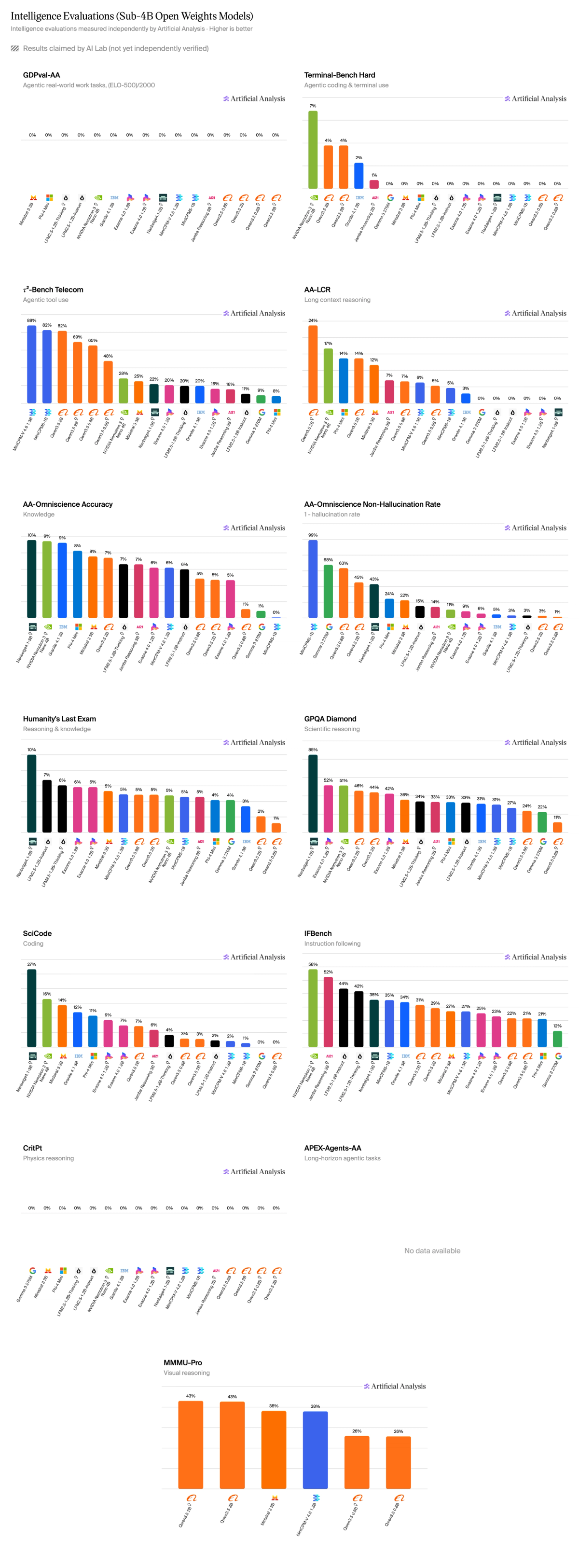
➤ MiniCPM5-1B scores 17.9 on the Artificial Analysis Intelligence Index, the highest of any open weights model at 1B parameters or below by 7.4 points. The next-most-intelligent open weights model at this scale is Qwen3.5 0.8B (Reasoning, 10.5). No other open weights model under 2B parameters has exceeded 15 on the Intelligence Index; its predecessor MiniCPM-V 4.6 1.3B sits at 12.7.
➤ MiniCPM5-1B extends the open weights Pareto frontier on both Intelligence vs. Total Parameters and Intelligence vs. Active Parameters at the sub-2B scale. It surpasses its predecessor MiniCPM-V 4.6 1.3B (12.7) by 5.3 points at ~23% fewer parameters, and beats Qwen3.5 2B (Reasoning, 16.3) by 1.6 points at less than half the parameter count.
➤ MiniCPM5-1B is more token-efficient than the larger reasoning peers it surpasses, but uses more output tokens than its (also non-reasoning) predecessor MiniCPM-V 4.6 1.3B. It used 12.6M output tokens to run the Intelligence Index, ~31x fewer than Qwen3.5 2B (Reasoning, 389M) and ~8x fewer than Qwen3.5 2B (Non-reasoning, 100M), but ~2.3x more than MiniCPM-V 4.6 1.3B's 5.4M.
➤ AA-Omniscience score of -1 is the highest in its size class, earned by abstaining rather than hallucinating. MiniCPM5-1B declines to answer the vast majority of AA-Omniscience questions, avoiding the hallucination penalty that pulls sub-2B peers down to the -70 to -89 range (Qwen3.5 0.8B Non-reasoning at -89, MiniCPM-V 4.6 1.3B at -85, Exaone 4.0 1.2B Non-reasoning at -83). Choosing to abstain rather than guess is the more honest posture, and AA-Omniscience credits it positively.
Additional model details:
➤ Size: 1B total parameters (dense)
➤ Context window: 128K
➤ Modality: Text input and output only
➤ Precision: BF16
➤ License: Apache 2.0
➤ Providers: No confirmed providers upon release
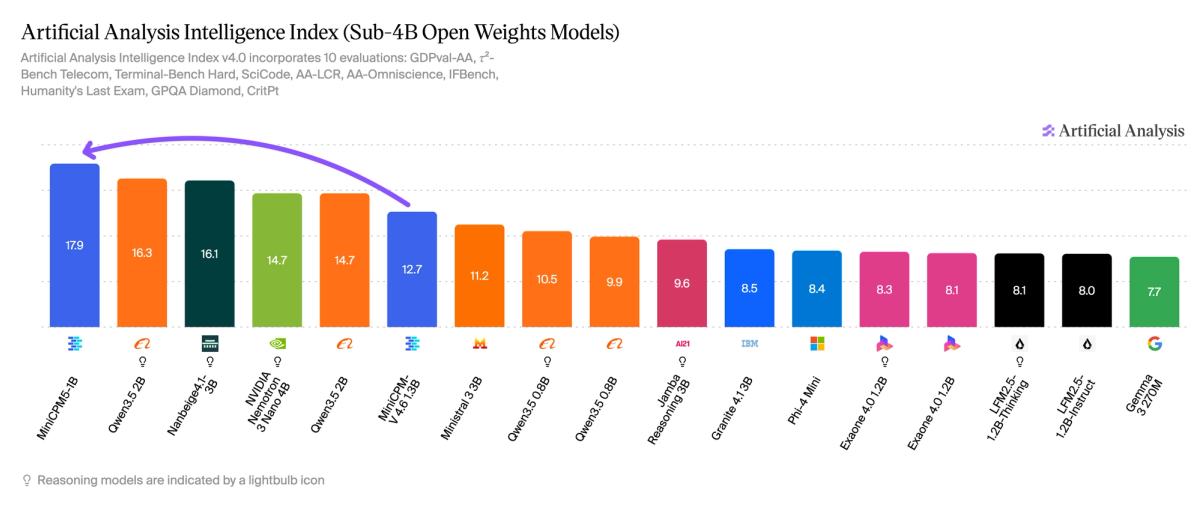
MiniCPM5-1B extends the open weights Pareto frontier for Intelligence vs. Parameters at the sub-2B scale, scoring 17.9 with just 1B parameters, a 5-point increase in intelligence with an approximately 23% decrease in parameter count compared to OpenBMB's previous MiniCPM-V 4.6 1.3B.
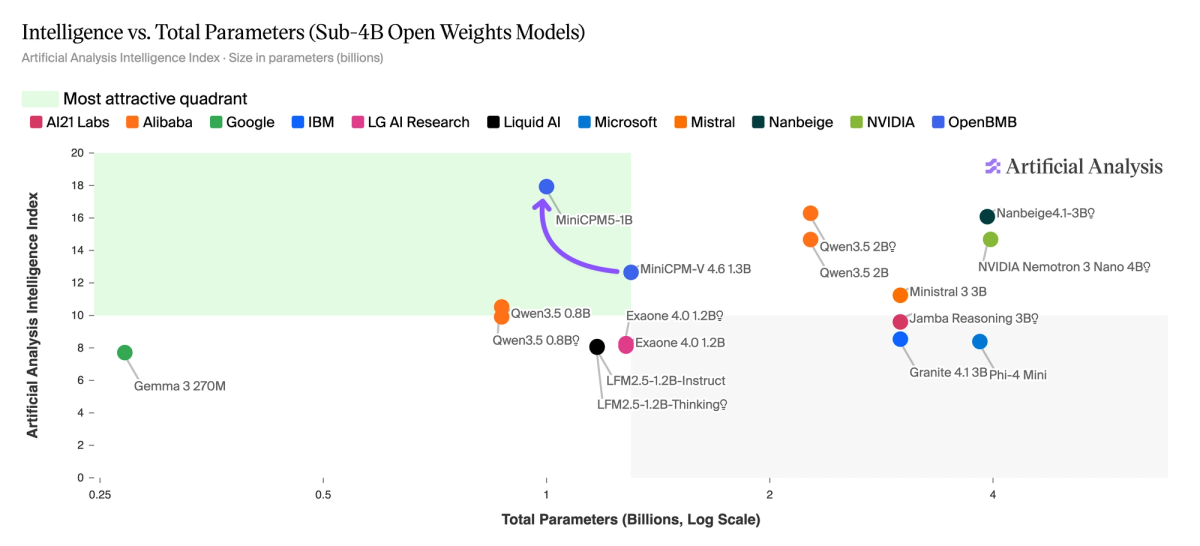
MiniCPM5-1B uses up to 31x fewer output tokens than the larger reasoning peers it surpasses on the Intelligence Index. It used 12.6M output tokens to run the Intelligence Index, ~31x fewer than Qwen3.5 2B (Reasoning, 389M) and ~8x fewer than Qwen3.5 2B (Non-reasoning, 100M), though ~2.3x more than its predecessor MiniCPM-V 4.6 1.3B's 5.4M.
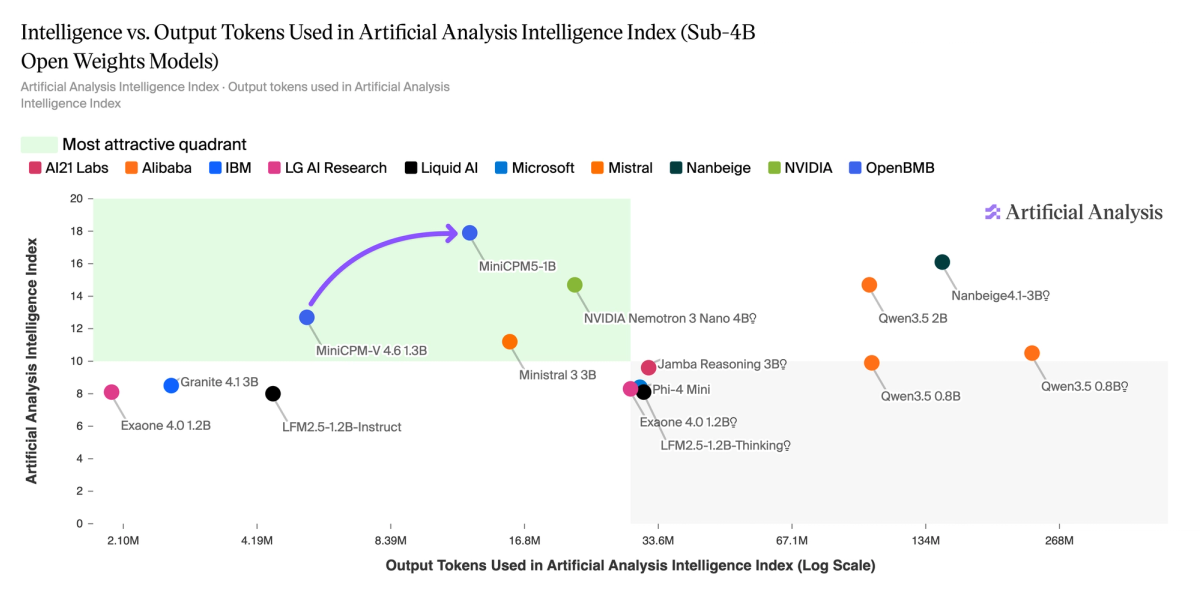
MiniCPM5-1B scores -1 on AA-Omniscience, the highest in its size class, earned by abstaining rather than hallucinating. Sub-2B peers typically attempt a large proportion of questions and hallucinate at high rates, resulting in low AA-Omniscience scores; MiniCPM5-1B declines the majority of questions, an honest posture that AA-Omniscience credits positively.
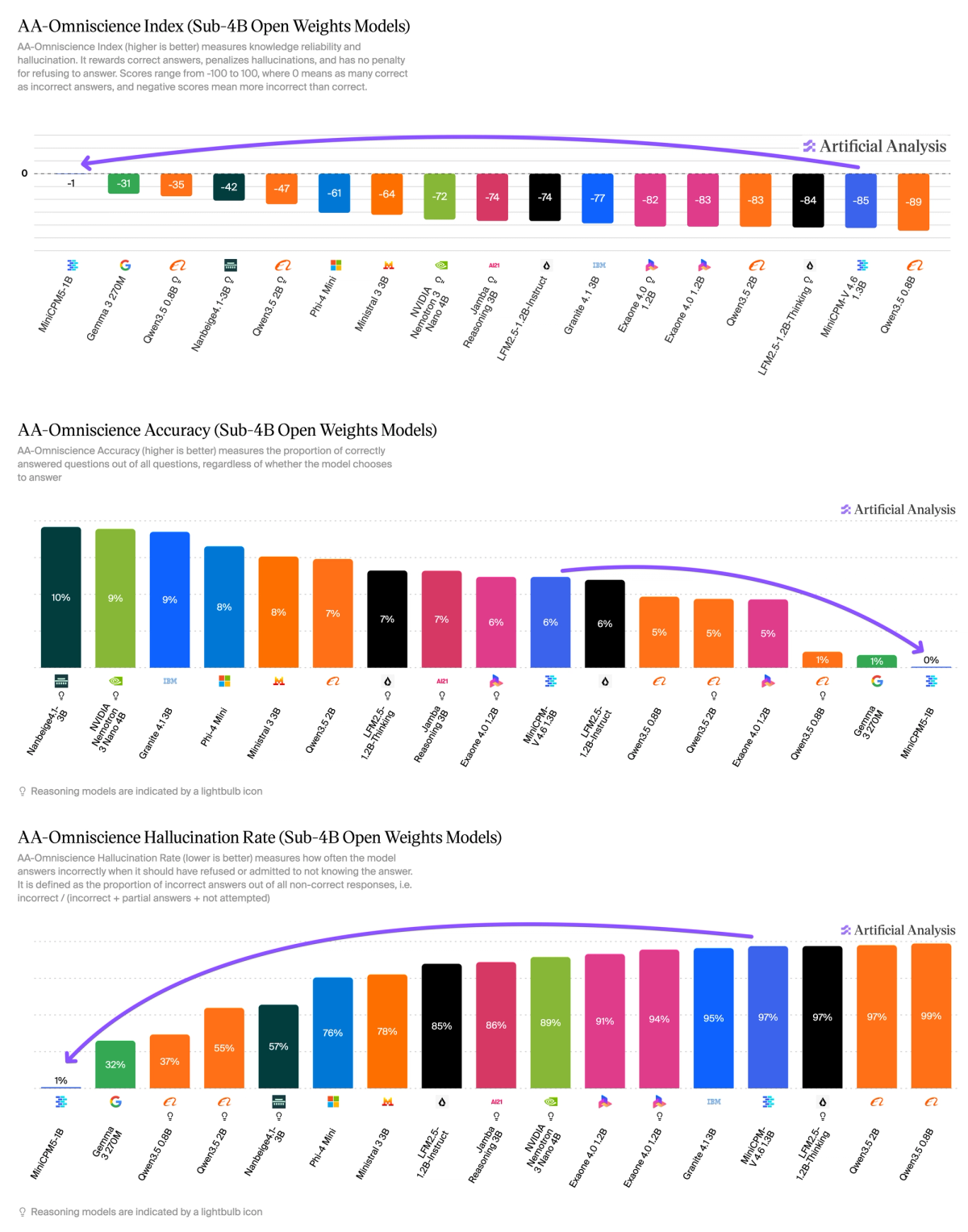
The full Artificial Analysis Intelligence Index per-evaluation breakdown:
Read the latest

Welcome to the era of embodied AI: Introducing AA-Robotics v0.1
We are launching AA-Robotics v0.1, our research preview that measures frontier language model performance on understanding, planning, and acting in the physical world. In v0.1, each model is given control of a 6-axis robot arm (5 joints and a gripper) and a simple objective. We’re releasing results for our first eight tasks today.
October 14, 2026
Artificial Analysis Decision Index v1.0
The Artificial Analysis Decision Index benchmarks decision models, a new category of models that answer structured decisions in a single call with a probability for each option. Version 1.0 combines four evaluations across classification, tool calling, knowledge, hallucination, and reasoning.
October 13, 2026
Announcing AA-3D: a benchmark for AI models building interactive 3D experiences
AA-3D is a new benchmark of how well AI models build interactive 3D experiences. Each model turns a written brief into a working three.js scene in an offline sandbox, and our recruited panel compares the scenes in blind pairwise votes.
October 12, 2026