June 30, 2026
Claude Sonnet 5: strong agentic performance at a higher cost per task
See model pageClaude Sonnet 5 achieves 53 on the Artificial Analysis Intelligence Index, but without promotional pricing will cost more per task than Opus 4.8
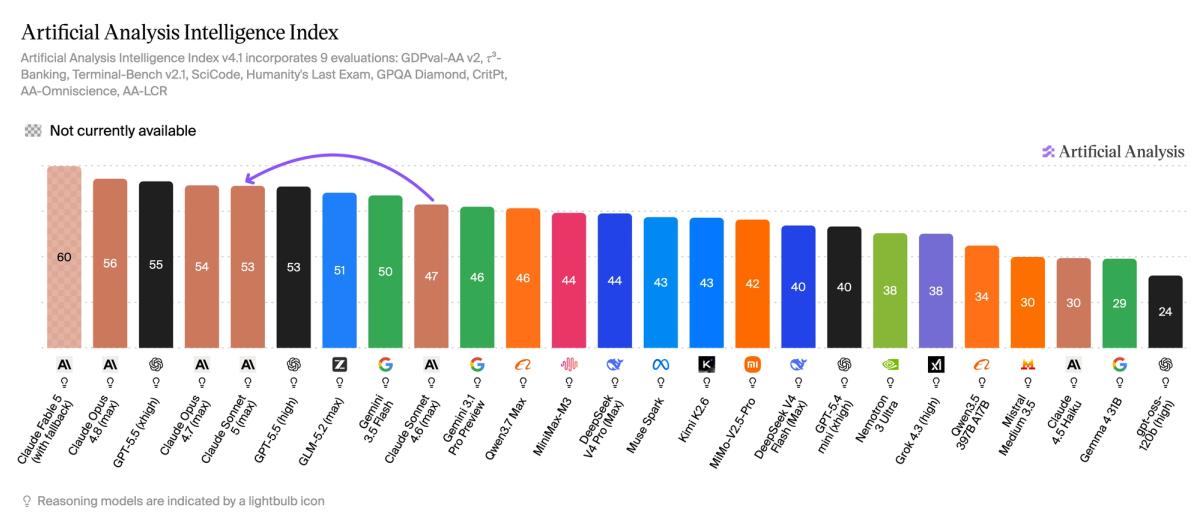
We supported Anthropic to evaluate Claude Sonnet 5 ahead of release: with max effort it improves 6 points over Sonnet 4.6 to achieve the same Intelligence Index as GPT-5.5 with high reasoning, but remains behind Opus 4.7 and 4.8
Key takeaways:
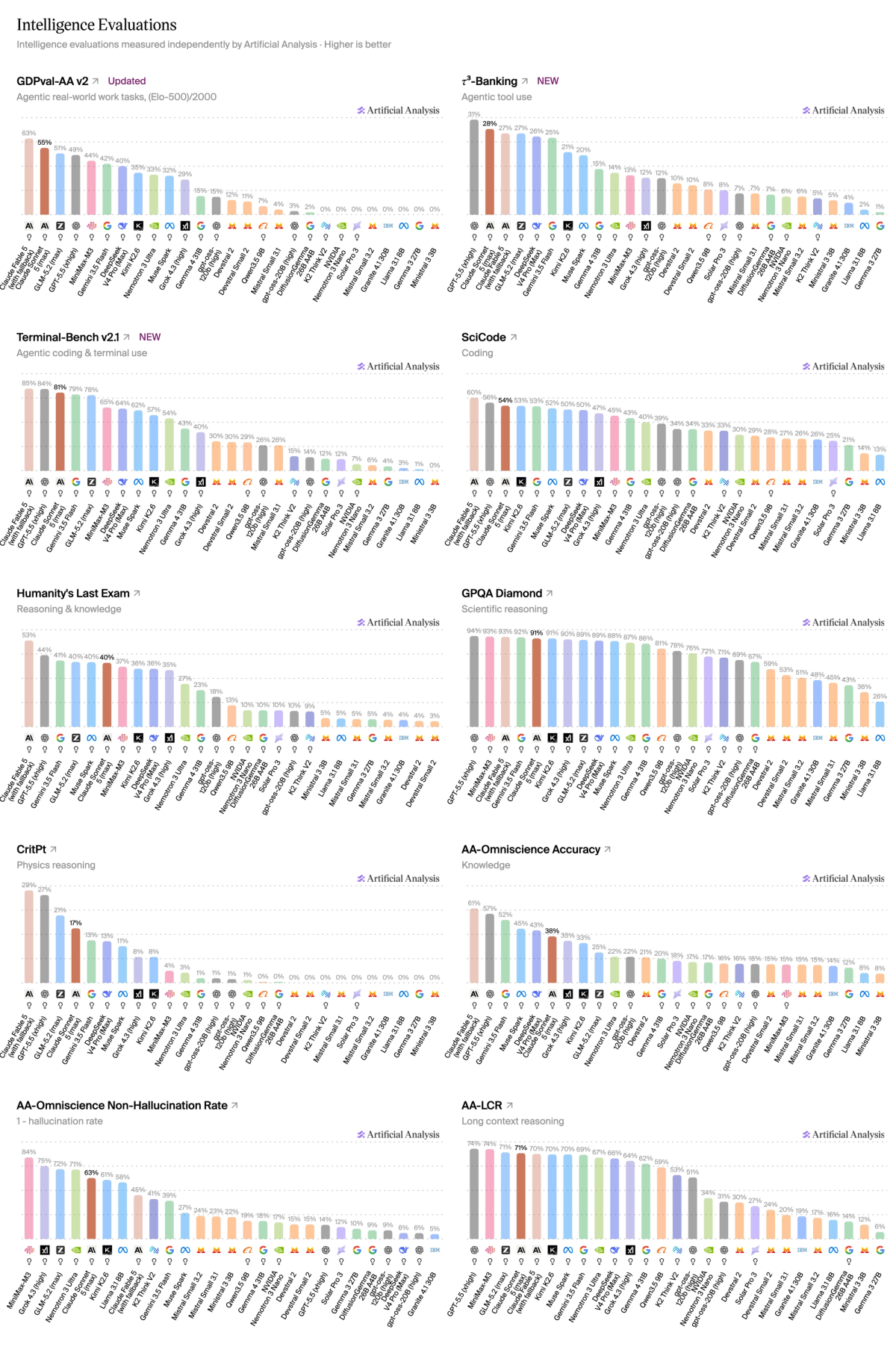
➤ Claude Sonnet 5 is the #5 model on the Artificial Analysis Intelligence Index, only 2-3 points behind GPT-5.5 (xhigh) and Opus 4.8 (max)
➤ With max effort, Sonnet 5 works harder than previous Anthropic models: it used ~40% more output tokens per Intelligence Index task than Sonnet 4.6, and ~3x the agentic turns for our knowledge work evaluations AA-Briefcase and GDPval-AA. This behavior scales well with the ‘effort’ setting, with the max effort using around 6x more turns than low effort on GDPval-AA
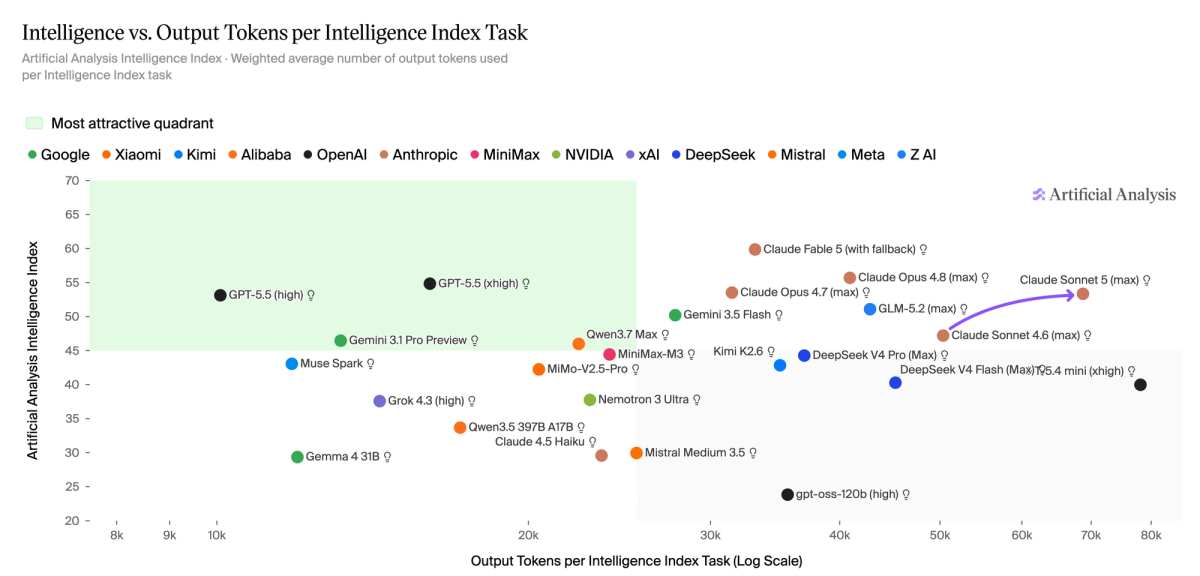
➤ Claude Sonnet 5 costs more per task than Opus 4.8 before accounting for promotional pricing: Claude Sonnet 5 costs $2.29 per task on the Intelligence Index, a ~2x increase compared to Sonnet 4.6 and ~15% more than Claude Opus 4.8. This is driven entirely by increased token usage. Sonnet 5 retains the same $3/$15 per 1M input/output token pricing as Sonnet 4.6 (compared to $5/$25 for Opus 4.8), however Anthropic is offering a one-third reduction to $2/$10 until September 1. Our results use standard $3/$15 pricing
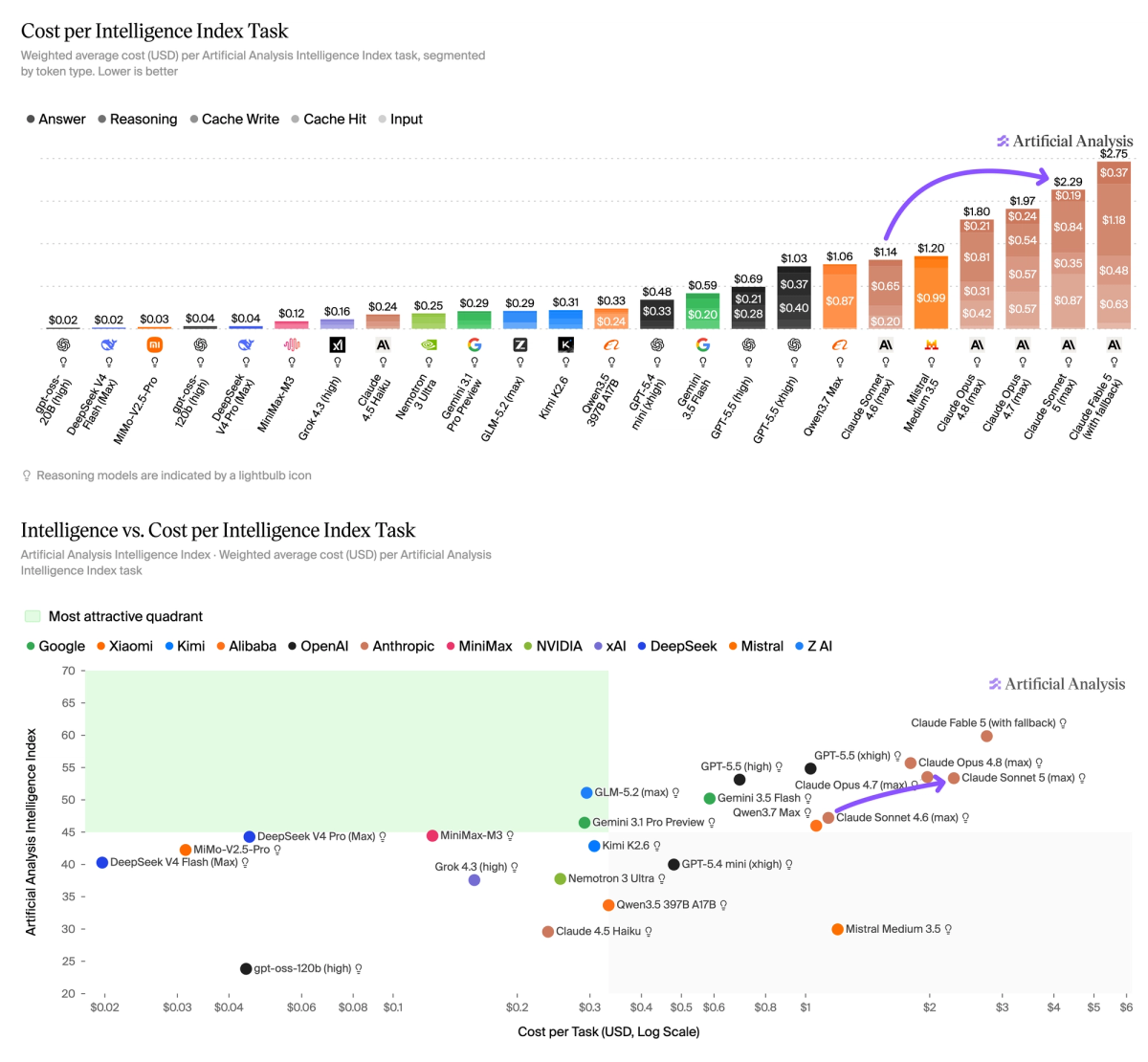
➤ Sonnet 5 matches or outperforms Opus 4.8 on agentic knowledge work tasks: on both AA-Briefcase and GDPval-AA, Claude Sonnet 5 sits just ahead of Opus 4.8, trailing only Claude Fable 5 (which is not currently generally available). These benchmarks test the ability of models to produce accurate and well-presented professional outputs using our open source reference agent harness, Stirrup
➤ For reasoning and knowledge-heavy tasks, Sonnet still sits behind its larger siblings: despite substantial gains across many evaluations, heavy reasoning and knowledge benchmarks still show Opus 4.8 ahead of Sonnet 5. On CritPt, a frontier physics reasoning benchmark developed by researchers at Argonne and UIUC, Sonnet 5 scores 17% - this is 14 points higher than its predecessor, but behind GLM-5.2, Claude Opus and Fable, and GPT-5.5 (xhigh and Pro)
➤ Sonnet 5 also showed significant improvements over Sonnet 4.6 on Terminal-Bench v2.1 (+9 points), Humanity’s Last Exam (+10 points), and SciCode (+7 points), with relatively flat scores elsewhere
Other key model details:
➤ Context window of 1 million tokens (equivalent to Sonnet 4.6)
➤ Pricing of $3/$15 per 1M tokens of input/output (reduced to $2/$10 until September 1); cache pricing remains at a 25% premium for cache writes ($3.75 per million tokens) with 5-minute time to live, and 90% discount for cache hits ($0.3 per million tokens)
➤ Effort remains the recommended way of configuring model performance and latency. Sonnet 5 adds an additional ‘xhigh’ effort setting relative to Sonnet 4.6, matching the 5 effort levels available on Opus 4.8 (max, xhigh, high, medium, low)
Compare Claude Sonnet 5 with other leading models at: https://artificialanalysis.ai/models/claude-sonnet-5
Read the latest
Announcing Harvey LAB-AA v1.1: adding hallucination checks to raise the bar for agentic legal work
Harvey LAB-AA v1.1 adds hallucination auditing with a new Hallucination-Gated All-Pass Rate headline metric, a three-judge grading panel, and Harvey's latest private dataset with improved tasks and criteria.
October 8, 2026

Introducing trusted-access models to the Artificial Analysis Cyber Index
GPT-6 Sol (Daybreak Blue) now leads the Cyber Index
October 8, 2026
Anthropic has released Claude Haiku 5.5
Claude Haiku 5.5 scores 43 on the Artificial Analysis Intelligence Index, up 26 points one year after the last Haiku release
October 7, 2026