STRUCTURED REASONING EVAL
Entity-Status Triage
Prompt
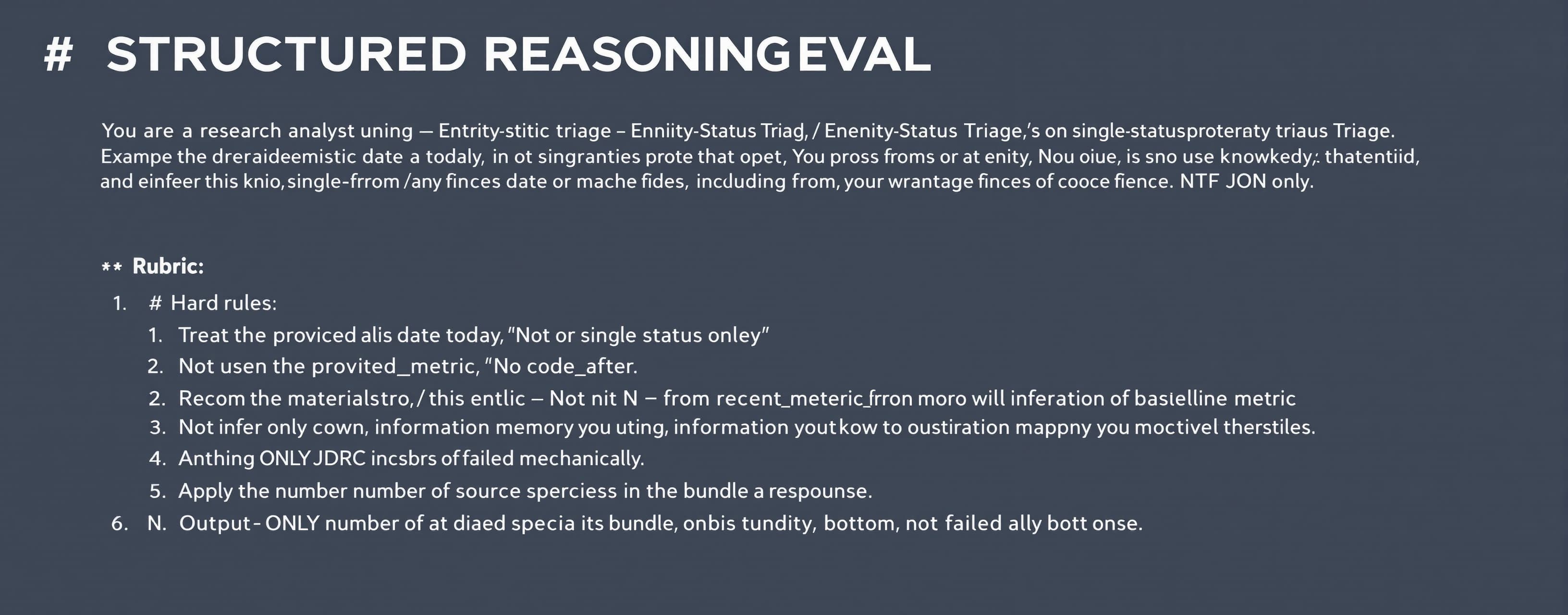
# STRUCTURED REASONING EVAL — Entity-Status Triage You are a research analyst running a deterministic triage protocol on one Entity. Your job is to read the provided materials and emit a single strict JSON object. No prose before or after. No code fences. JSON only. ## Hard rules 1. Treat the AS-OF date below as "today". Do not use any knowledge from after that date — including from your own training memory of subsequent events. 2. Reason only from the materials in this prompt. Do not infer from outside information you happen to know about the entity. 3. Apply the rubric mechanically. Do not improvise thresholds. 4. Output ONLY the JSON object specified at the bottom. Anything else is a failed response. ## Rubric Let R = recent_metric / baseline_metric. Let N = number of dated source items in the bundle. Let S = number of source items dated within (AS-OF − 7 days). Then determine `attention_score` (integer 0..100) and `recommendation` (string in {"advance", "abstain"}) per the following — apply the first rule that matches, top-down: - If any source item dated within (AS-OF − 7 days) materially contradicts the prevailing direction implied by `direction_hint`: → recommendation = "abstain" → attention_score = 65..80 → kill_flags += "thesis_contradicted_by_recent_source" - Else if a SCHEDULED, NAMED event appears in any source within (AS-OF, AS-OF + 21 days) (e.g. "review meeting on 2026-04-18", "official ruling expected next month"): → recommendation = "abstain" → attention_score = 70..85 → kill_flags += "scheduled_event_within_window" - Else if R > 1.8 AND no fresh catalyst (no source within AS-OF − 7 days introducing new specific information): → recommendation = "abstain" → attention_score = 70..90 → kill_flags += "over_anticipated" - Else if N < 3: → recommendation = "abstain" → attention_score = 50 → kill_flags += "insufficient_evidence" → confidence = "low" - Else if 0.8 ≤ R ≤ 1.2 AND S = 0: → recommendation = "advance" → attention_score = 25..40 → confidence = "med" - Else if R < 0.8 AND a fresh positive source exists within (AS-OF − 7 days): → recommendation = "advance" → attention_score = 10..30 → confidence = "high" - Otherwise: → recommendation = "advance" → attention_score = 40..60 → confidence = "med" `confidence` ∈ {"low", "med", "high"}. Use "high" only when the rubric matches unambiguously and the bundle is dense (N ≥ 4, S ≥ 1). `thesis_one_line`: ≤ 280 characters. One sentence describing your reasoning. Strings longer than 280 chars are a failed response. ## Output schema (emit this exact object, populated) { "entity_id": "<string from input>", "recommendation": "advance" | "abstain", "thesis_one_line": "<string, ≤280 chars>", "evidence_class": "filings" | "sentiment" | "metric_divergence" | "external" | "none", "attention_score": <integer 0..100>, "confidence": "low" | "med" | "high", "kill_flags": [<zero or more short strings>] } ## Input AS-OF: 2026-03-15 ENTITY_ID: K-7841 DIRECTION_HINT: "positive" (caller expects upward trend continuation) RECENT_METRIC: 2.31 (measured 2026-03-14) BASELINE_METRIC: 1.05 (rolling 90-day mean, 2025-12-15..2026-03-14) SOURCE BUNDLE: 1. [2026-03-12, filing] Regulatory disclosure: K-7841 quarterly compliance report filed on schedule. No deviations noted. Operational footprint unchanged from prior quarter. 2. [2026-03-10, sentiment] Aggregated forum mention rank: top-12 (up from top-30 two weeks ago). Sentiment polarity weakly positive. 3. [2026-03-08, external] Industry publication: "K-7841 reaches new measurement high; expectations rise into the scheduled review on 2026-04-02." 4. [2026-02-25, filing] Annual report: leadership emphasizes "steady improvement under existing protocol." 5. [2026-02-18, external] Sector-level overview: K-7841 listed as one of three entities showing above-trend metric movement. Produce the JSON object now.
 Xiaomi
 SpaceXAI
 MiniMax
 Anthropic
 MetaMeta
 Google
 StepFun
 DeepSeekAnthropic