June 16, 2026
GLM-5.2 is the new leading open weights model on the Artificial Analysis Intelligence Index
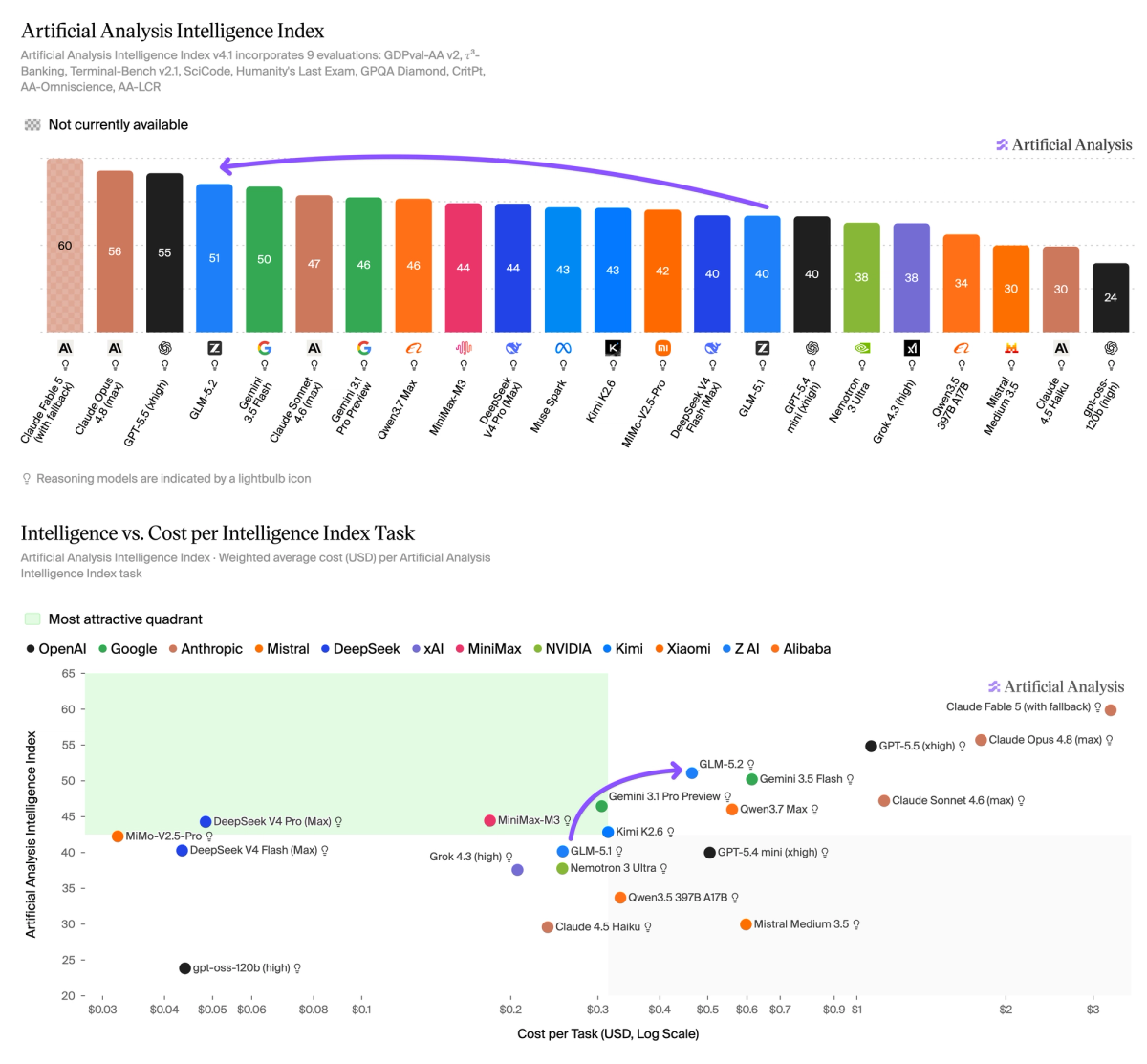
See model pageZ ai’s GLM-5.2 is the new leading open weights model on the Artificial Analysis Intelligence Index scoring 51 and it sits on the Pareto frontier of Intelligence vs Cost per Task
GLM-5.2 is the same size as GLM-5.1 (744B total / 40B active parameters) but scores 11 points higher on the Intelligence Index v4.1, placing ahead of MiniMax-M3 (44) and DeepSeek V4 Pro (max, 44). On the first-party API it is priced in line with GLM-5.1 at $1.4/$4.4/$0.26 per 1M input/output/cache hit tokens
Key results:
➤ GLM-5.2 is the leading open weights model on the Intelligence Index v4.1. At 51, it leads MiniMax-M3 (44), DeepSeek V4 Pro (max, 44) and Kimi K2.6 (43)
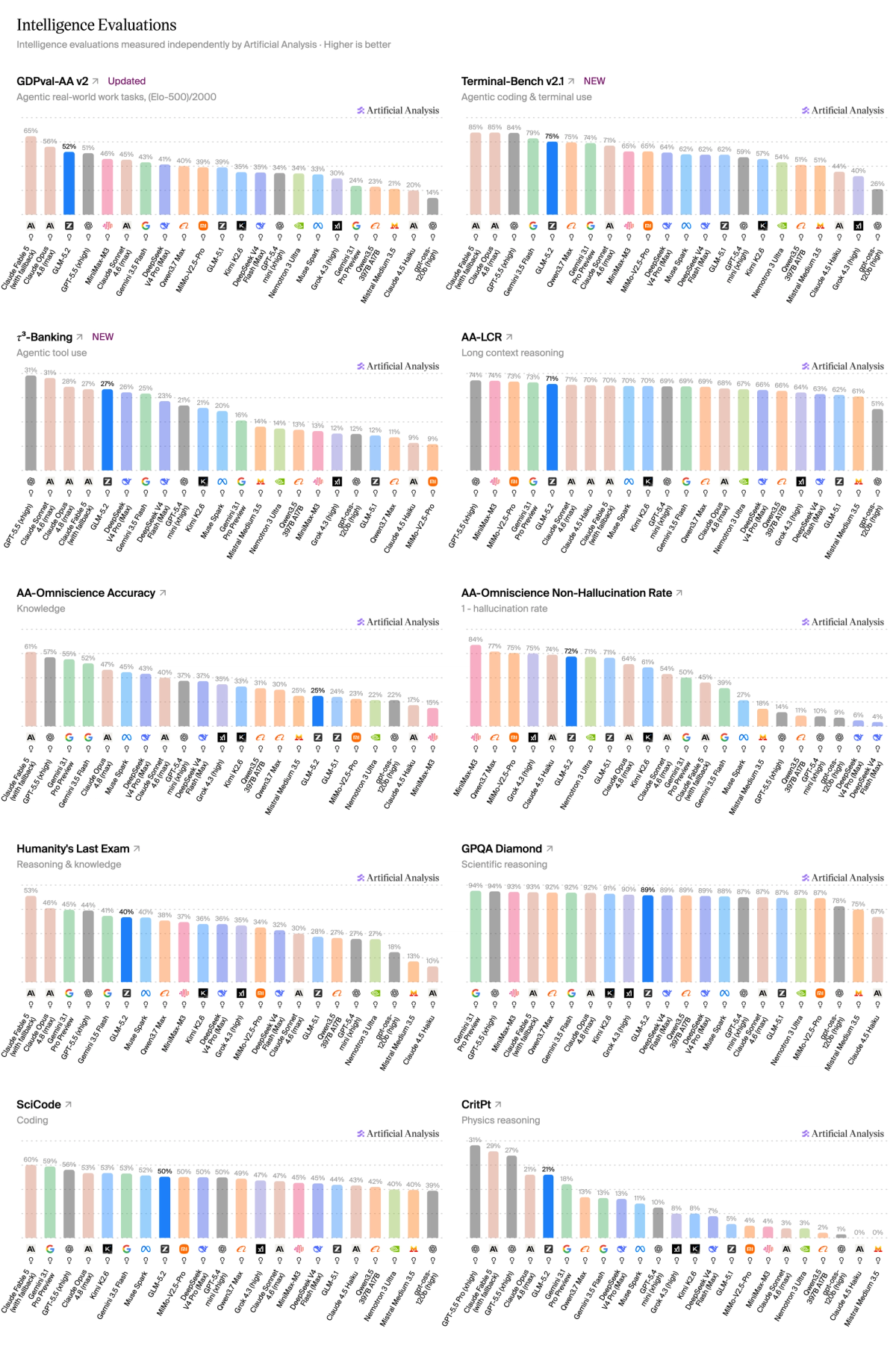
➤ Improvements across most evaluations, particularly scientific reasoning: GLM-5.2 gains over GLM-5.1 on most evaluations, led by scientific reasoning on CritPt (+16 points to 21%) and HLE (+12 points to 40%), alongside AA-LCR (+9 points to 71%), tau3 banking (+15 points to 27%) and SciCode (+7 points to 50%). TerminalBench v2.1 also improves (+16 points to 78%) and GPQA Diamond gains 3 points to 89%
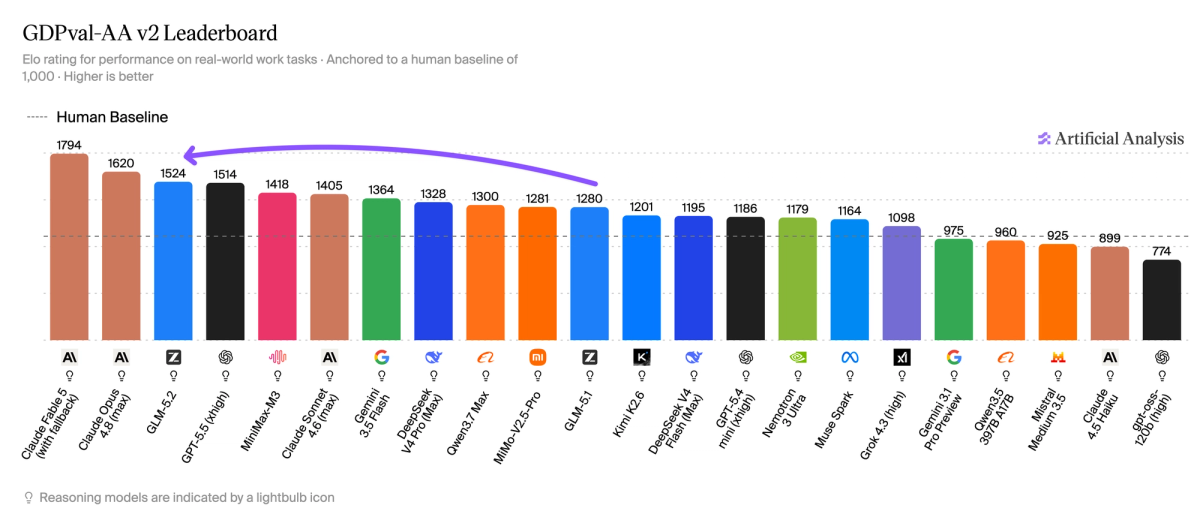
➤ Leading open weights model on GDPval-AA v2 and competitive with proprietary models: GLM-5.2 scores 1524 on GDPval-AA v2, ahead of MiniMax-M3 (1418) and DeepSeek V4 Pro (max, 1328). This impressive result places GLM-5.2 in-line with proprietary models including GPT-5.5 (xhigh reasoning). GDPval-AA v2 builds on the original GDPval-AA by baselining Elo to human performance at 1000, introducing a rotating panel of frontier-model judges, and raising the turn limit from 100 to 250 for longer-horizon agent trajectories
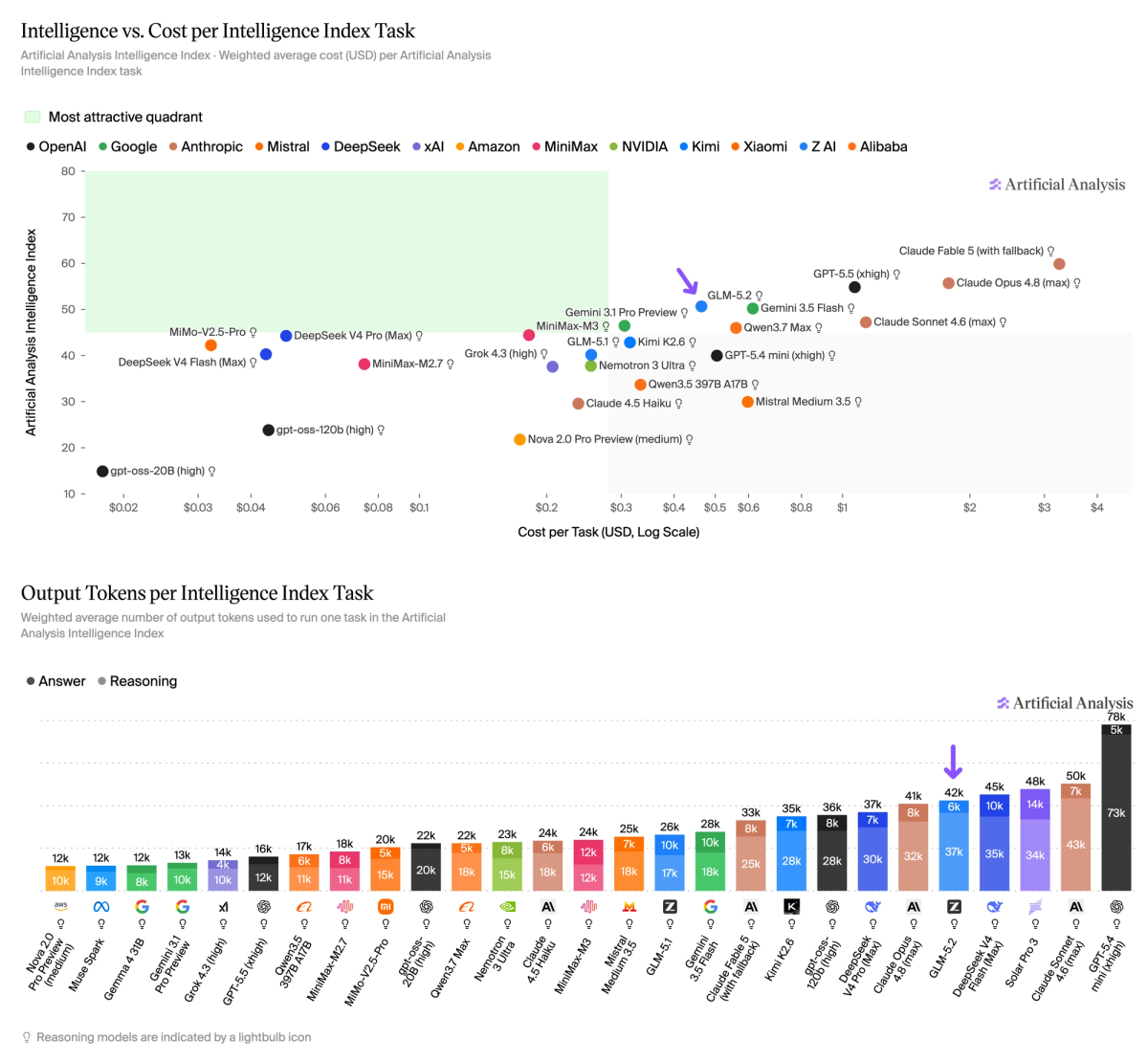
➤ GLM-5.2 uses more output tokens per task than other leading open weights models: the model uses 43k output tokens per Intelligence Index task, up from GLM-5.1 (26k) and above MiniMax-M3 (24k), Kimi K2.6 (35k) and DeepSeek V4 Pro (max, 37k)
➤ On the Intelligence vs. Cost per Task Pareto Frontier: GLM-5.2 is on the Pareto frontier of the Intelligence vs Cost per Task chart, with the lowest cost per task among models at its intelligence level. GLM-5.2 costs ~$0.46 per task, compared to GLM-5.1 ($0.25), Kimi K2.6 ($0.31), MiniMax-M3 ($0.18) and DeepSeek V4 Pro (max, $0.05)
Additional Model Details:
➤ License: MIT
➤ Size: 744B total parameters, 40B active parameters, equivalent to GLM-5.1
➤ Context window: 1M tokens, up from 200K on GLM-5.1
➤ Pricing: $1.4/$0.26/$4.4 per 1M input/cache hit/output tokens
➤ Availability: Alongside Z ai's first-party API, GLM-5.2 is available across third-party providers including DeepInfra, Novita, Nebius, Parasail, Siliconflow, GMI Cloud, Baseten, and Fireworks
GLM-5.2 leads all open weights models on GDPval-AA v2, our primary metric for real-world agentic performance. At 1524 it places ahead of MiniMax-M3 (1418) and DeepSeek V4 Pro (max, 1328), and is effectively level with GPT-5.5 (xhigh, 1514). We visually inspected GLM-5.2's outputs across a range of GDPval-AA tasks. We have attached a selection below.

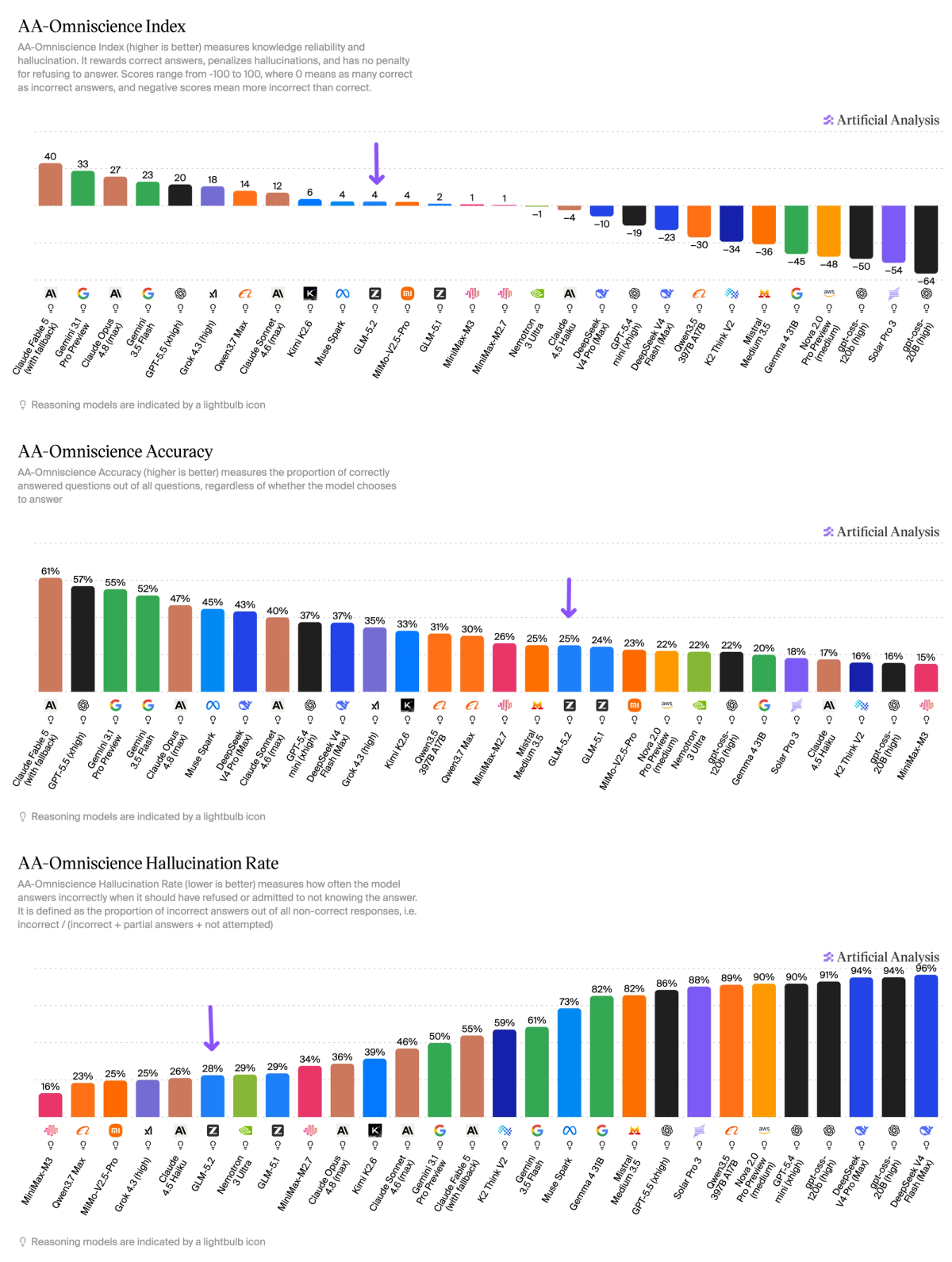
GLM-5.2 scores 4 on the AA-Omniscience Index, up from GLM-5.1 (2). The gain comes from both higher accuracy (25.1% vs 24.2%) and a lower hallucination rate (28.1% vs 29.4%), with attempt rate flat at 47%.
GLM-5.2 uses 43k output tokens per Intelligence Index task, of which 37k is reasoning. This is up from GLM-5.1 (26k) and higher than open weights peers MiniMax-M3 (24k) and Kimi K2.6 (35k), placing it among the less token-efficient open weights models at its intelligence level. GLM-5.2 sits off the most attractive quadrant on the Intelligence vs Output Tokens chart.
Breakdown of the individual evaluations in the Artificial Analysis Intelligence Index v4.1.
Compare GLM-5.2 with other leading models at: https://artificialanalysis.ai/models/glm-5-2
Read the latest
Artificial Analysis Decision Index v1.0
The Artificial Analysis Decision Index benchmarks decision models, a new category of models that answer structured decisions in a single call with a probability for each option. Version 1.0 combines four evaluations across classification, tool calling, knowledge, hallucination, and reasoning.
October 13, 2026

Announcing AA-3D: a benchmark for AI models building interactive 3D experiences
AA-3D is a new benchmark of how well AI models build interactive 3D experiences. Each model turns a written brief into a working three.js scene in an offline sandbox, and our recruited panel compares the scenes in blind pairwise votes.
October 12, 2026
Announcing FrontierCode on Artificial Analysis: can AI models write code maintainers would merge?
Cognition's FrontierCode 1.1 tests whether AI models make code changes that maintainers of real open source repositories would merge. Leading models still fail more than 40% of the time.
October 12, 2026