July 29, 2026
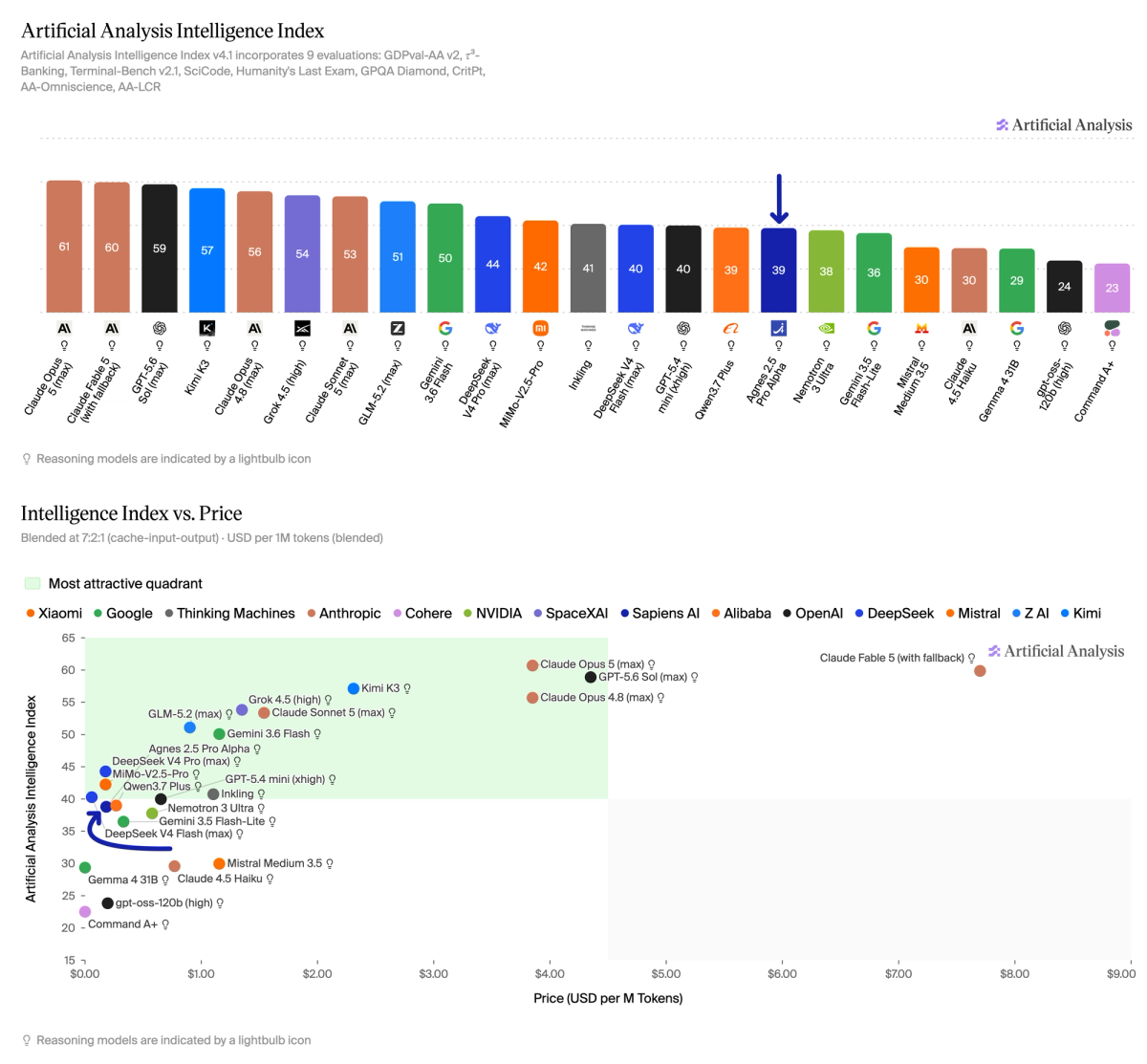
Agnes AI has launched Agnes 2.5 Pro Alpha, a low-priced reasoning model reaching 39 on the Artificial Analysis Intelligence Index at $0.45/$0.90 per 1M tokens
Agnes AI is a Singapore-based AI lab that trains its own full-modality foundation models in-house across text, image, and video, and offers them through a free omni-modal API that has passed 3 million users. Agnes 2.5 Pro Alpha is a text, image, and video input reasoning model with text output.
Agnes 2.5 Pro Alpha scores 39 on the Artificial Analysis Intelligence Index, placing it mid-pack among reasoning models we have tested and below the current proprietary frontier. Its defining characteristic is price: at $0.45 per 1M input tokens and $0.90 per 1M output tokens, Agnes 2.5 Pro Alpha is among the lowest-priced proprietary models at its intelligence level.
Key results:
➤ Agnes 2.5 Pro Alpha debuts at 39 on the Artificial Analysis Intelligence Index, its first appearance on our leaderboard. This places it mid-pack among current reasoning models.
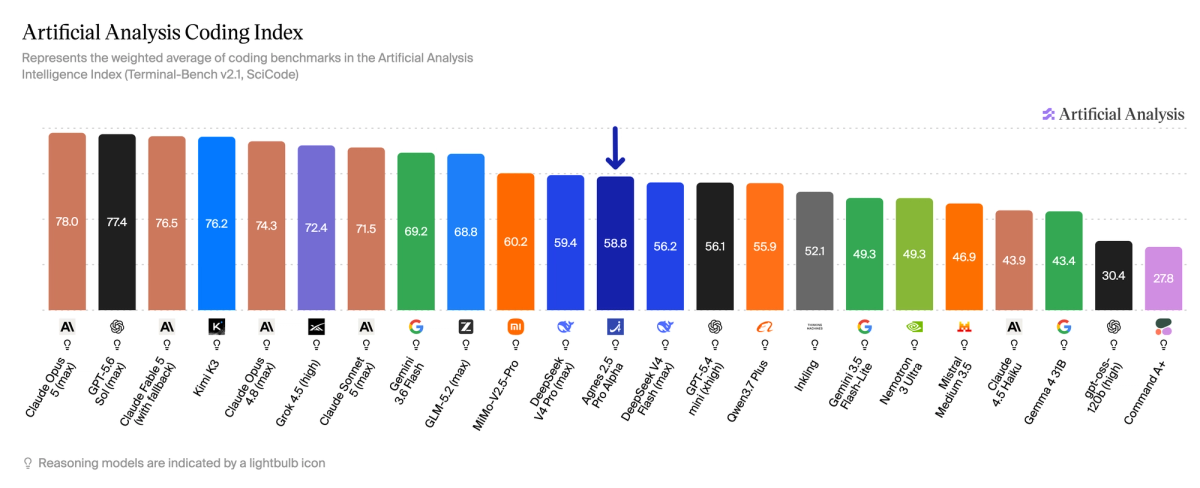
➤ Coding is a relative strength for Agnes 2.5 Pro Alpha, scoring 58.8 on the Coding Index, near the top for its intelligence tier. This is above similarly priced models including DeepSeek V4 Flash (56.2), GPT-5.4 mini (56.1) and Qwen3.7 Plus (55.9), and sits just behind Nex-N2-Pro (59.1).
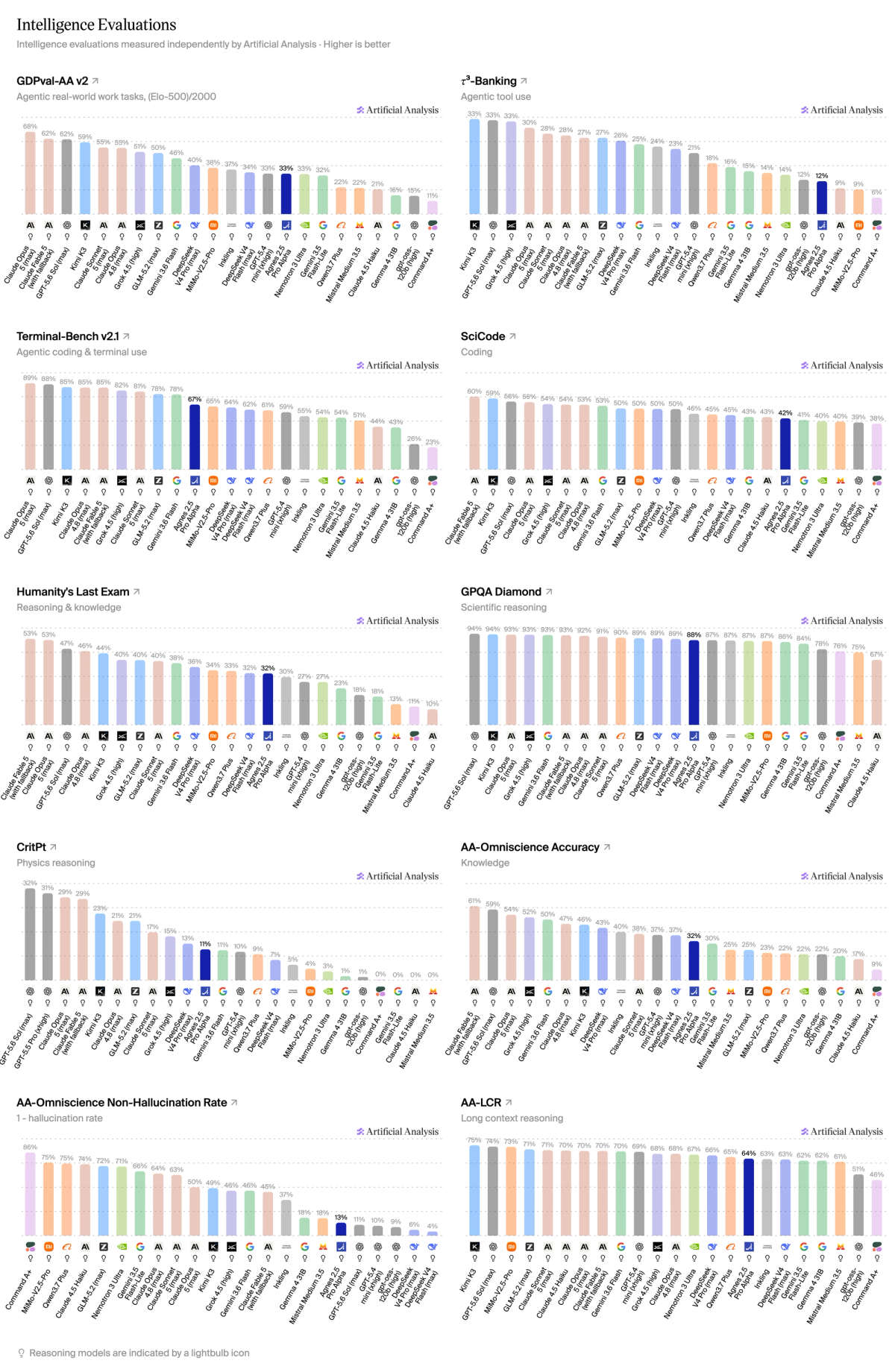
➤ On academic reasoning, Agnes 2.5 Pro Alpha is competitive for its tier, scoring 32% on Humanity's Last Exam and 88% on GPQA Diamond. Its Humanity's Last Exam result leads similarly priced proprietary models including GPT-5.4 mini (xhigh, 27%) and GPT-5.4 nano (xhigh, 26%), and its GPQA Diamond score is in line with peers near its Intelligence Index.
➤ At $0.45/$0.90 per 1M input/output tokens, Agnes 2.5 Pro Alpha is the second cheapest model at its intelligence level. Blended at 7:2:1 (cache-input-output) it costs $0.18 per 1M tokens, behind only DeepSeek V4 Flash (Reasoning, Max Effort) at $0.06 among models scoring 38-40 on the Artificial Analysis Intelligence Index. Open weights alternatives including DeepSeek V4 Pro (Reasoning, Max Effort) and MiMo-V2.5-Pro match that $0.18 price at higher intelligence.
Additional model details:
➤ Context window: 1M tokens.
➤ Pricing: $0.45 / $0.90 / $0.0038 per 1M input / output / cache hit tokens.
➤ Input modalities: Text, image, and video.
➤ Availability: Agnes AI first-party API.
Agnes 2.5 Pro Alpha is strong in coding relative to its price tier: its Coding Index of 58.8 is above similarly priced models including DeepSeek V4 Flash (56.2), GPT-5.4 mini (56.1) and Qwen3.7 Plus (55.9).
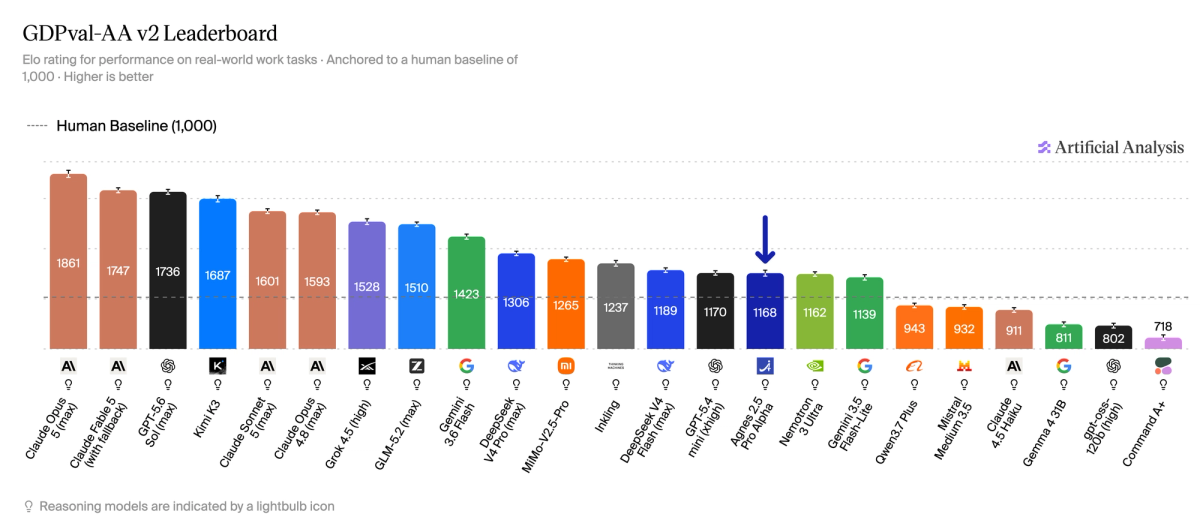
On GDPval-AA v2, which rates performance on real-world work tasks against a human baseline of 1,000, Agnes 2.5 Pro Alpha scores 1168, above the baseline and level with GPT-5.4 mini (xhigh, 1169), ahead of Qwen3.7 Plus (943) but behind DeepSeek V4 Flash (max, 1189).
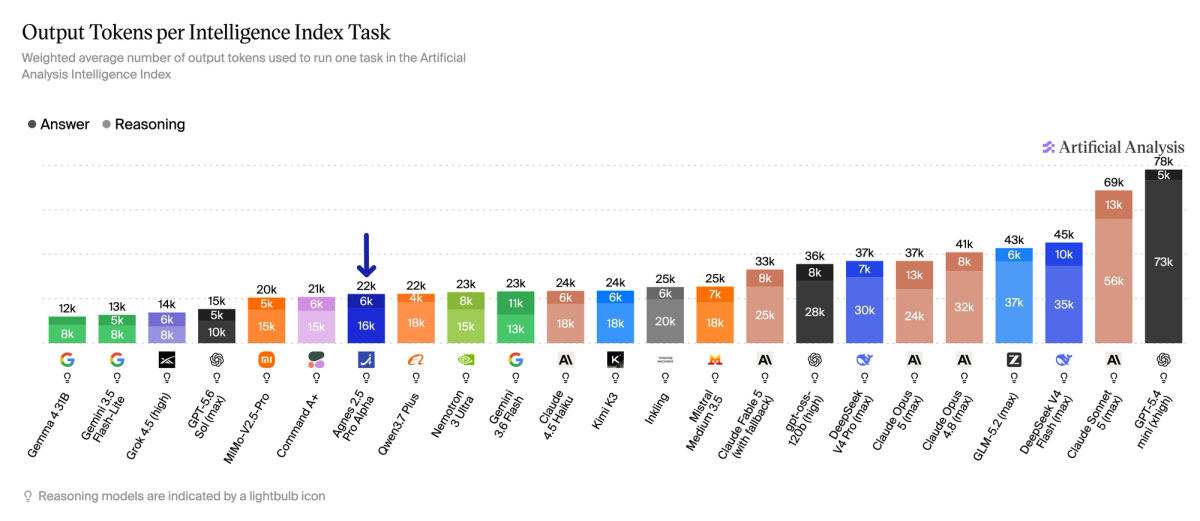
Agnes 2.5 Pro Alpha used 22k output tokens per Artificial Analysis Intelligence Index task, 16k of them reasoning tokens, 51% fewer than DeepSeek V4 Flash (max, 45k) and 72% fewer than GPT-5.4 mini (xhigh, 78k).
Agnes 2.5 Pro Alpha's per-evaluation profile across the ten evaluations in the Artificial Analysis Intelligence Index, showing its stronger results on GPQA Diamond and Humanity's Last Exam alongside the areas where it currently trails.
Read the latest
Artificial Analysis Decision Index v1.0
The Artificial Analysis Decision Index benchmarks decision models, a new category of models that answer structured decisions in a single call with a probability for each option. Version 1.0 combines four evaluations across classification, tool calling, knowledge, hallucination, and reasoning.
October 13, 2026
Announcing AA-3D: a benchmark for AI models building interactive 3D experiences
AA-3D is a new benchmark of how well AI models build interactive 3D experiences. Each model turns a written brief into a working three.js scene in an offline sandbox, and our recruited panel compares the scenes in blind pairwise votes.
October 12, 2026
Announcing FrontierCode on Artificial Analysis: can AI models write code maintainers would merge?
Cognition's FrontierCode 1.1 tests whether AI models make code changes that maintainers of real open source repositories would merge. Leading models still fail more than 40% of the time.
October 12, 2026