April 23, 2026
OpenAI's GPT-5.5 is the new leading AI model
See model pageOpenAI's GPT-5.5 is the new leading model. GPT-5.5 tops the Artificial Analysis Intelligence Index by 3 points, breaking a three-way tie with Anthropic and Google
OpenAI gave us pre-release access to test all five reasoning effort levels: xhigh, high, medium, low and non-reasoning.
Key takeaways:
➤ OpenAI tops five headline evaluations: GPT-5.5 (xhigh) leads Terminal-Bench Hard, GDPval-AA and our newly hosted APEX-Agents-AA. The model trails only other OpenAI models in CritPt and AA-LCR, and comes second to Gemini 3.1 Pro Preview on three additional evaluations. The largest gains are on AA-Omniscience (+14 pts), our knowledge and hallucination benchmark, and τ²-Bench Telecom (+7 pts), a customer service agent benchmark.
➤ 20% more expensive to run our Index: Per-token pricing has doubled from GPT-5.4 to $5/$30 per 1M input/output tokens. However, a ~40% token use reduction largely absorbs the hike - resulting in a net ~+20% cost to run our Intelligence Index.
➤ Effort a clear ladder for balancing intelligence and cost: GPT-5.5 (medium) scores the same as Claude Opus 4.7 (max) on our Intelligence Index at one quarter of the cost (~$1,200 vs $4,800) - although Gemini 3.1 Pro Preview scores the same at a cost of ~$900. GPT-5.5 (low) approximates Claude Opus 4.7 (Non-reasoning, high) on our Intelligence Index at half the cost to run (~$500 vs ~$1,000).
➤ Number one in GDPval-AA with an Elo of 1785: GPT-5.5 (xhigh) leads Claude Opus 4.7 (max) by ~30 pts and Gemini 3.1 Pro Preview by ~470 pts. GDPval-AA is Artificial Analysis' benchmark that leverages OpenAI's GDPval dataset to evaluate models on real-world economically valuable tasks.
➤ Top AA-Omniscience accuracy, but trailing the frontier on hallucination: Our private AA-Omniscience benchmark rewards factual knowledge across diverse topics, but punishes hallucination. GPT-5.5 (xhigh) has the highest accuracy at 57% - meaning the model can recall facts in the Omniscience corpus more effectively than any other model. However, it has a hallucination rate of 86% - vs Opus 4.7 (max) at 36%, and Gemini 3.1 Pro Preview at 50%. This makes it more likely to answer a question when it does not 'know' the answer. The 14 pt gain in AA-Omniscience from GPT-5.4 (xhigh) was largely driven by knowledge, with a modest improvement in hallucination.
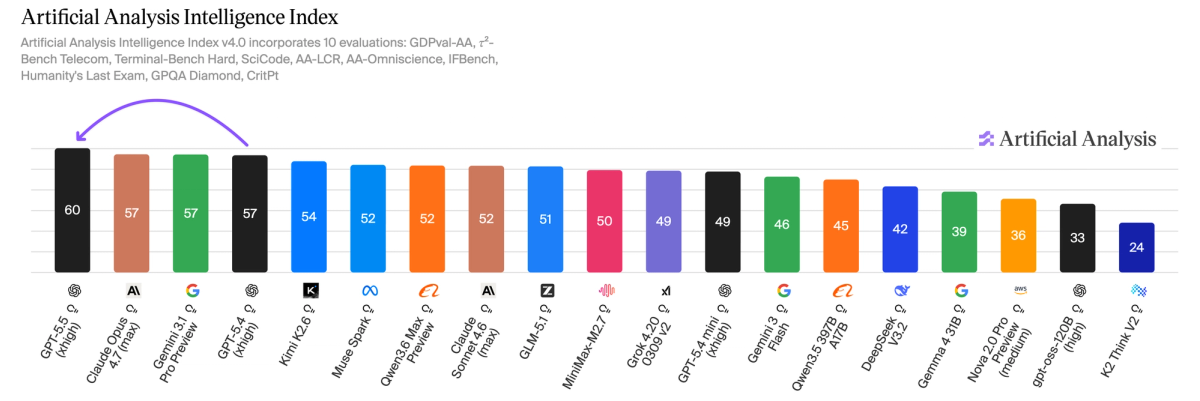 GPT-5.5 tops the Artificial Analysis Intelligence Index by 3 points, breaking a three-way tie with Anthropic and Google
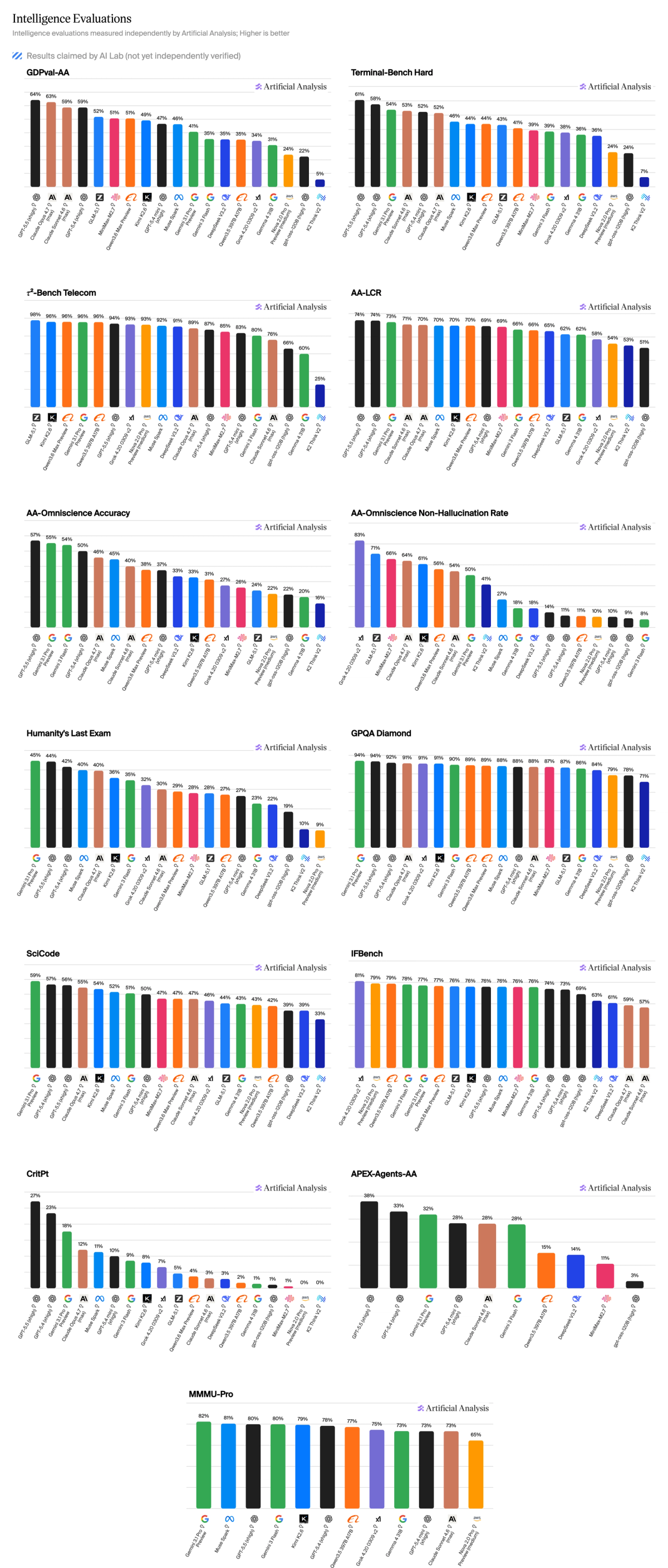 OpenAI leads five of our headline evaluations and places second to Gemini 3.1 Pro Preview on three.
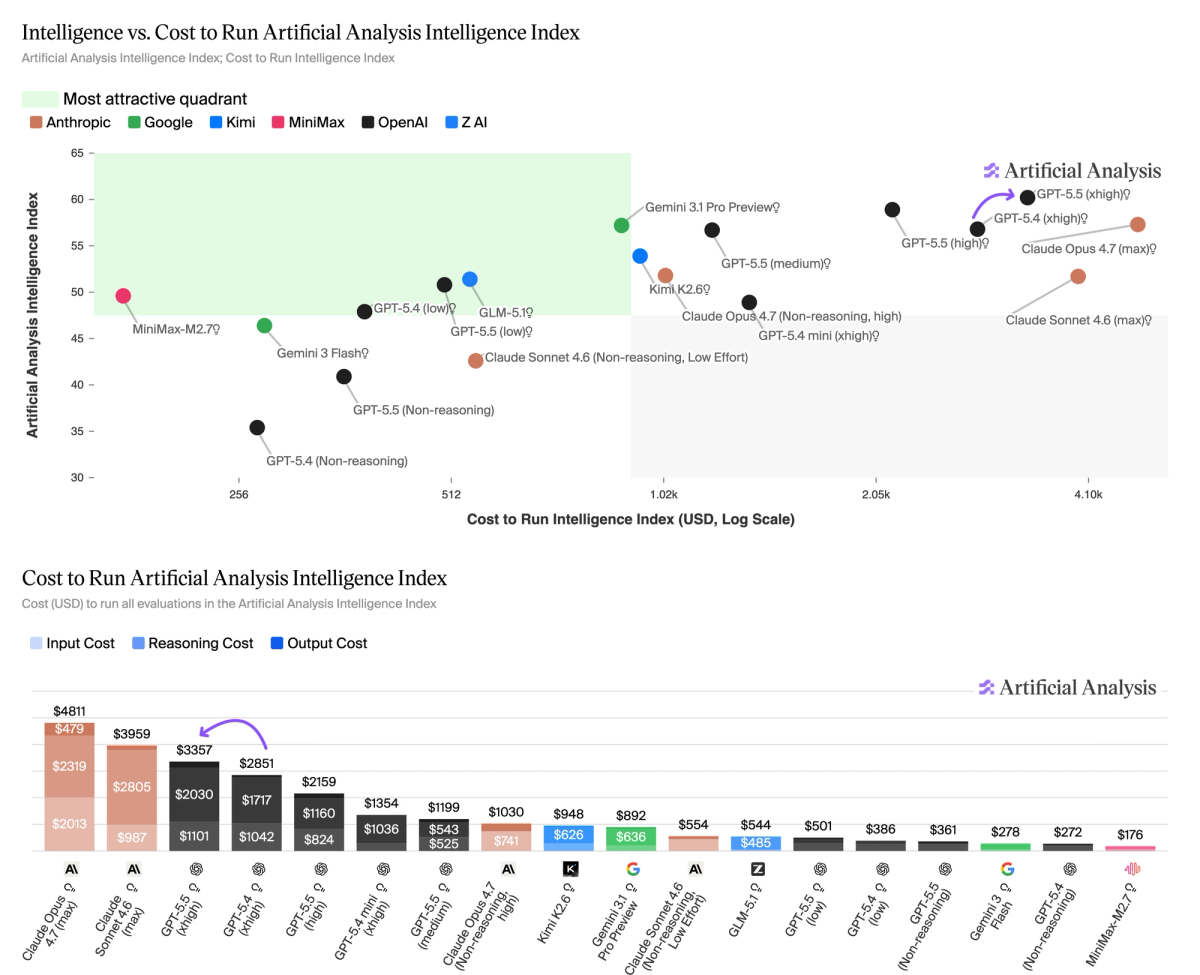 Effort variants provide a clear ladder to balance intelligence and cost. GPT-5.5 (xhigh) is ~20% more expensive to run our Index than its predecessor, but 30% cheaper than Claude Opus 4.7 (max)
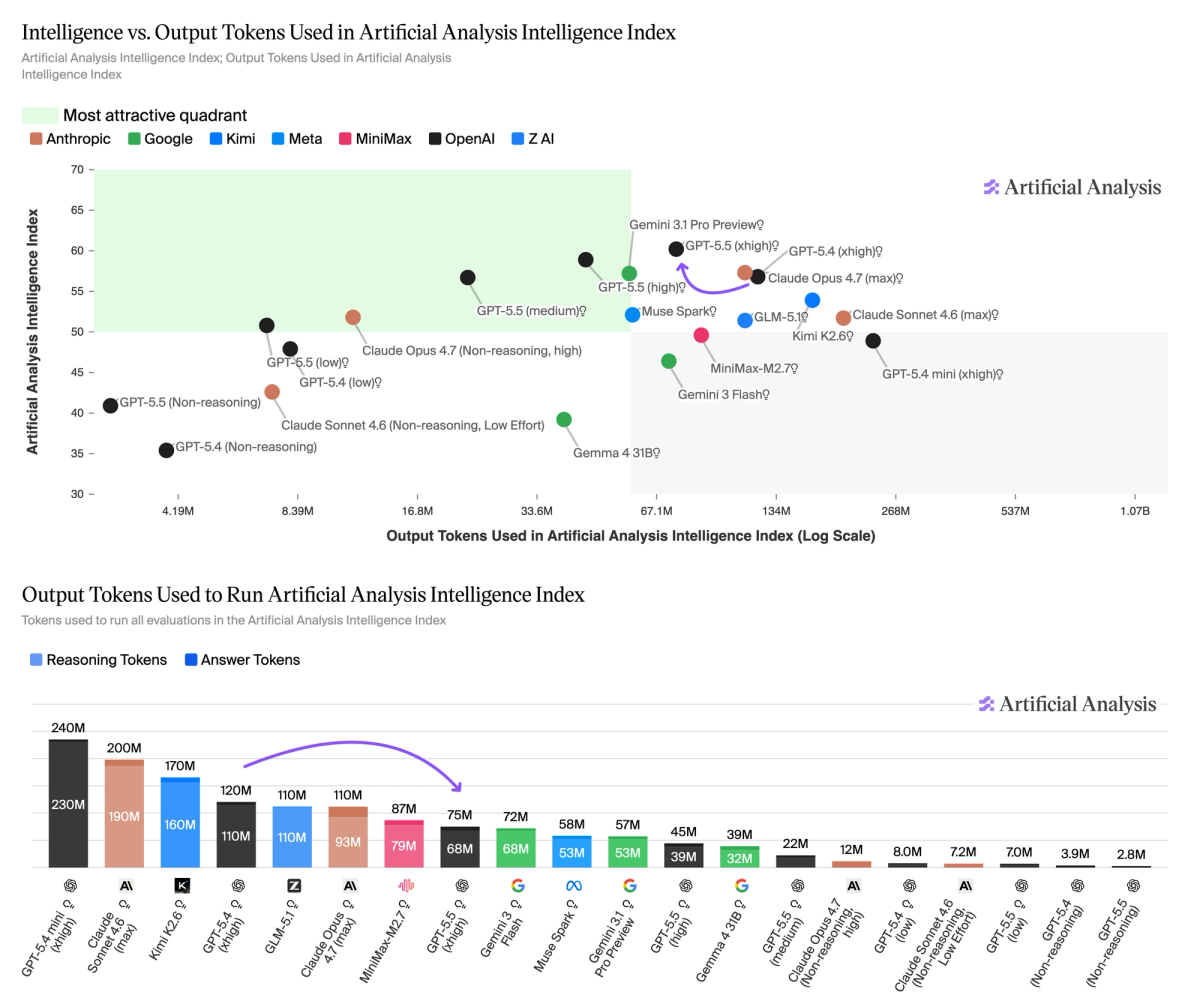 GPT-5.5 (xhigh) uses ~40% fewer output tokens to run our Index than its predecessor
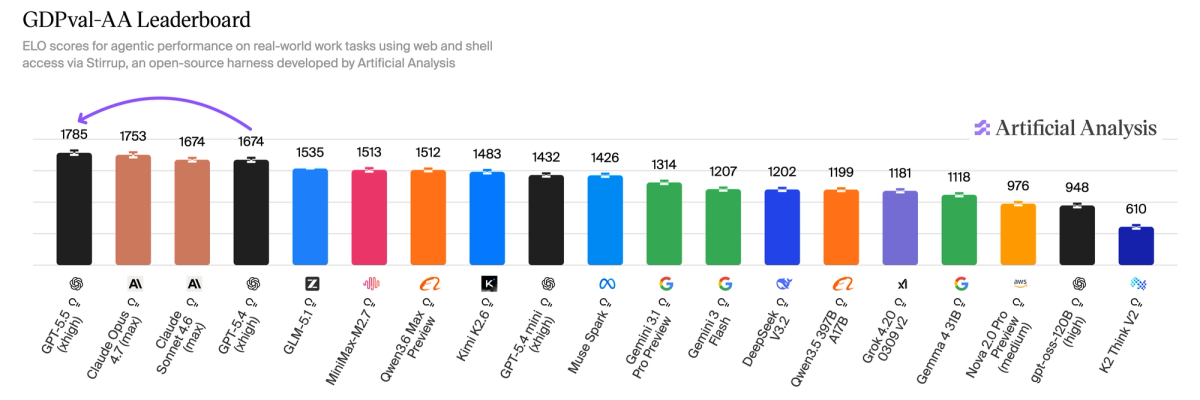 GPT-5.5 (xhigh) leads GDPval-AA with an Elo of 1785
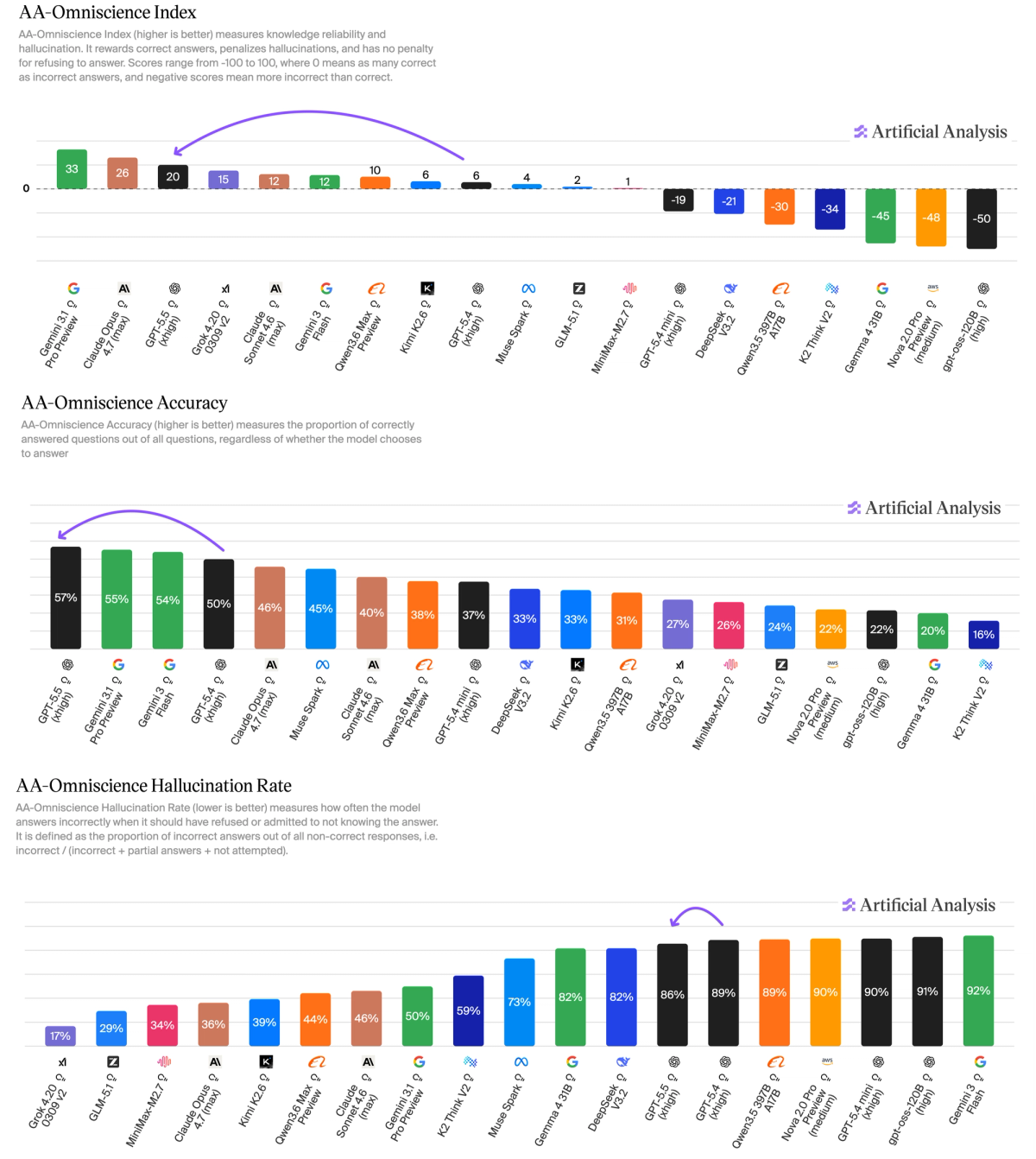 GPT-5.5 (xhigh) records our highest ever AA-Omniscience accuracy score but trails the frontier on hallucination
See Artificial Analysis for further details and benchmarks of GPT-5.5: https://artificialanalysis.ai/models/gpt-5-5
Read the latest
Artificial Analysis Decision Index v1.0
The Artificial Analysis Decision Index benchmarks decision models, a new category of models that answer structured decisions in a single call with a probability for each option. Version 1.0 combines four evaluations across classification, tool calling, knowledge, hallucination, and reasoning.
October 13, 2026
Announcing AA-3D: a benchmark for AI models building interactive 3D experiences
AA-3D is a new benchmark of how well AI models build interactive 3D experiences. Each model turns a written brief into a working three.js scene in an offline sandbox, and our recruited panel compares the scenes in blind pairwise votes.
October 12, 2026
Announcing FrontierCode on Artificial Analysis: can AI models write code maintainers would merge?
Cognition's FrontierCode 1.1 tests whether AI models make code changes that maintainers of real open source repositories would merge. Leading models still fail more than 40% of the time.
October 12, 2026