June 8, 2026
MiniMax-M3: Leading open weights model, once the weights are released
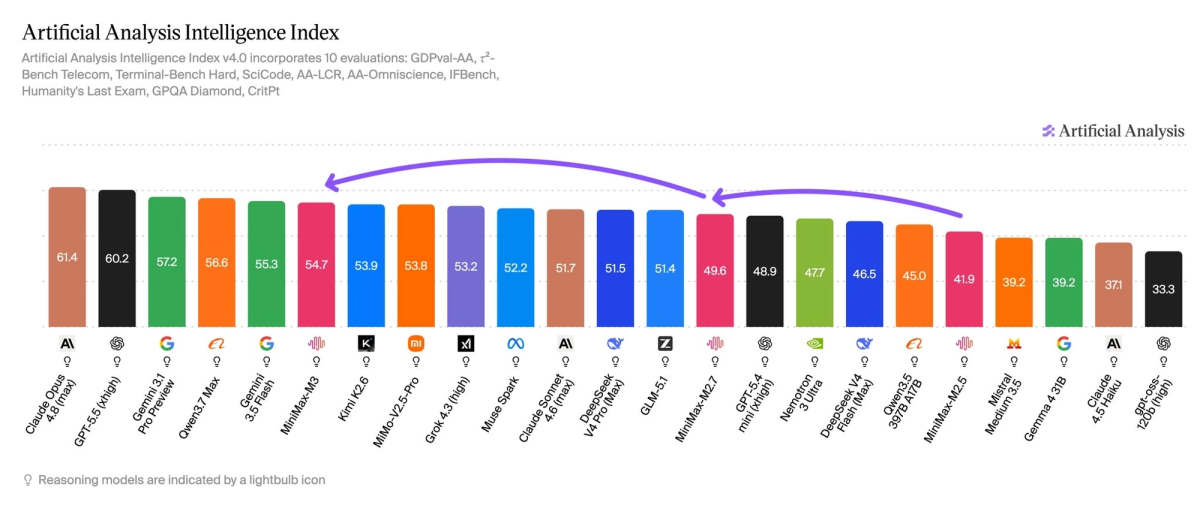
See model pageMiniMax-M3 scores 55 on the Artificial Analysis Intelligence Index. Once the weights are released, it will be the leading open weights model
M3 is MiniMax's first multimodal M-series model, adding image and video input and a 1M token context window over the text-only MiniMax-M2.7 (50). At 55 on the Intelligence Index it sits just ahead of open weights peers Kimi K2.6 (54) and MiMo-V2.5-Pro (54). MiniMax has noted they plan to release the weights within ~10 days. When MiniMax released the weights for M2.7, it was under a commercially restricted license.
Key takeaways:
-
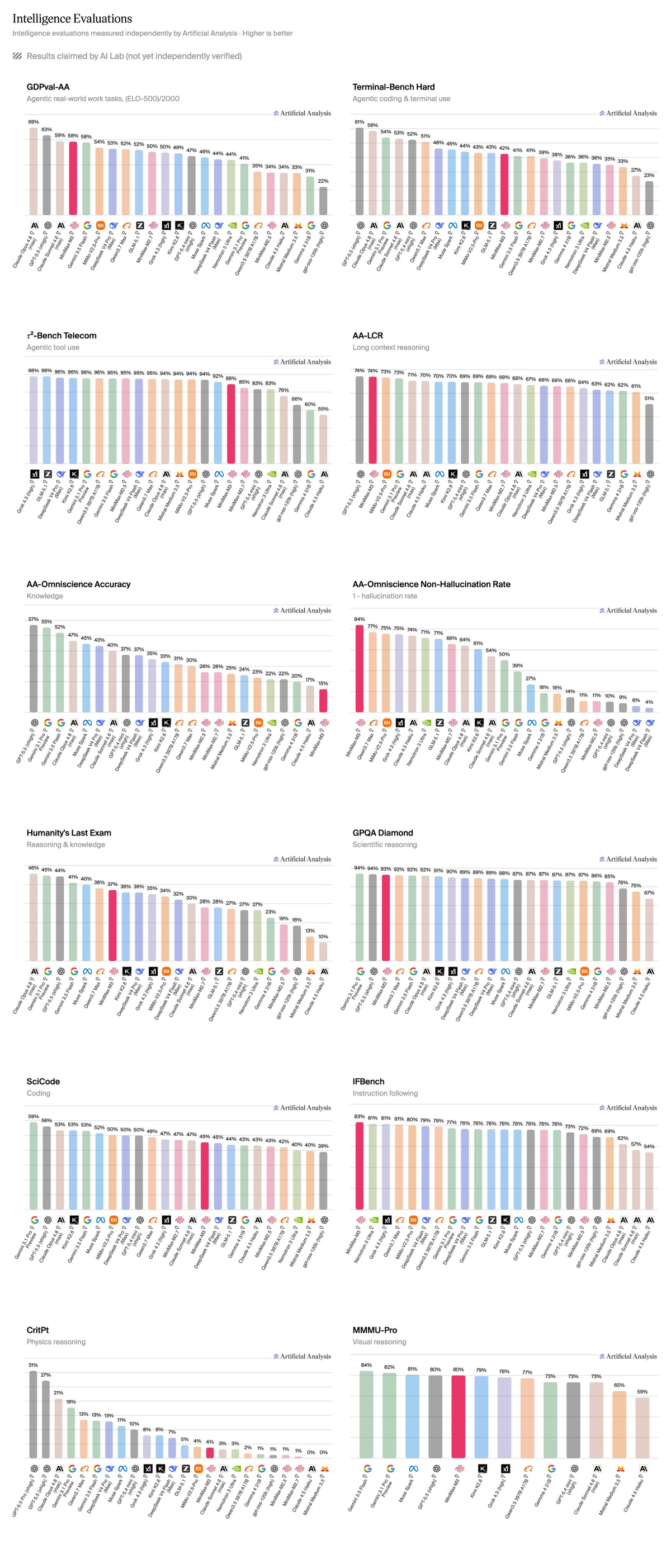
MiniMax-M3 improves on MiniMax-M2.7 across most evaluations. HLE +9 points (28% to 37%), GPQA Diamond +6 (87% to 93%), AA-LCR +5 (69% to 74%), IFBench +7 (76% to 83%), and CritPt +3 (1% to 4%), with a small regression on SciCode (47% to 45%)
-
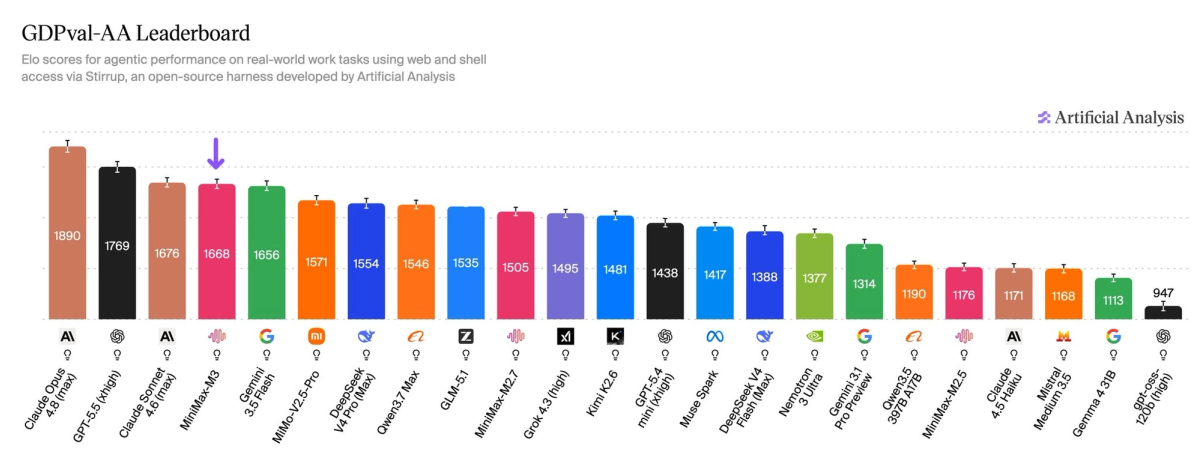
M3 scores ~1670 on GDPval-AA, behind Claude Opus 4.8 (max, 1890) and GPT-5.5 (xhigh, 1769), and level with Claude Sonnet 4.6 (max, 1676). GDPval-AA measures real-world tasks across 44 occupations and 9 industries
-
Native multimodality, scoring ~80% on MMMU-Pro. Level with GPT-5.5 (xhigh, 79.9%) and Kimi K2.6 (79.4%), behind Gemini 3.5 Flash (high, 84.3%). Not all open weights models support native vision input
-
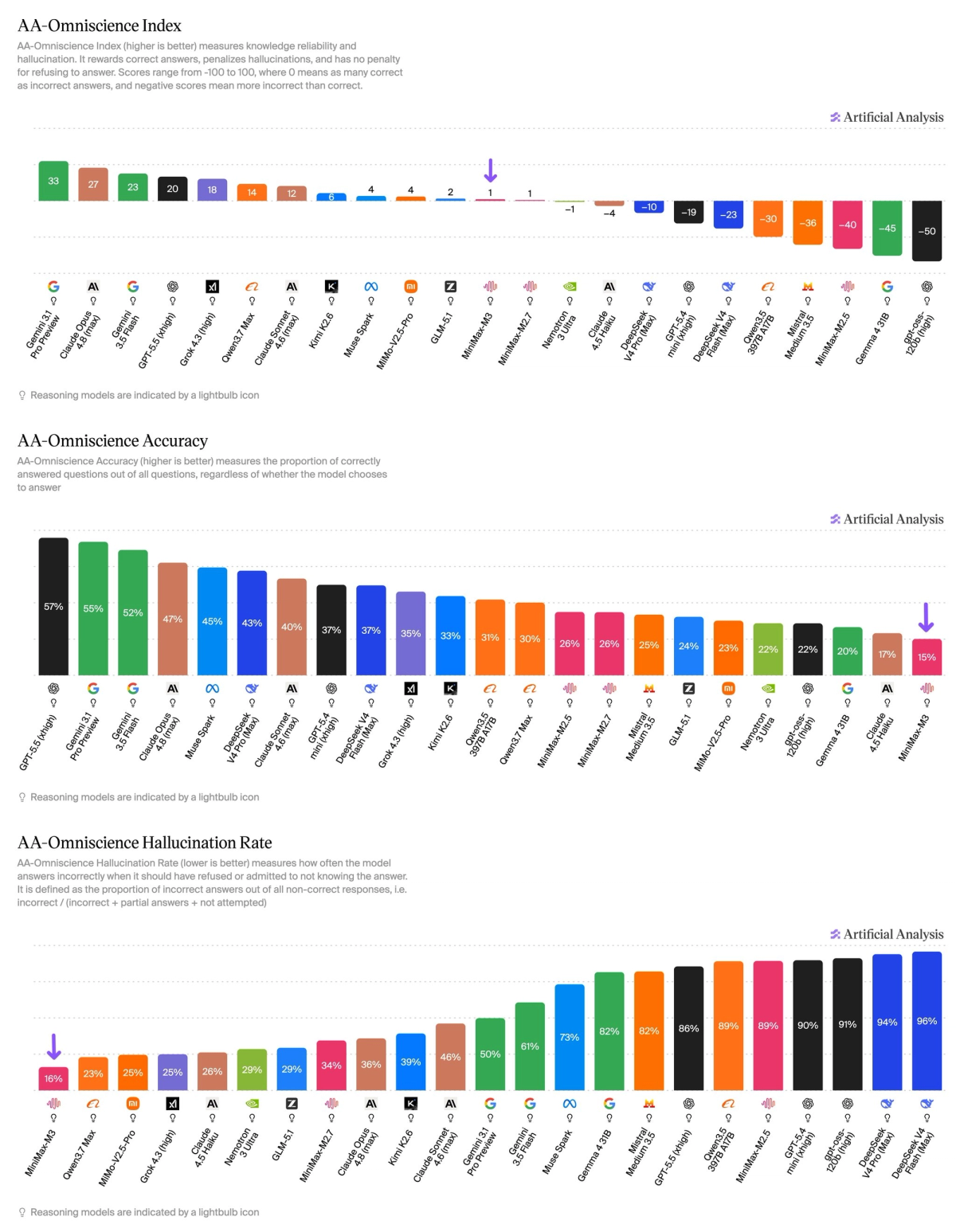
On AA-Omniscience, heavy abstention drives both low hallucination and low accuracy. M3 attempts only 30.9% of questions, the lowest among current peers, yielding a low hallucination rate (16.1%) and low accuracy (15.0%)
-
MiniMax-M3's token usage is close to M2.7's, using ~91M output tokens to run the Intelligence Index (~81M reasoning) versus ~87M (~79M reasoning), while scoring 5 points higher
Key model details:
-
Context window: 1M tokens, up from MiniMax-M2.7's 200K
-
Pricing: $0.30/$1.20 per 1M input/output tokens up to 512K context, rising to $0.60/$2.40 for 512K to 1M context
-
Weights: Not yet released. MiniMax has stated the weights will follow
-
Availability: MiniMax first-party API, SiliconFlow, GMI and Novita
MiniMax-M3 scores ~1670 on GDPval-AA, behind GPT-5.5 (xhigh, 1769) and level with Claude Sonnet 4.6 (Adaptive Reasoning, Max Effort, 1676). Once the weights are released, it will be the highest-scoring open weights model on GDPval-AA. GDPval-AA measures performance on real-world tasks across 44 occupations and 9 major industries
On AA-Omniscience, MiniMax-M3 attempts only 30.9% of questions, the lowest among current peers. The abstention yields a low hallucination rate (16.1%) and accuracy (15.0%)
Breakdown of individual evaluation results for MiniMax-M3
Read the latest
Artificial Analysis Decision Index v1.0
The Artificial Analysis Decision Index benchmarks decision models, a new category of models that answer structured decisions in a single call with a probability for each option. Version 1.0 combines four evaluations across classification, tool calling, knowledge, hallucination, and reasoning.
October 13, 2026
Announcing AA-3D: a benchmark for AI models building interactive 3D experiences
AA-3D is a new benchmark of how well AI models build interactive 3D experiences. Each model turns a written brief into a working three.js scene in an offline sandbox, and our recruited panel compares the scenes in blind pairwise votes.
October 12, 2026
Announcing FrontierCode on Artificial Analysis: can AI models write code maintainers would merge?
Cognition's FrontierCode 1.1 tests whether AI models make code changes that maintainers of real open source repositories would merge. Leading models still fail more than 40% of the time.
October 12, 2026