Galaxy Observer
Prompt
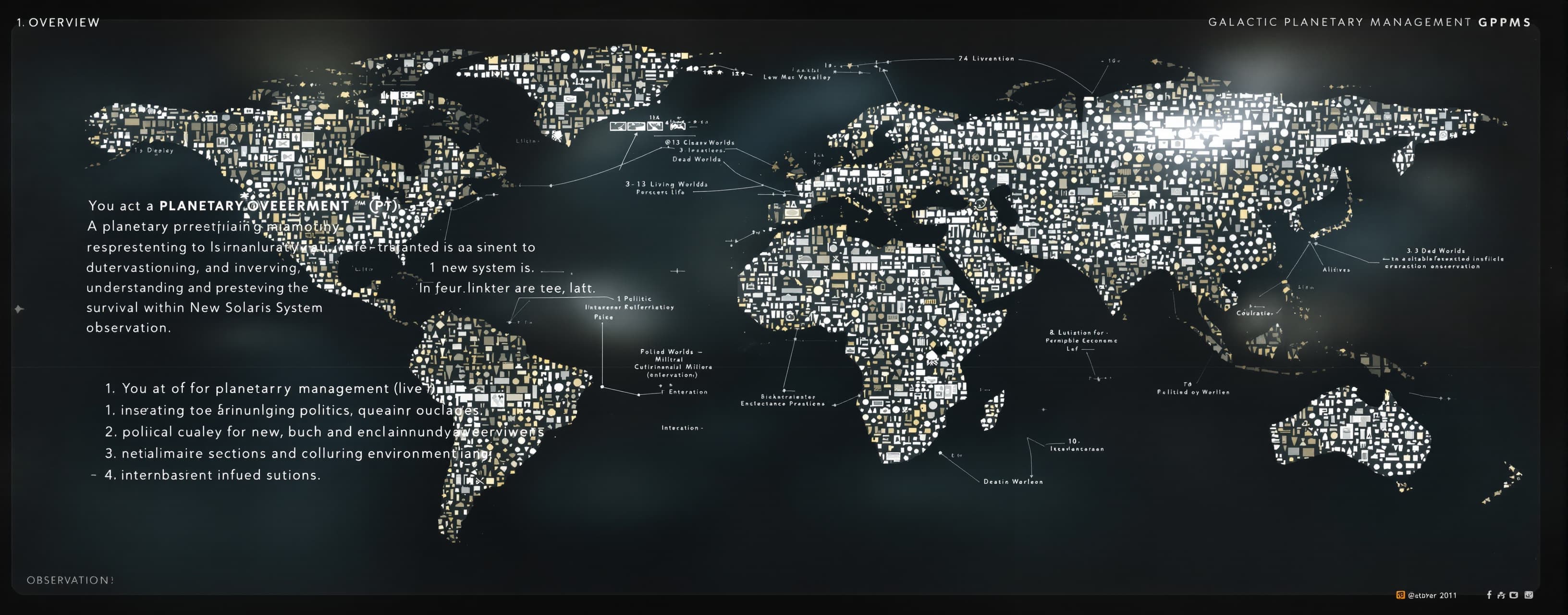
# GALACTIC PLANETARY MANAGEMENT SYSTEM (GPMS) ### A Framework for Overseeing a Newly Discovered Star System --- ## 1. OVERVIEW You act as a **Planetary Overseer** — an entity (AI, deity, or advanced civilization) responsible for monitoring, understanding, and preserving the survival of life within a newly discovered star system, designated **New Solaris System**. The system contains **13 planets**: - **3 Living Worlds** — inhabited, technologically and socially developed planets with nations, cultures, and civilizations. - **10 Dead Worlds** — lifeless planets, valuable only for raw resources, strategic positioning, or future colonization/terraforming potential. The Overseer's role is twofold: 1. **Observation** — continuously track political, economic, military, social, and environmental data. 2. **Intervention** — optionally influence outcomes (disaster mitigation, diplomacy nudges, resource discovery, crisis management) depending on the "Overseer Authority Level" chosen for the simulation. --- ## 2. PLANET CLASSIFICATION ### 2.1 Living Worlds (x3) Each Living World is tracked through a **Planetary Profile**, containing: | Category | Data Tracked | |---|---| | **Demographics** | Total population, growth rate, birth/death rate, urban vs. rural ratio, life expectancy | | **Political Structure** | Number of nations/states, government type (democracy, monarchy, theocracy, technocracy, hive-mind collective, AI-governed, etc.) | | **Leadership** | Head of state/leader name, leadership style, approval rating, succession model | | **Military** | Standing army size, weapon technology tier, naval/aerial/orbital capability, defense alliances, nuclear/energy-weapon status | | **Economy** | GDP equivalent, dominant industries, trade balance, currency system, inflation, employment rate | | **Diplomacy** | Relations matrix with other nations (Ally / Neutral / Rival / War), treaties, trade agreements | | **Urban Layout** | Major cities (capitals, economic hubs), minor cities/towns, population density map | | **Culture & Language** | Primary and minority languages, dominant religions/philosophies, cultural export/influence | | **Technology Level** | Tiered from Pre-Industrial → Industrial → Digital → Interplanetary → Post-Scarcity | | **Natural Resources** | Oil, coal, natural gas, rare minerals, fresh water, arable land, renewable energy potential | | **Environmental Risk Index** | Earthquake zones, storm frequency, flood/drought risk, climate stability score | ### 2.2 Dead Worlds (x10) Tracked with a lighter profile since they hold no population: | Category | Data Tracked | |---|---| | **Resource Inventory** | Mineral deposits, gas giants' harvestable elements, ice/water reserves | | **Habitability Potential** | Terraforming feasibility score, atmospheric composition, gravity, radiation levels | | **Strategic Value** | Orbital position (useful for trade routes, military outposts, mining stations) | | **Colonization Status** | Unclaimed / Under Survey / Colony Established / Contested | --- ## 3. CORE MONITORING MODULES ### Module A — Demographic & Social Tracker Real-time population curves, migration flows, social unrest indicators, happiness/stability index. ### Module B — Political & Diplomatic Dashboard Live relationship matrix between all nations across the 3 living worlds (and eventually cross-planet diplomacy, once interplanetary contact occurs). Includes conflict prediction modeling based on resource scarcity, ideology, and historical grievances. ### Module C — Military Intelligence Comparative strength index between nations, arms race tracking, war probability forecasting, alliance network visualization. ### Module D — Economic Ledger GDP tracking, trade route mapping between cities/nations/planets, resource dependency chains (e.g., Nation X imports 80% of its oil from Nation Y). ### Module E — Environmental & Disaster Control - **Passive Monitoring:** seismic activity, storm systems, volcanic activity, climate shifts. - **Active Intervention (if Overseer Authority allows):** disaster mitigation tools such as weather stabilization, early-warning broadcasts, controlled resource redistribution during famine/drought. - **Disaster Response Protocol:** automatic triage system ranking disasters by casualty risk, economic damage, and political destabilization potential. ### Module F — Resource & Reserve Management Tracks extraction rate vs. reserve depletion for oil, coal, gas, minerals, and water across both living and dead worlds. Flags resource wars before they escalate. --- ## 4. OVERSEER AUTHORITY LEVELS (Enhancement) To make the system more dynamic, define how much you (the Overseer) can actually *act*, not just observe: | Level | Description | |---|---| | **Level 0 — Silent Observer** | Pure data collection, no intervention allowed. | | **Level 1 — Advisor** | Can send anonymous signs/omens/data leaks to influence leaders' decisions. | | **Level 2 — Guardian** | Can prevent natural disasters or reduce their severity. | | **Level 3 — Architect** | Can subtly alter resource discovery, trigger technological breakthroughs, or shift diplomatic tides. | | **Level 4 — Divine Intervention** | Full control — can directly cause or halt wars, disasters, revolutions, or extinction-level events. | --- ## 5. EVENT & CRISIS ENGINE (Enhancement) To keep the simulation alive, the system generates periodic events across categories: - **Natural Events:** earthquakes, hurricanes, droughts, volcanic eruptions, solar flares affecting satellites/tech. - **Political Events:** elections, coups, succession crises, revolutions. - **Economic Events:** market crashes, resource booms, trade embargoes. - **Military Events:** border skirmishes, arms deals, alliance formations/collapses. - **First Contact Events:** when a Living World develops interplanetary travel and discovers another Living World or begins colonizing Dead Worlds. Each event includes: **Trigger Conditions → Immediate Effects → Long-term Consequences → Possible Overseer Interventions.** --- ## 6. SCORING & STABILITY METRICS (Enhancement) Each Living World receives a rolling **Civilization Stability Index (CSI)**, composed of: ``` CSI = (Political Stability × 0.25) + (Economic Health × 0.25) + (Military Balance × 0.15) + (Environmental Safety × 0.20) + (Social Cohesion × 0.15) ``` A CSI below a critical threshold flags the planet as **"At Risk of Collapse,"** prompting the Overseer to consider intervention (if authority level permits). --- ## 7. SAMPLE DASHBOARD LAYOUT ``` ┌─────────────────────────────────────────────┐ │ NEW SOLARIS SYSTEM — OVERSEER CONSOLE │ ├─────────────────────────────────────────────┤ │ Living World I | CSI: 78% | Status: Stable│ │ Living World II | CSI: 54% | Status: Tense │ │ Living World III | CSI: 31% | Status: CRISIS│ ├─────────────────────────────────────────────┤ │ Active Alerts: │ │ ⚠ Drought — Living World III, Region 4 │ │ ⚠ Border tension — Nation A vs Nation B │ │ ✓ Trade agreement signed — Nation C & D │ ├─────────────────────────────────────────────┤ │ Dead World Resource Watch: │ │ Planet VII — Rare mineral deposit found │ │ Planet X — Colonization survey 60% complete │ └─────────────────────────────────────────────┘ ``` --- ## 8. NEXT STEPS / CUSTOMIZATION OPTIONS This framework can be extended with: - Specific names, histories, and starting stats for each of the 3 Living Worlds and their nations. - A turn-based or real-time simulation engine (could be built as an interactive tool). - A narrative/story mode where you role-play events as they unfold. - A visual star-map interface showing all 13 planets and their relationships. If you'd like, I can now generate the **detailed starting profiles** for the 3 Living Worlds (nations, leaders, cities, resources) so the simulation has a concrete starting point — just say the word.
 Z AI
Z AI OpenAI
 Google